(VOVWORLD) - Fascinated by the beauty of Vietnam’s heritage and inspired by research materials on traditional lion heads preserved at the Musée du Quai Branly in France and the École Française d’Extrême-Orient (EFEO) in Vietnam, researcher Kevin Vuong, after many years living and working in France, returned to Vietnam to embark on a journey of reviving the traditional lion head of Vietnam’s northern region. With an exhibition called “Vietnamese moon”, Kevin Vuong and members of his project are promoting the beauty of Vietnam’s Mid-Autumn Festival.
“When I first encountered archival photos and documents from France about Vietnam’s Mid-Autumn Festival during the Indochina period of the 1930s and 1940s, I was deeply impressed by the beauty and spirit of the traditional toys created by Vietnamese artisans of the time. Sadly, those handmade toys have disappeared, replaced by plastic ones. My wish is to help restore those traditional toys.”
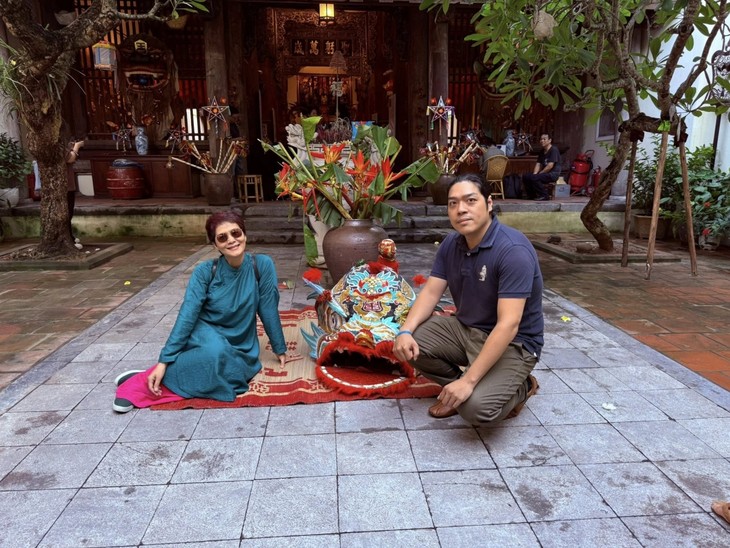 Kevin Vuong and an exhibition goer Kevin Vuong and an exhibition goer |
Within the historic setting of Kim Ngan Communal House, in Hanoi, Kevin Vuong has curated an exhibition and discussion program called “Trăng ta (Vietnamese moon)” that recreates the atmosphere of a traditional Mid-Autumn Festival and explores some ways that heritage can be revived in contemporary life. The event showcases the research he has done on lion heads in trying to revive traditional Mid-Autumn toys.
The lion head, once an indispensable Mid-Autumn toy, is part of the cherished childhood memories of multiple generations. Unlike the lion head of southern Vietnam, which reflects a Chinese influence, the northern lion head has distinctly Vietnamese features – in particular, carp-shaped eyebrows, a symbol of wet rice civilization. Over the years, the distinctive image of the northern lion head has faded and blurred into other images.
Drawing from archival materials in France and Vietnam, Kevin Vuong worked with bamboo, dó paper, and natural lacquer to bring the northern lion head back to life. This effort took more than five years of research and systematic documentation.
Recalling the difficulties, Vuong said: “Archival sources abroad are relatively good, but the practical work was very difficult. No one makes these lion heads anymore. Finding an artisan capable of crafting the bamboo frame was already a huge challenge. I had to search the Old Quarter of Hanoi and visit craft villages in Ha Dong ( formerly Ha Tay) and Nam Dinh (now part of Ninh Binh). Even then, it was difficult to find someone who still practiced the craft. Living abroad made collaboration nearly impossible—I went through many failed attempts before succeeding. Only by working closely with the artisans could we create the lion head you see today.”
Art historian Dr. Tran Hau Yen The praised Vuong’s dedication. “Heritage is transmitted but also transformed, which makes the search for authenticity in Vietnam’s heritage urgent. We’ve seen the disruption by war of culture and language over the past century, leading to a loss of continuity. What Kevin is doing—going all the way to France to research museum archives—is really commendable. Much remains to be done for many other objects, crafts, and fields.”
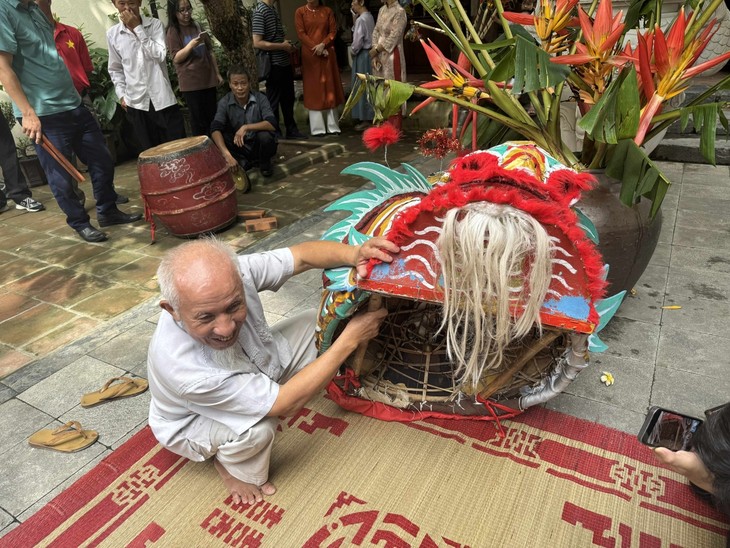 78-year-old artisan Nguyen Xuan Hien of Hanoi’s Chuong My ward show to perform lion dance 78-year-old artisan Nguyen Xuan Hien of Hanoi’s Chuong My ward show to perform lion dance |
The “Trăng ta” exhibition presents multiple restored northern lion heads in various sizes. A highlight of the event was a lion dance performance by 78-year-old artisan Nguyen Xuan Hien of Hanoi’s Chuong My ward. The lion head used in his performance was created in 1932 and has been preserved through generations in his village.
The intricate brushstrokes and elaborate motifs of the ancient lion heads on display impressed visitors:
“This is the first time I’ve seen such an old lion head up close and watched a traditional lion dance performed live. I felt a strong connection with the past. The lion head is very heavy, yet the artisan—now over 70—performed with great skill.”
“I find the lion heads beautiful and faithful to the originals. The smaller versions make it easier to reach more people and to inspire love for heritage. This is an excellent project with the potential to spread widely among young people and heritage enthusiasts.”
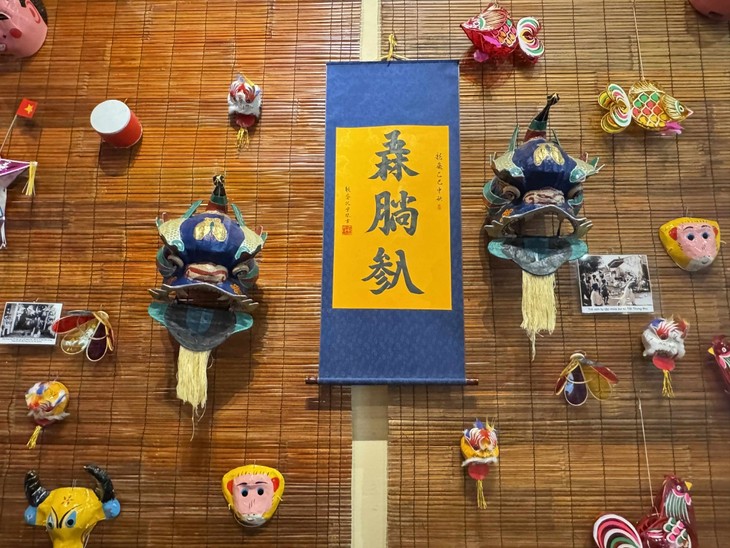 Versions of lion heads are showcased at the exhibition Versions of lion heads are showcased at the exhibition |
The exhibition also recreated a traditional Mid-Autumn offering tray containing mooncakes, fruits, rice flour figurines, miniature lion heads, and intricately carved produce, nostalgically evoking the atmosphere of Mid-Autumn Festivals of the past.
Kevin Vuong and the “Trăng ta” project have organized hands-on workshops at the Kim Ngan communal house, where children can make miniature lion heads. The project will also present their restored lion heads during a lantern parade, called “Full Moon Festival Night”, around Hoan Kiem Lake’s pedestrian street on Friday (the 12th day of the 8th lunar month).