(VOVWORLD) - Looking at the modern cityscape of Ca Mau province with its well-connected transportation network, few would imagine that behind the rows of spacious houses, small ferries still shuttle passengers across the river each day.
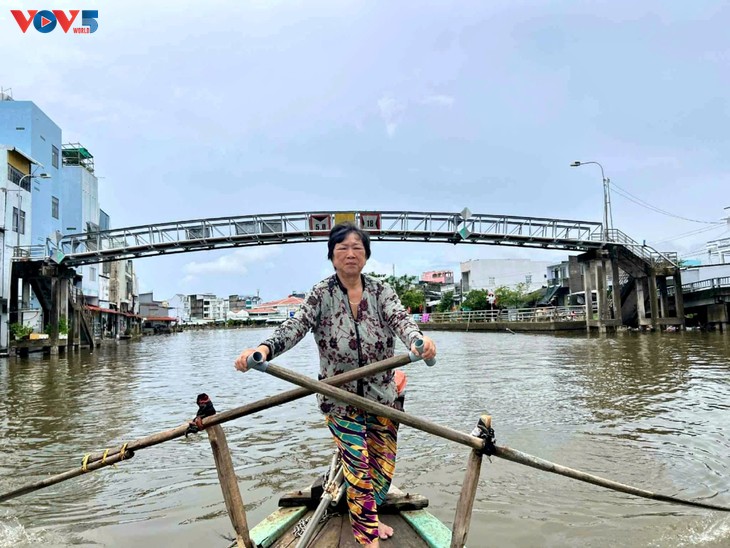 Boatwoman Lam Bich Thuy. (Photo: Huyen Trang/VOV5) Boatwoman Lam Bich Thuy. (Photo: Huyen Trang/VOV5) |
Along the riverside roads of old Ca Mau city—now part of several central wards—many ferry crossings remain. These ferries are scattered rather than centralized, often tucked away at the end of narrow alleys, behind a boatman’s house, or at any convenient spot for passengers to board.
In the past, when bridges were scarce, ferries were the main way people crossed rivers. The city has grown and bridges now span the river at many places, but some residents still prefer the ferry for its speed and convenience.
“Walking across the bridge is tiring, so people take the ferry instead. It only costs 11 to 18 cents,” said boatwoman Lam Bich Thuy.
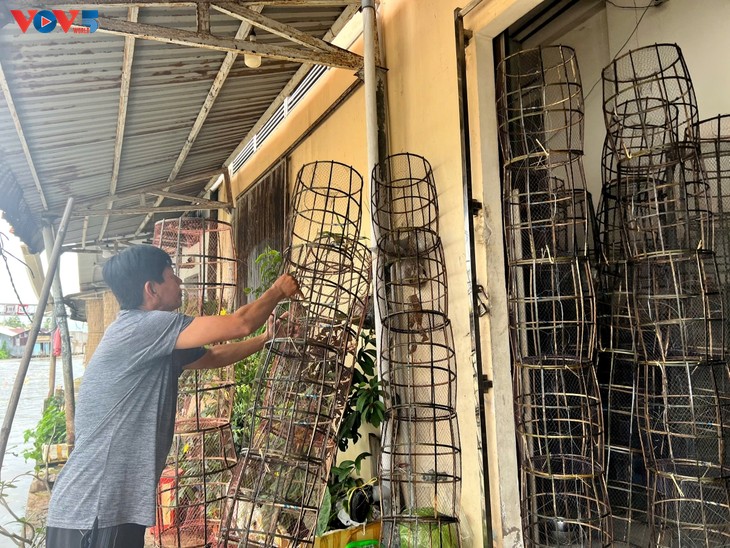 For greater convenience and cost savings, Trinh Duc Phong transports fishing gear by motorized canoe. (Photo: Huyen Trang/VOV5) For greater convenience and cost savings, Trinh Duc Phong transports fishing gear by motorized canoe. (Photo: Huyen Trang/VOV5) |
At the end of a small alley, Nguyen Van Phan waits for passengers. Watching boats pass, he recalls his more than 20 years on the river, witnessing numerous changes in his hometown. Holding a small net in his hand, he occasionally scoops up bits of trash drifting by.
In his younger days, Phan drove a motorized boat; now, he rows a ferry. Though passenger numbers have declined, women, the elderly, and people on foot or bicycle still rely on the service. On a good day, Phan earns 4 USD—a modest sum, but enough to cover his basic needs.
“This river used to be like Can Tho’s floating market - crowded with boats. If there were ten people traveling by boat back then, now there’s only one,” Phan recalled, adding, “These days, only those who can’t afford a motorbike still take the ferry. But it’s faster than going the long way round by bridge. The ferry gets you home quicker.”
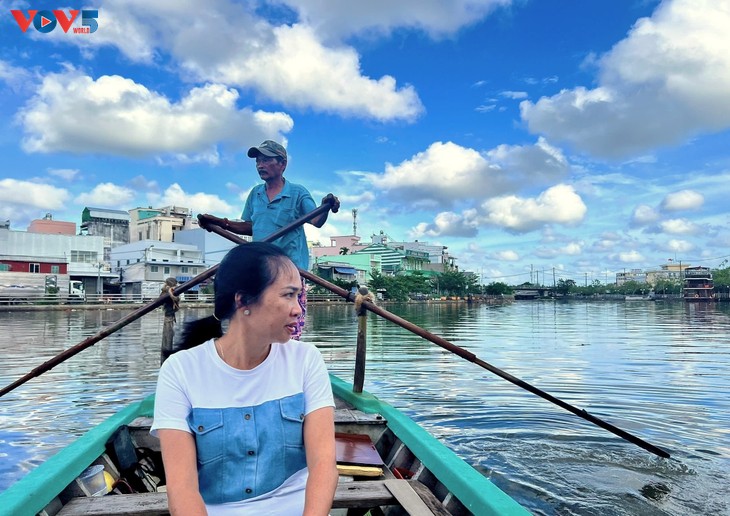 Ngo Thanh Chau has been involved in ferry transport on the Ca Mau River for more than 20 years. (Photo: Huyen Trang/VOV5) Ngo Thanh Chau has been involved in ferry transport on the Ca Mau River for more than 20 years. (Photo: Huyen Trang/VOV5) |
Trinh Duc Phong, who lives near the Ca Mau river, runs a small fishing gear shop. Every month he travels dozens, sometimes hundreds, of kilometers to remote communes to stock up on supplies. For these trips, he uses a vo lai - a small motorized boat common in the Mekong Delta. Where many roads are too narrow for trucks, the Delta’s dense network of rivers and canals makes water transport the easiest and cheapest option.
“Some goods can’t be hauled by truck, so I use a vo lai to bring them home, then transfer them. Trucks just can’t carry bulky items on these narrow roads. If it fits on a truck, I use a truck. If not, I use a boat. Both land and river routes have their place,” said Phong.
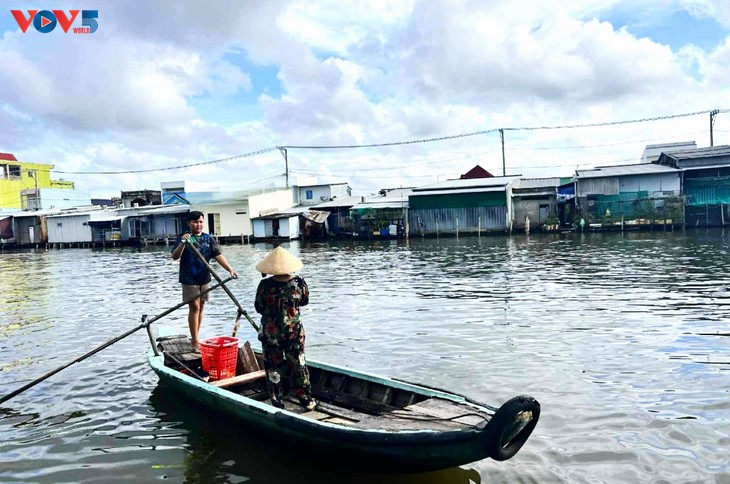 Many locals prefer to travel by ferry for its speed and convenience. (Photo: Huyen Trang/VOV5) Many locals prefer to travel by ferry for its speed and convenience. (Photo: Huyen Trang/VOV5) |
For visitors, and even for locals who don’t live by the river, ferry rides in Ca Mau are a novelty that offer a different perspective. Boatmen, always ready with stories of life on the water, give passengers a good sense of the land and its friendly people.
Ca Mau resident Ngo Thanh Chau said, “The ferry is busiest in the morning, when people head to the market. There are fewer customers in the afternoon. Sometimes foreign visitors take a ferry ride just for fun, and to take photos. Students from Ho Chi Minh city come here to film or practice rowing.”
The calls of ferry boatmen stir a feeling of familiarity in the people of the Mekong Delta, where life is inseparable from the network of canals and rivers.