(VOVWORLD) -The buttery taste of peanuts, the sweetness of sugarcane molasses, the fragrance of fresh ginger, and the crispness of rice girdle cakes combine to make Ha Tinh’s famous Cu Do candy, a treat beloved by both locals and foreign visitors. Cu Do has become a proud representative of Vietnamese culinary culture, earning a place among the “Top 100 Vietnamese Specialty Dishes and Gifts”.
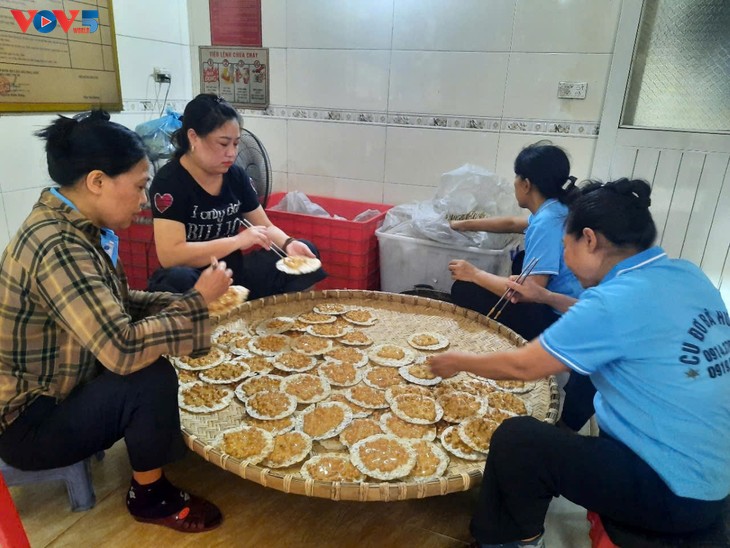 The final step in Cu Do candy making (Photo: Kim Lieu/VOV5) The final step in Cu Do candy making (Photo: Kim Lieu/VOV5) |
Each ingredient in Cu Do reflects Ha Tinh’s agricultural identity, creating the locality’s unique flavor. The molasses, the soul of the candy, must be pure, reddish-brown, and pleasantly sweet without being harsh. It is sourced from the mountain areas of Son Tho, now Vu Quang commune. The peanuts, locally known as cúc peanuts, are small, firm, and rich in flavor, grown in the sandy soils along the banks of the Ngan Sau, Ngan Pho, and La rivers. The ginger, known for its pungent aroma and warmth, comes from Huong Khe or Vu Quang. The rice girdle cake, the candy’s crunchy “shell”, is made from Duc Tho rice flour, sometimes sprinkled with black sesame seeds for extra fragrance.
Nguyen Thi Thao, owner of a Cu Do production facility in Huong Son commune, said that they follow every step carefully, from ingredient selection to preparation, processing, and packaging. “All ingredients are completely natural and sourced from Ha Tinh. Everything is thoroughly sorted; damaged or low-quality peanuts are discarded. Each stage — from cleaning molasses, peanuts, ginger, and rice girdle cake to cooking — is done meticulously to ensure the best quality,” said Thao.
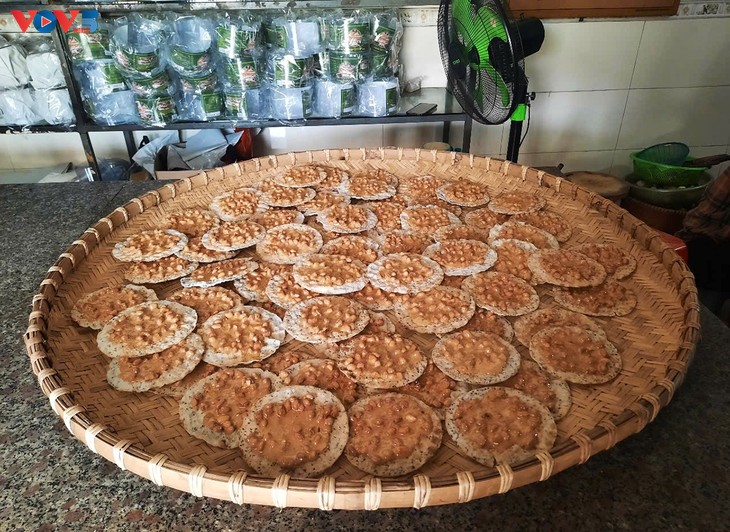 Cu Do candies blending the nutty flavor of peanuts, spicy ginger, and rich sugarcane molasses (Photo: Kim Lieu/VOV5) Cu Do candies blending the nutty flavor of peanuts, spicy ginger, and rich sugarcane molasses (Photo: Kim Lieu/VOV5) |
Making Cu Do requires patience, experience, and intuition — something machines can never replace. The process begins by roasting peanuts evenly in a cast-iron pan with a pinch of salt until fragrant and the skins crack open. Ginger is peeled, washed, and finely shredded. The crucial step is cooking the molasses, which is boiled in a deep, thick-bottomed pan.
The candy maker must control the heat precisely and stir continuously to prevent burning. A drop of boiling molasses is tested in cold water — if it forms a perfect, amber-colored ball that doesn’t dissolve, it’s ready. At that moment, roasted peanuts and ginger are quickly mixed in before the blend is poured over a rice paper sheet and topped with another, pressed gently to bind them.
Each family or workshop has its own secret techniques, adding to the diversity of Cu Do flavors. Tran Thi Huong, owner of the Cu Do Ba Huong facility in Huong Son commune, who has 45 years of experience, said, “Cooking by hand preserves the flavor better than electric cookers. Some batches need 15 minutes, others 17 or 18, depending on the molasses.”
“Before removing it from the heat, I drizzle in a bit of fresh ginger juice to increase the spiciness. After finishing, I add a touch of fresh lime and another layer of ginger to deepen the flavor,” Huong added.
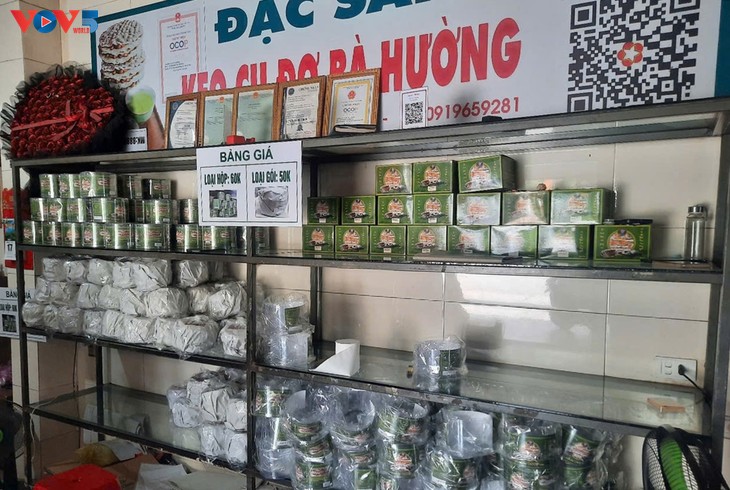 A Cu Do production facility in Huong Son commune, Ha Tinh province (Photo: Kim Lieu/VOV5) A Cu Do production facility in Huong Son commune, Ha Tinh province (Photo: Kim Lieu/VOV5) |
The most challenging step is knowing exactly when to remove the pot from the fire — just as the mixture reaches perfection. Timing is crucial. Once removed, the candy must be spread between rice girdle layers immediately, before it hardens.
According to Ho Thi Xuan, owner of the Xuan Kien Cu Do workshop, “Temperature control is the key. If the heat is too high, the candy burns; too low and it won’t set properly. Makers must have skill and experience to get it right.”
Today, Ha Tinh is home to hundreds of Cu Do producers — from family-run workshops to larger enterprises — employing thousands of locals. The “One Commune, One Product” (OCOP) program has helped standardize production, ensure food safety, improve packaging and branding, and expand markets. Certified as a 3-star OCOP product, Cu Do has conquered domestic markets and reached international shelves.
Tran Thi Hoa, the third-generation heir of her family’s craft, said, “Cu Do has recently been exported to Japan and the US, the first local product exported. I’m proud that it promotes Ha Tinh’s economy and brings our traditional flavor to the world.” “Because the market is increasingly competitive and demanding of product quality, the Cu Do brand has strengthened its reputation by paying attention to every detail — from ingredient selection to the production process,” said Hoa.
Cu Do is more than a sweet treat — it’s the culinary essence of Ha Tinh. Hoang Thi Hang, a tourist from Hanoi, said, “Every time I travel through Ha Tinh, I always buy Cu Do as a gift for my family and colleagues. You can feel the nutty peanuts, the crisp rice paper, and the sweet molasses blending perfectly. It’s a charming taste of the countryside — especially delicious with a cup of strong green tea.”
For generations, Cu Do has been a symbol of Ha Tinh — an iconic gift from the sun-drenched land of central Vietnam.