

As Vietnam’s cities expand and demand for electricity continues to grow, apartment rooftops are emerging as an underused space for solar power generation. Rooftop solar could help apartment buildings meet part of their electricity needs, particularly in common areas, while reducing energy costs and emissions. Yet its wider adoption faces legal, technical and management challenges.

- Vietnam’s total installed solar power output reached 18.5 GWp in 2025, 25 to 30% of its total capacity.
- According to Vietnam Electricity (EVN), more than 28,000 self-produced, self-consumed private rooftop solar systems had been installed nationwide as of July 2026.
- Vietnam has 28.6 million households, with an estimated 2.8–3 million rooftops technically suitable for solar installations, according to the National Statistics Office.
- Under Power Development Plan VIII, by 2030, 50% of government office buildings and 50% of homes in urban and residential areas are expected to have self-produced, self-consumed rooftop solar power for on-site consumption.
- The roadmap targets rooftop solar installations on 10% of new residential and commercial buildings each year.

Six years ago, Dinh Quoc Huy’s family moved into the Ecohome 3 social housing complex on Tan Xuan street in Hanoi. At the time, like many other residents, Huy paid little attention to the rooftop solar array designed to power shared utilities. Huy also believed that rooftop solar panels on his apartment building merely saved residents a few pennies on their electrical bills, until a sudden storm proved otherwise.
A massive downpour flooded the area, triggering a safety shutoff of the main grid and plunging the neighborhood into pitch darkness. But inside Huy’s building, corridors, elevators, and the community center remained lit, powered entirely by the rooftop solar panels.

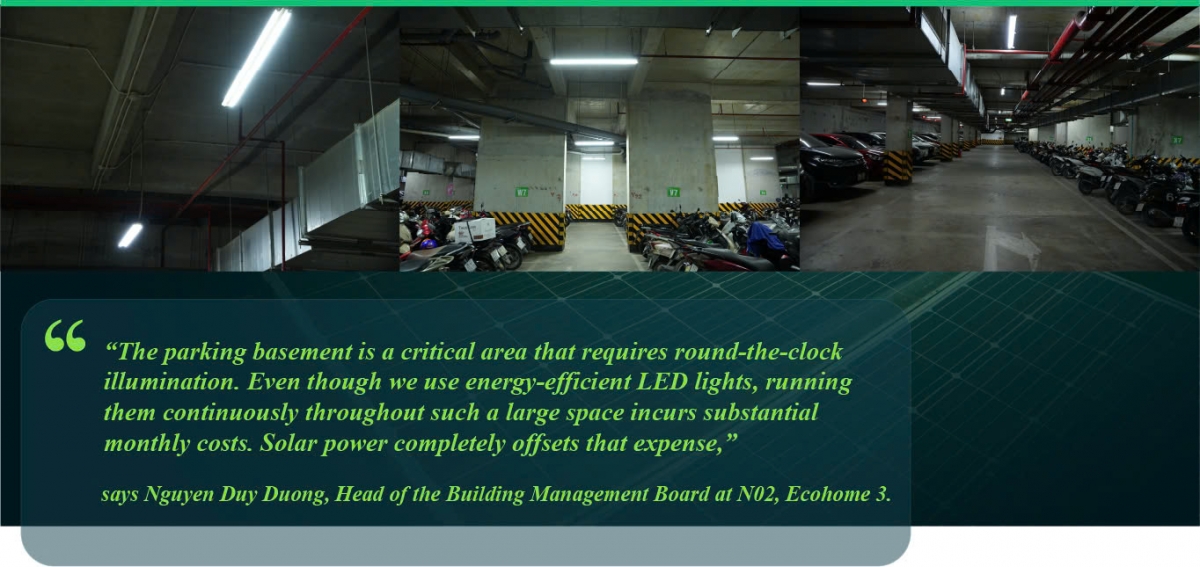
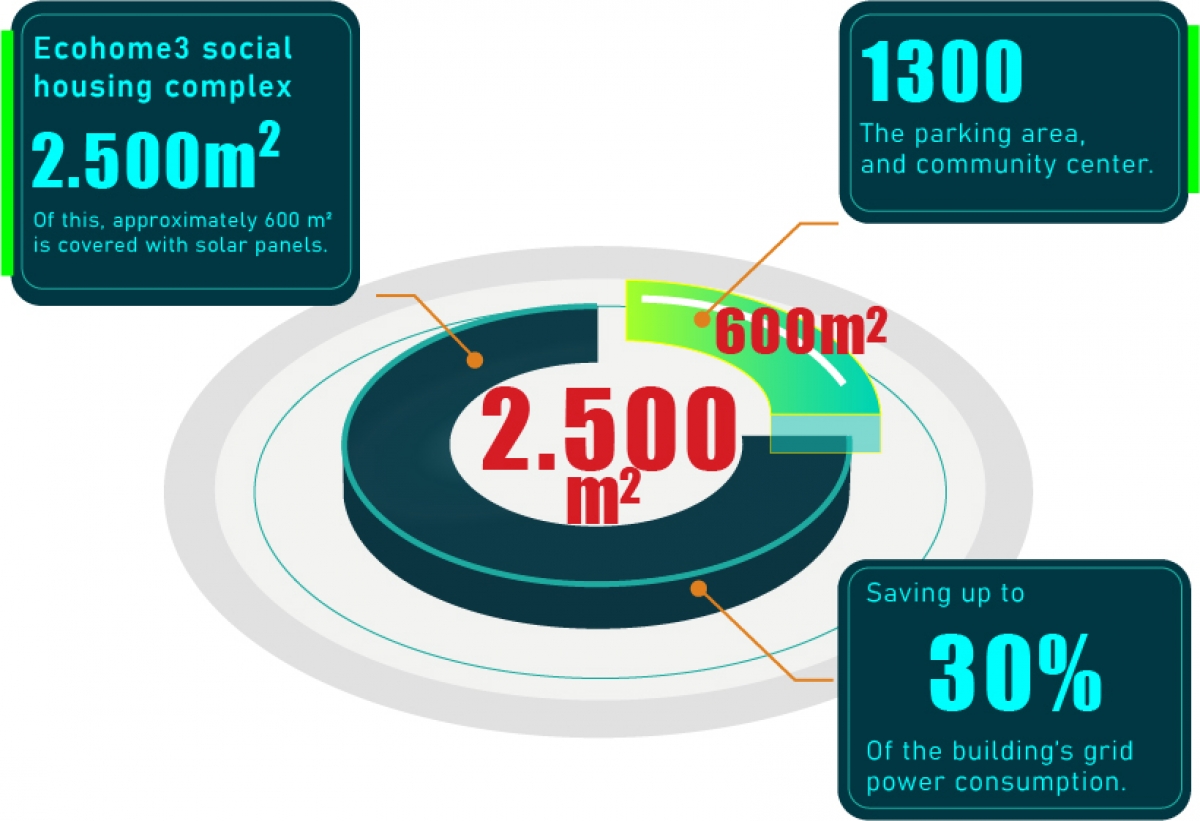
Nguyen Duy Duong, Head of the Building Management Board at N02, Ecohome 3, said 600 square meters of their 2,500-square-meter rooftop is covered with solar panels. The system powers roughly 1,300 lighting fixtures in corridors, basements, and gardens, and the community hall ceiling fans.
During mid-summer rolling blackouts, solar power made the community hall a cool refuge for seniors and children, continuously lit the basement parking area, and slashed the building's grid electricity consumption by 30%.
Under Politburo Resolution 70 on ensuring national energy security through 2030, with a vision to 2045 and Prime Minister Directive 10 which calls for stronger electricity-saving measures and greater development of rooftop solar power nationwide, Vietnam aims to have rooftop solar systems installed at least 10% of public offices and households nationwide, while introducing state budget support policies to promote the development of this renewable energy source for the 2026-2030 period.
With rapid urbanization, Vietnam’s growing number of high-rise apartment buildings represents a significant untapped market for rooftop solar. Their common facilities, including lighting, water pumps and ventilation systems, create a steady and predictable demand for electricity.
Dr. Vo Quang Lam of the Vietnam Clean Energy Association says this presents a major opportunity to expand solar power in urban areas.
Ministry of Construction statistics show that Vietnam has 4,500 apartment complexes nationwide, including 2,000 modern commercial and resettlement developments. With Ho Chi Minh City aiming for 200,000 social housing units by 2030 and Hanoi expanding multi-function urban zones, the potential rooftop generation capacity is substantial.
Nguyen Anh Dung, Energy Transition Specialist and Projects Director at The Asia Foundation in Vietnam, said studies by The Asia Foundation indicate that Hanoi alone has thousands of megawatts in rooftop solar potential.
The value of apartment rooftop solar extends beyond the added grid megawattage. Its primary advantage lies in generating clean electricity in places with high demand, reducing reliance on the main grid and strengthening the urban power infrastructure against peak-load stress.

Technically, any roof with 15 to 20 square meters of unshaded space possesses favorable baseline conditions to harness solar energy. But according to Dr. Lam, there’s a gap between the potential and actual panels on the roof.
Dr. Lam said deploying solar power on high-rise apartment buildings faces 3 big hurdles.
First, shared complex ownership legally classifies roofs as shared property, requiring full consensus among developers, management boards, and residents regarding financing, asset ownership, and cost distribution.
Second, retrofitting existing structures demands rigorous technical and safety evaluations, including structural load recalculations, specialized engineering, and strict fire safety certifications.
Finally, urban spatial constraints, such as varied building orientations and shadows cast by neighboring high-rises, can sharply reduce real-world solar exposure.

According to Dr. Lam said, in Vietnam, optimal solar exposure requires orienting panels south, southeast, or southwest. But building orientations vary, and surrounding structures frequently cast shadows during key generation hours, sharply reducing solar irradiance. Thorough site surveys assessing roof orientation, shading patterns, and real-world solar radiation are mandatory before any installation.
Specialist Dung of The Asia Foundation suggests that solar infrastructure be embedded into architectural blueprints.
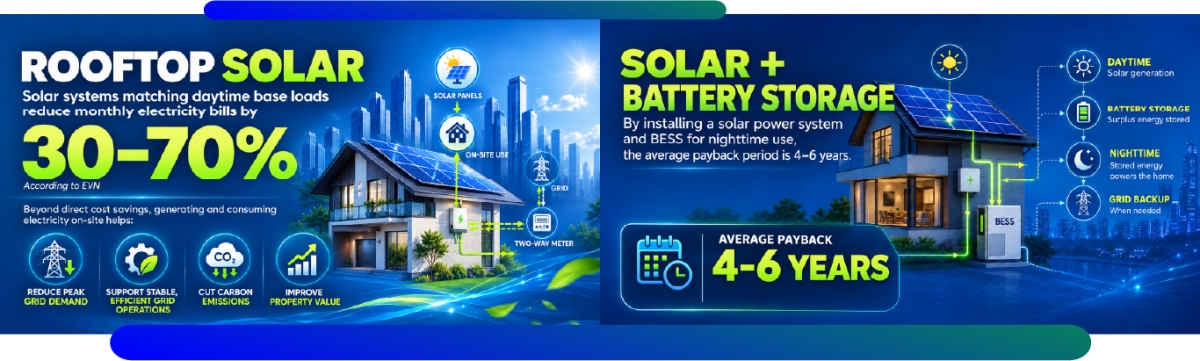
EVN estimates that solar systems matching daytime base loads reduce monthly electricity bills by 30 to 70%, with payback periods averaging 4 to 6 years, especially when paired with Battery Energy Storage Systems (BESS) for nighttime usage.
To encourage adoption, Bui Quoc Hung, Deputy Director of the Electricity Regulatory Authority under the Ministry of Industry and Trade, said authorities are drafting new promotional mechanisms and state subsidies.
At the municipal level, Hanoi, for example, is considering direct subsidies of 38 USD per kWp of solar capacity plus 38 USD per kWh of BESS storage, providing combined incentives of up to 230 USD per installation.
But for high-rise apartment complexes, a tailored mechanism is needed to address shared ownership and collective energy consumption. Addressing these regulatory and planning gaps from the ground up is essential, according to specialist Dung of The Asia Foundation.
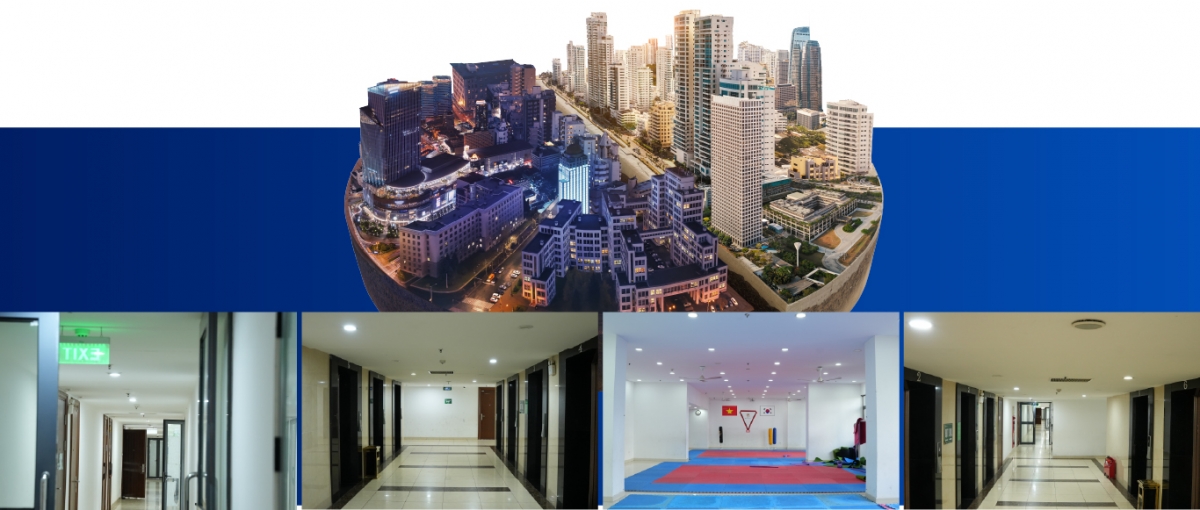
In the long term, existing high-rises will require targeted technical audits to identify high-viability candidates rather than blanket retrofits. For new real estate developments, solar integration should be mandated at the architectural design phase, harmonizing hardware with structural engineering, fire safety, and energy storage.
By resolving these core challenges, urban rooftops can transform high-rise communities from heavy grid consumers into resilient hubs for urban clean energy.
Aiming to achieve net-zero emissions by 2050 and the strong shift towards green energy, self-produced and self-consumed rooftop solar power is emerging as one of the most effective solutions for households and businesses in Vietnam.