(VOVWORLD) - The town of Inami in Nanto city, Toyama prefecture, is home to one of Japan’s most remarkable wood-carving traditions—a craft defined by its dynamism, precision, and an astonishing level of detail achieved using only chisels. Originating more than 250 years ago during the reconstruction of a temple, Inami carving has evolved through generations of artisans who continue to advance its expressive and technical boundaries. In this week’s Culture Rendezvous, we explore the craft of Inami wood carving and the people who keep it alive.
 (Photo: Inami wood carving Corperative) (Photo: Inami wood carving Corperative) |
The tradition began in the 18th century during the rebuilding of Zuisen-ji temple, when master sculptor Maekawa Sanshirō was invited from Kyoto to lead the project. His techniques were passed to local artisans, who spent the next 150 years refining a unique three-dimensional carving style that is now renowned across Japan and beyond.
Today, around 200 woodcarvers work in Inami, along the historic, stone-paved Yōkamachi street where the rhythmic tapping of chisels fills the air.
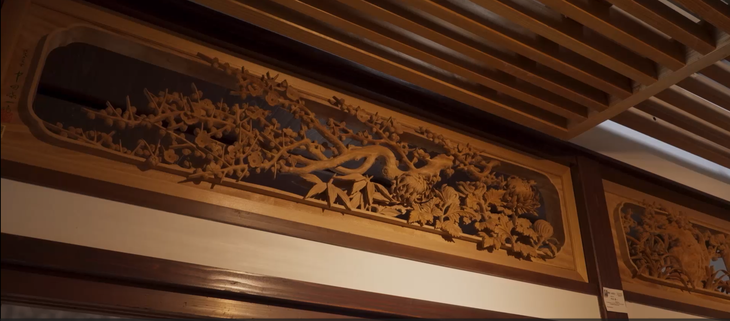
A signature of Inami craftsmanship is the ranma, an openwork transom panel placed between ceilings and room partitions in traditional Japanese houses. These panels allow light and air to circulate while serving as intricate wooden artworks, meticulously carved to be appreciated from either side.
 Wood sculptor Maekawa Daichi (Photo: Embassy of Japan) Wood sculptor Maekawa Daichi (Photo: Embassy of Japan) |
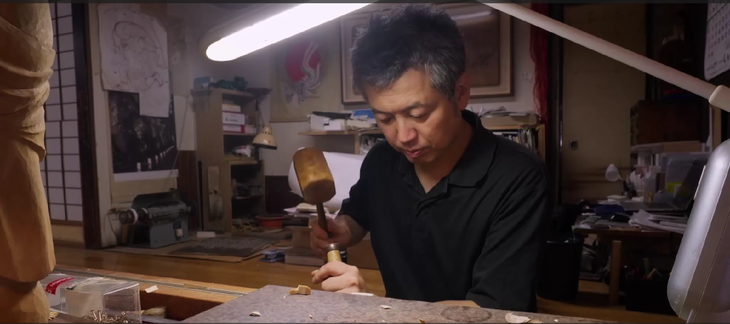
At the workshop of wood sculptor Maekawa Daichi, artisans begin each piece by roughing out the overall form. This sets the stage for all later details.
Maekawa Daichi said, “Rough carving is the most difficult stage. Once you carve out a part, that part is gone, so you must be certain. This is the most important technique to master, and you can only work quickly after many years of practice.”
Inami carving is broadly divided into rough carving and finish carving. During rough carving, the chisel is struck forcefully with a hammer to make bold cuts; during finish carving, only the strength of the hands and arms is used. Rough carving includes rough shaping, rough carving, and fine carving—stages that define the contours and the placement of every element.
Master artisan Iwakura Ryosen emphasized the importance of this stage: “While most people believe finishing is the most difficult stage, in Inami wood carving the rough carving is the crucial stage and is the responsibility of the master artisan.”
After the rough carving is complete, the work moves into the finish carving phase. This includes preliminary carving—handled mainly by apprentices—and then detailed finishing and decorative carving. Carving often goes against the grain, requiring years of experience to control the blade while adapting to the wood’s natural flow.
Iwakura notes, “The preliminary carving stage is a learning environment where younger craftsmen learn the properties of wood. After acquiring sufficient technical skills through this process, they can move on to the more detailed decorative carving.”
Throughout the entire process, Inami artisans rely exclusively on chisels—more than 200 different types—switching tools constantly to refine every surface without ever using files or sandpaper.
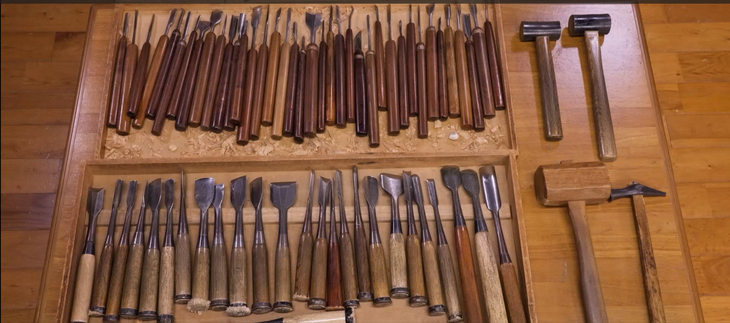 About 200 carving chisels of various sizes are used to bring out the shape of an Inami carving work. (Photo: Embassy of Japan) About 200 carving chisels of various sizes are used to bring out the shape of an Inami carving work. (Photo: Embassy of Japan) |
Developed originally for temples and shrines, Inami carving later became popular in ordinary homes. Today’s artisans range from veterans with decades of experience to young newcomers continuing the lineage.
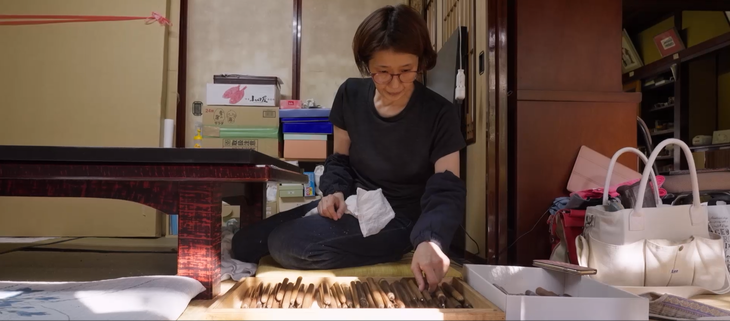
Wood sculptor Kamo Kaoru said, “Inami has the largest number of wood sculptors in the country, so for really big projects, we can provide any size of group needed.”
For commissioned ranma, Iwakura begins by visiting the client’s home, studying the layout, gathering references, and developing a design that often reflects a cherished memory or hometown landscape. Carving the backside of the panel adds further complexity; because no design is pre-drawn there, the artisan must improvise while ensuring that motifs on both sides align—sometimes using a mirror to check angles.
 Wood sculptor Kamo Kaoru (Photo: Embassy of Japan) Wood sculptor Kamo Kaoru (Photo: Embassy of Japan) |
The final stages include delicate decorative cuts, correction work, and fitting the carving into a frame made by a specialist carpenter. Only after the frame is installed are temporary reinforcement joints removed, revealing the carving in its completed form.
Today, Inami’s wood-carving tradition extends far beyond the region. The town hosts international sculpture camps and attracts artisans from around the world who come to learn, exchange techniques, and experience a community that has preserved this heritage with deep dedication.
Using only chisels to transform solid blocks of wood into airy, intricate sculptures, Inami’s carvers continue to breathe new life into a centuries-old craft—one that blends technical mastery, artistic sensitivity, and an enduring respect for tradition.