(VOVWORLD) - Du Ke, a style of musical theater, has become an indispensable spiritual and cultural art form of the Khmer ethnic community of Southern Vietnam. Ancient plays always feature a very special character - one who appears with a distinctive face and unique dance movements that both fascinate and frighten audiences: the Chan.
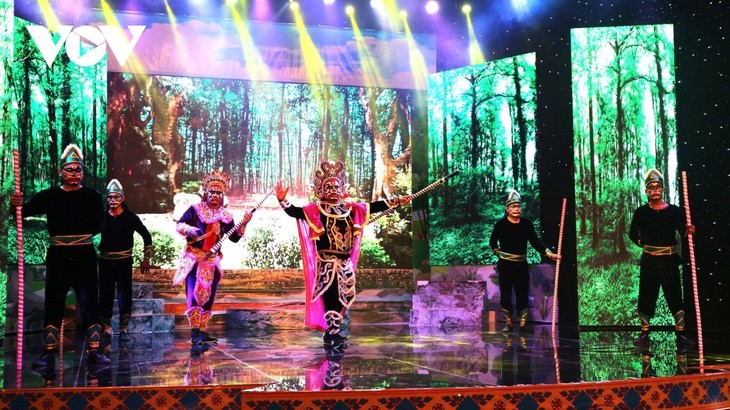 The Chan in Khmer Du Ke musical theatre (Photo: VOV) The Chan in Khmer Du Ke musical theatre (Photo: VOV) |
In Du Ke, the Chan is a villainous character. Chan does not exist in real life but possesses magical power and can transform into humans or various animals. It is not a poor or hungry creature, but rather a cunning, deceitful figure with lustful intentions. Their specialty lies in using sorcery to provoke war and conflict.
Stories about defeating the Chan to save innocent people have long been common in Du Ke performances and have become familiar plot elements to audiences. Through these stories lies a philosophy: evil always exists alongside good, yet good ultimately triumphs - the happy ending that audiences continually hope for.
“I think the image of the Chan in literature or in the Ba Sak plays often originates from Khmer folktales or from the Indian epic Ramayana,” Master Danh Men, from the Southern Intermediate Pali Culture Training School in Can Tho City, said.
In Du Ke theatre, each role has its unique performance style, and the Chan is considered one of the most technically demanding roles. Apart from its striking costume and movements, actors playing the Chan must master color composition in face painting to convey the fierce, mysterious, and powerful nature of the character. As the embodiment of evil, the Chan’s dance moves are exaggerated and frightening.
The Chan relies mainly on physical combat movements to overpower opponents, rarely using speech but instead emitting roars or beast-like screams. Therefore, the role requires many years of rigorous, detailed training.
“When I joined the troupe, I learnt from senior artists how to perform the Chan role, from hand techniques and weapon-based choreography to how to paint the face to look fierce and malicious, using mainly black and white, sometimes adding green or red to show anger and cruelty. At first, it was very difficult. The voice and breathing style often caused throat pain and dryness, but gradually, with continued training, I have improved and been able to perform until today,” Lam Thanh Hung from the Khmer Art Troupe of Can Tho City, said.
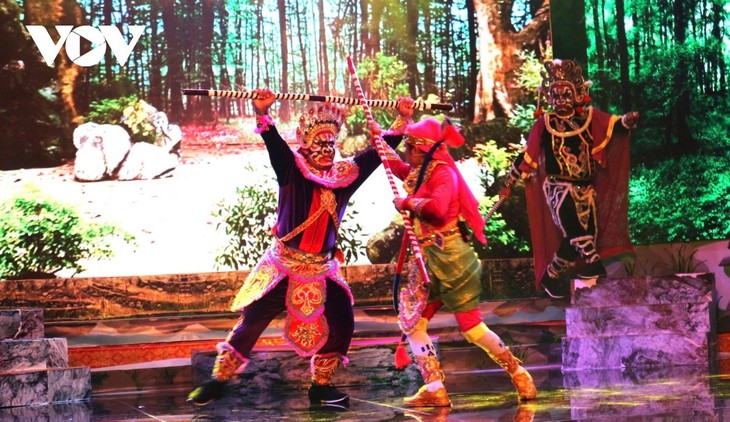 As the Chan’s role symbolizes evil, its dance movements are exaggerated and appear very fierce. (Photo: VOV) As the Chan’s role symbolizes evil, its dance movements are exaggerated and appear very fierce. (Photo: VOV) |
On the Du Ke stage, the Chan is not merely a magical, fictional being, it reflects the evil and wrongdoing that exist around us in real life: deceitful, cruel individuals who threaten peace, safety, and human lives.
“The Chan not only symbolizes evil but also mirrors negative social phenomena. First, it represents greed and the abuse of power, as the Chan is often portrayed as a king or leader who misuses authority. Second, it reflects violence and invasion that cause harm to others,” Master Danh Men further explained.
Today, although perceptions of the Chan role have evolved, the contrasting dramatic structure - good versus evil, virtue versus brutality, justice versus injustice, patriotism versus betrayal remains a consistent preference in traditional theatre appreciation.
Through the image of the Chan on the Du Ke stage, Khmer folk artists aim to convey a meaningful life philosophy: good and evil may coexist, but good will always prevail. This is the profound humanitarian lesson that Khmer traditional artists have passed down through generations.