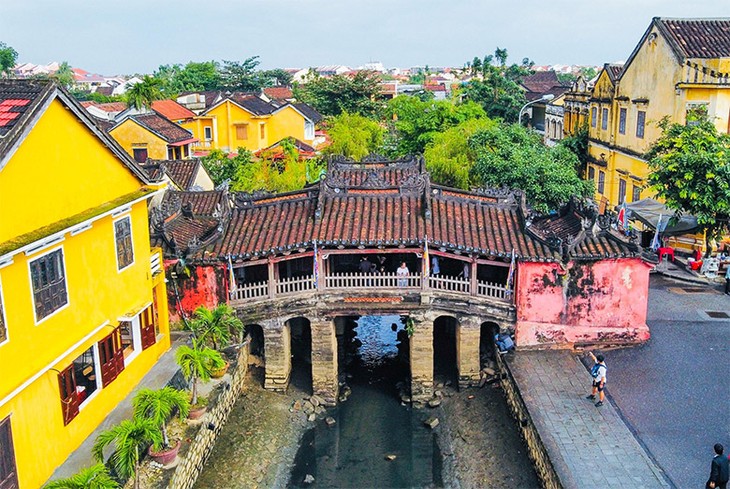
 The bridge-pagoda in Hoi An ancient town (photo: hoangthanhthanglong.vn) The bridge-pagoda in Hoi An ancient town (photo: hoangthanhthanglong.vn) |
B: I hope you’re enjoying a pleasant autumn. But here in Vietnam, the central region is bracing for Typhoon Kalmaegi while resolving the aftermath of recent historic flooding.
B: We’re so moved to read messages of sympathy from our listeners abroad. Chinmoy Mahato of India wrote to express his concern after learning from the media about the record-breaking rainfall and severe flooding in central Vietnam. He said he and his fellow club members were deeply saddened by the tragedy and are praying for the health and strength of the people affected by the disaster.
A: British listener Gerry Neumann voiced his concerns for his friends in Hue city, who have been affected by heavy rain and flooding. A few years ago, Gerry spent several summers in Hue, where he taught English.
B: Vietnam’s central region often sees flooding between summer and autumn due to heavy rains and rising river levels. While the floods can disrupt transportation and limit access to some tourist attractions, they also create an atmosphere that shows off the resilience and adaptability of the Vietnamese people.
A: Visitors to Hue city and Hoi An ancient town may have seen the residents skillfully cope with the rising waters, using boats to move around, and continuing their daily routines despite the rain.
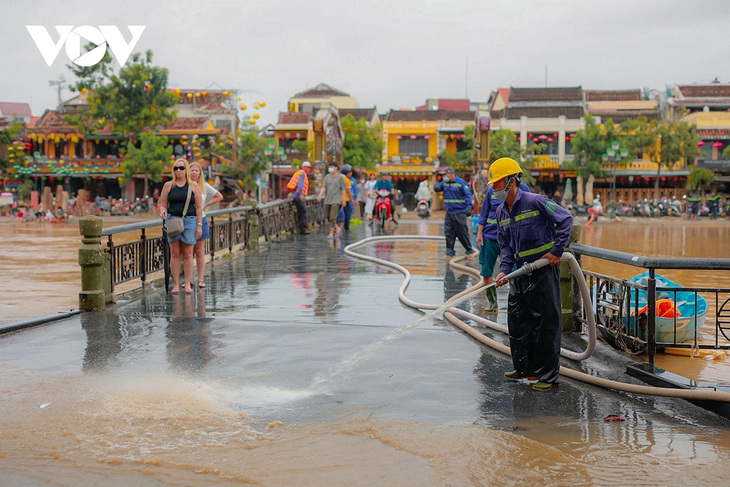 People in Hoi An are cleaning up after heavy flooding. (photo: VOV) People in Hoi An are cleaning up after heavy flooding. (photo: VOV) |
B: We received a message from Nigel Bristowe saying he and his wife will visit Vietnam in November with a UK tour group. They’ll spend time in Ho Chi Minh City, Da Nang, Hue, Ha Long and Hanoi. They’ll have some free time in Hanoi to explore the city on their own. Mr. Bristowe asks if “a visit to VOV might be possible?”
A: You’re very welcome to visit VOVWORLD at 45 Ba Trieu Street, in the heart of Hanoi — just a short walk from Hoan Kiem Lake. We’d be delighted to meet you and share our proud history and work with you. Please let us know in advance!
B: Your travel itinerary will take you to some of Vietnam’s major cities and tourist destinations. We hope you have a wonderful trip filled with memorable experiences and happy moments!
A: We got a question this week from Chris Malboeuf of Canada: “Does Vietnam allow dual citizenship?”
A: Thanks for the question! According to Vietnam’s Law on Nationality, dual citizenship is generally not permitted, except in special cases approved by the President. Vietnamese citizens who acquire another nationality without such approval could lose their Vietnamese citizenship.
B: A person may retain their foreign nationality when acquiring Vietnamese nationality if they meet all requirements for naturalization.
A: The law stipulates that Vietnamese children adopted by foreign nationals may retain their Vietnamese nationality and hold dual citizenship. These cases are reviewed individually and must be approved by the President of Vietnam.
B: The National Assembly in June adopted a revised Law on Nationality that makes it easier for foreign investors, scientists, and experts to acquire Vietnamese citizenship and retain their foreign nationality.
A: Vietnam’s legal principles concerning nationality are becoming more flexible in order to attract talent and foster international cooperation.
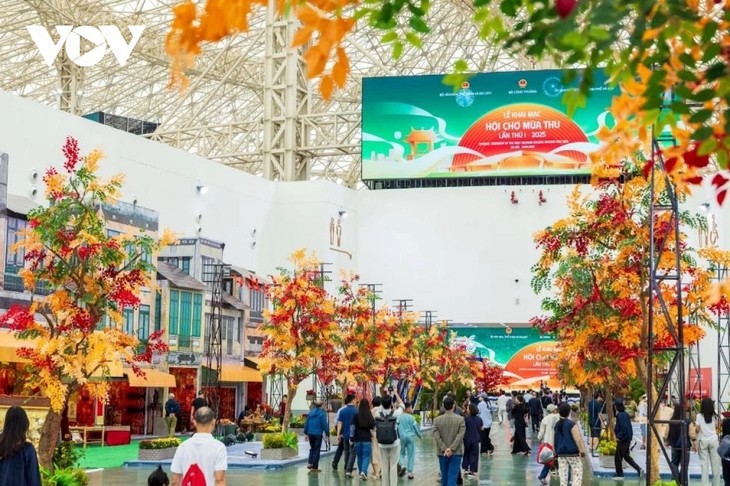 At the Autumn Fair 2025 (photo: VOV) At the Autumn Fair 2025 (photo: VOV) |
B: News about the Autumn Fair 2025 drew our listeners’ attention last week. Korean listener Im Sinna said: “I’ve never attended a fair like that, but your reports and photos show me that Vietnamese specialties are promoted in a creative way. Your news report broadened my understanding in many ways.”
A: Listener Phol Phanit of Phnom Penh, Cambodia, said: “Although I’ve never been to Vietnam, when I read your articles about the Autumn Fair on the VOVWORLD website, I was really fascinated by the photos of traditional crafts. The skillfulness and creativity of the Vietnamese people are clearly reflected in each product. Everything looks lively, delicate, and rich in Vietnamese culture. I really hope to have the opportunity to visit and experience it in person.”
B: Thank you, Sinna and Phanit! We’re delighted to hear that our reports brought you closer to Vietnam’s culture and creativity. The Autumn Fair 2025 may well become an annual event, featuring even more traditional crafts, local specialties, and creative cultural industries.
A: We’ll give you details as the next event approaches. Who knows, maybe next year some of you will be able to attend the Autumn Fair in person.
B: From Japan, regular listener Hokamura Fumito of Japan wrote that he wants to hear more about Vietnamese coffee.
A: Well, coffee is one of the most popular drinks in Vietnam and an important part of daily life here. You can find coffee shops almost everywhere.
B: Vietnamese coffee comes in many varieties. The traditional drink is strong black coffee, usually served without sugar. It’s famous for its strong aroma and bold, slightly bitter taste. It can be enjoyed hot or poured over ice.
A: Traditionally, Vietnamese coffee is brewed using a small metal drip filter called a phin, which allows hot water poured over ground coffee to drip slowly into your cup, creating a rich, concentrated flavor. Today, most cafés use a modern espresso or coffee-making machine to brew a wider variety of coffee drinks.
A: For those who prefer something lighter, there’s coffee with condensed milk, a sweet and creamy favorite among Vietnamese coffee drinkers. And then there’s Hanoi’s famous egg coffee, made with whipped egg yolk and condensed milk, giving it a smooth, custard-like flavor.
B: In recent years, people have gotten creative, coming up with new recipes like coffee with cream cheese, yogurt coffee, and coffee flavored with coconut, ginger, or durian.
A: Vietnam exports coffee in a variety of flavors and styles. Two popular brands are Trung Nguyen, best known for its G7 instant coffee and its Legend and Creative series of blends ranging from mild to extra strong, and Highlands Coffee, which offers both ground coffee and instant coffee with a smooth, aromatic flavor inspired by traditional Vietnamese brewing.
B: Other well-known brands are Vinacafe, famous for its rich, creamy 3-in-1 instant coffee mix; Mê Trang, with its specialty roasted beans; L’amant Café, whose certified organic coffee meets USDA and EU Organic standards; and Dakmark Coffee, who exports large volumes of robusta green coffee beans.
A: So, Hokamura, whether you enjoy something strong or something sweet, Vietnam has a coffee for every taste. We hope you and our other listeners will get a chance to come enjoy a cup of Vietnamese coffee in the country where it’s grown!
A: That’s a wrap for this week’s Letter Box. Keep listening and keep writing! “Goodbye from Hanoi!”