(VOVWORLD) - Since being inscribed on the list of Intangible Cultural Heritages in Need of Urgent Safeguarding 16 years ago, Ca Tru (ceremonial singing) has made a strong revival. Guilds and clubs have contributed to ensuring its lasting vitality. Artisan Van Mai, head of the Bich Cau Dao Quan Ca Tru Club in Hanoi, has been recognized for her devotion to this art form.
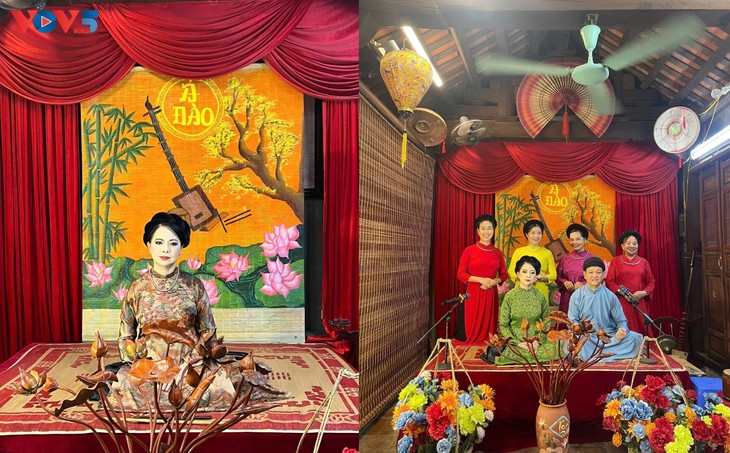 Emeritus artisan Van Mai and members of the Bich Cau Dao Quan Ca Tru Club (Photo: Kim Lieu/ VOV5) Emeritus artisan Van Mai and members of the Bich Cau Dao Quan Ca Tru Club (Photo: Kim Lieu/ VOV5) |
“Ca Tru’s vocal style is noble and elegant. Once you master the breathing technique, every word you sing feels like you are pouring out your emotions from deep within, letting your soul flow through the music. I can’t let such a treasure fade away. My greatest hope is to teach Ca Tru to as many young people as I can,” said Emeritus Artisan Van Mai, who developed a love for Ca Tru at an early age although she didn’t come from a musical family.
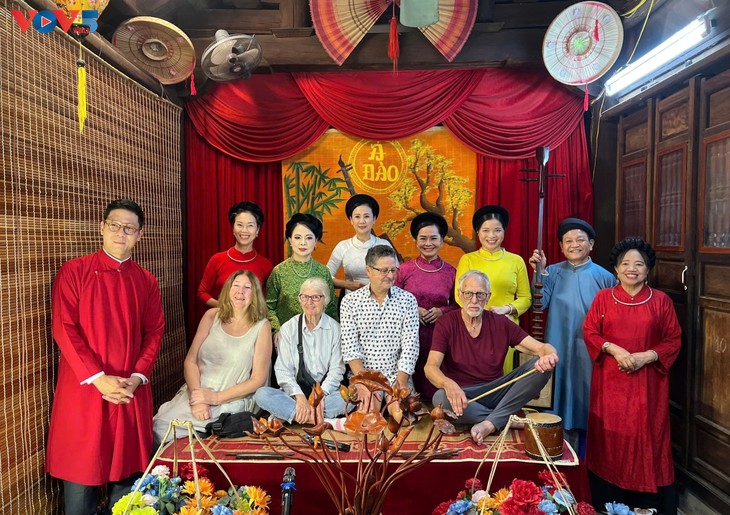 Emeritus artisan Van Mai and members of the Bich Cau Dao Quan Ca Tru Club with a group of Canadian tourists during a Ca Tru performance (Photo: Kim Lieu/ VOV5) Emeritus artisan Van Mai and members of the Bich Cau Dao Quan Ca Tru Club with a group of Canadian tourists during a Ca Tru performance (Photo: Kim Lieu/ VOV5) |
Blessed with a clear, sweet, bright voice, she learned to perform even the most difficult melodies. Learning to sing Ca Tru was a great challenge in the beginning, Mai said.
“I first listened to iconic artisan Quach Thi Ho singing Ca Tru on the Voice of Vietnam in 1995. Her style was truly remarkable and powerful. I had previously performed other traditional genres like Cheo (popular opera) and Chau van (ritual singing), but once I heard her perform Ca Tru, I fell deeply in love with it and have remained attached ever since. For years, I learned from various artisans and studied recordings made between 1930 and 1945. In 2006, I was honored to participate in a ‘Ca Tru Night’ program at the Hanoi Opera House.”
After years of intense practice in singing and percussion techniques, Mai has mastered all the Ca tru forms – offering incense, sending letters, lullabies – all delivered in a style that’s deeply emotional. She captivates audiences and has received acclaim for reviving an ancient song called Non mai hong hanh, which had been lost for 70 years. That song requires unique breathing and vibrato techniques.
“In Ca Tru, the vibrato technique is incredibly difficult. In Cheo or Quan Ho singing, the vibration comes from the throat, but Ca Tru it must be produced from the nasal area. From the throat you can only produce a single vibration, but with the nasal technique you can produce multiple vibrations. The elders used to say that Ca Tru is monophonic yet polyphonic,” Mai said.
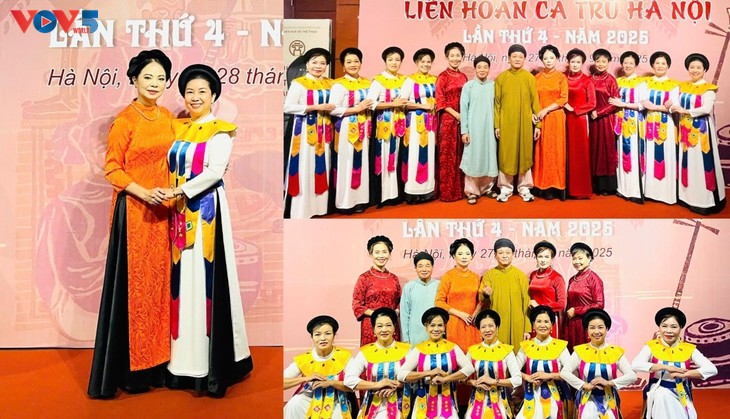 Emeritus artisan Van Mai and members of the Bich Cau Dao Quan Ca Tru Club at the 2025 Hanoi Ca Tru Festival (Photo: Kim Lieu/VOV5) Emeritus artisan Van Mai and members of the Bich Cau Dao Quan Ca Tru Club at the 2025 Hanoi Ca Tru Festival (Photo: Kim Lieu/VOV5) |
Mai’s desire to preserve and promote Ca Tru led her in 2015 to found the Bich Cau Dao Quan Ca Tru Club in Hanoi. It has become a rendezvous for fans and a place to nurture young talents.
“Ca Tru is a very scholarly and elegant form of traditional music. It contains deep layers of meaning in its poetic expressions. Ms. Mai is dedicated about Ca Tru and passionate about teaching it,” Cheo artist Nguyen Hong Hanh said.
Truc Linh, a member of the club, said, “I really admire Ms. Mai. She did not receive any formal music training, yet she sings wonderfully. She’s very enthusiastic about teaching anyone who wants to learn Ca Tru.”
An ancient art form that had begun to fade has returned stronger than ever thanks to devoted artists like Emeritus Artisan Van Mai.