(VOVWORLD) - The 10th anniversary of the tug-of-war ritual and games being recognized by UNESCO as an intangible cultural heritage of humanity has recently been celebrated at Tran Vu Temple in Hanoi. From early morning, the entire area came alive with the sound of festive drums, drawing in crowds eager to immerse themselves in the vibrant tug-of-war tradition.
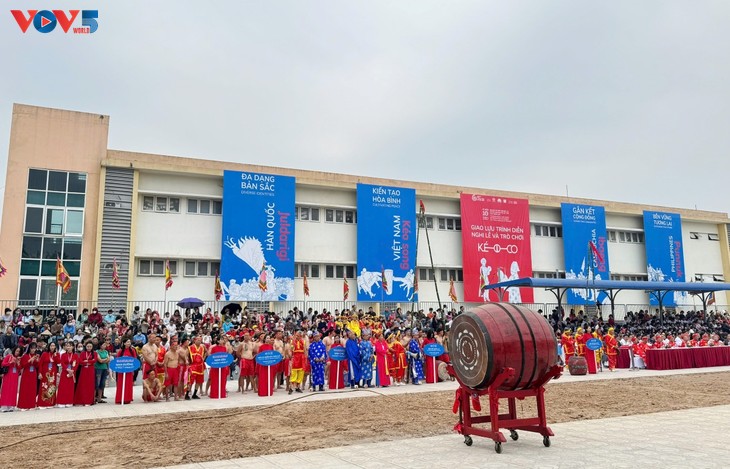 The tug-of-war celebration at Tran Vu Temple in Hanoi (photo: Thuy Tien) The tug-of-war celebration at Tran Vu Temple in Hanoi (photo: Thuy Tien) |
On the courtyard of Tran Vu Temple, tug-of-war teams from Vietnam’s northern localities gathered, surrounded by the cheers of the audiences.
Ten years ago, on December 2, 2015, in Namibia, the tug-of-war ritual and game of Vietnam, Cambodia, South Korea, and the Philippines, was officially inscribed on UNESCO’s Representative List of the Intangible Cultural Heritage of Humanity.
The event marked a major milestone for expanding the network of heritage-practicing communities. Vietnam now has 10 communities engaging in preserving, transmitting, and sustaining the tug-of-war heritage. People in Hanoi, Bac Ninh, Phu Tho, Lao Cai, Hung Yen, and Ninh Binh, continue to maintain the the tug-of-war ritual every year. The bamboo rope, rattan rope, or straw rope has become a symbol of community connection, awakening memories of village life.
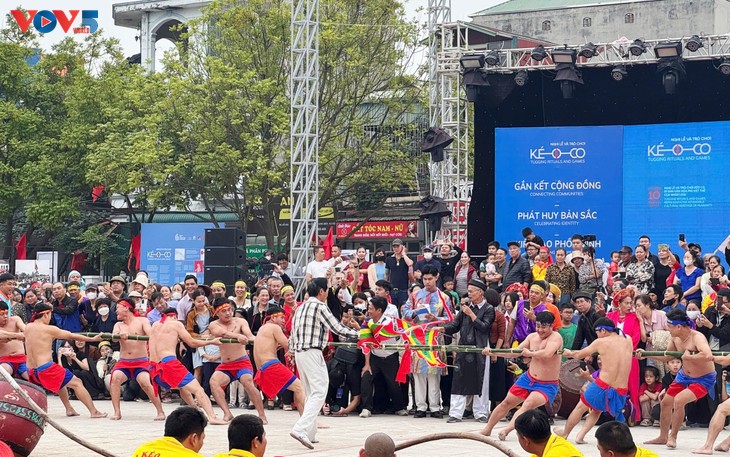 A tug-of-war match (photo: Thuy Tien) A tug-of-war match (photo: Thuy Tien) |
Ngo Quang Khai, Head of the Tran Vu Temple Relic Subcommittee and Chairman of the Vietnam Tug-of-War Network, said: “Communities from Lao Cai, Vinh Phuc, Ninh Binh, Hanoi, Bac Ninh, and Hung Yen participate in this event. Each province has a different pulling style and rope, but they all share the same meaning, pulling one rope. Whether bamboo, rattan, or straw braided rope, it symbolizes the wish to connect the community, the past, the future, and the present, and tightening unity and bonding. The participating communities also enrich their knowledge and customs of other regions and come closer together under one shared roof. Our ancestors preserved and passed down this heritage through generations, and we now have the responsibility to preserve and promote it.”
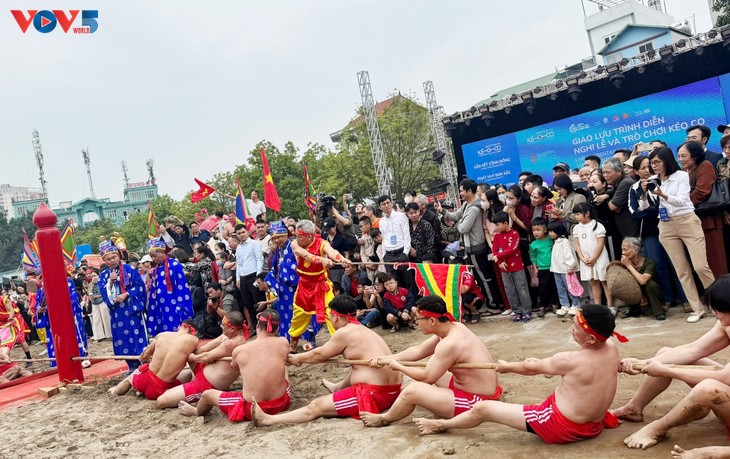 Sitting tug-of-war games (photo: Thuy Tien) Sitting tug-of-war games (photo: Thuy Tien) |
Against the backdrop of resounding festival drums, the players lined up, hands gripping the rope, feet planted firmly, and eyes fixed with determination. Outside the courtyard, the elderly people attentively watched the players preparing for the games. The audience, including many foreigners, cheered loudly and took photos of the exciting scenes.
Duong Van Tinh, a member of the tug-of-war team from Vinh Thanh commune, Phu Tho province, said: “My hometown has practiced this ritual for more than a hundred years. Every year from the 4th to the 8th day of the first lunar month, all people from Dong Temple and Gieng Temple gather to play tug-of-war. There are no prizes. What matters is the affection and joy. It is a great honor for our village to take part in this event, along with teams from South Korea, Cambodia, the Philippines, and Vietnam.”
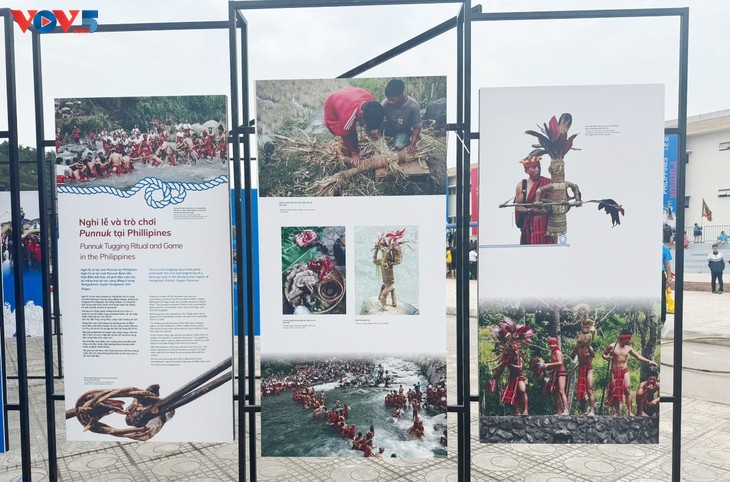 Display of tug-of-war ritual and games in Vietnam South Korea, Philippines, and Campuchia. (Photo: Thuy Tien/VOV) Display of tug-of-war ritual and games in Vietnam South Korea, Philippines, and Campuchia. (Photo: Thuy Tien/VOV) |
Not far away, young men of the Man Cho team were warming up. The sound of shoes striking the ground, deep breaths, and the rough sliding of the rope created an exciting atmosphere.
Player Nguyen Hong Quan said: “Tug-of-war at Tran Vu Temple has three teams called Man Cho, Man Duong, and Man Dia. It is held annually on the 10th day of the third lunar month. Before the festival, we gather to practice, each team has 18 to 20 players. I’m honored that our traditional ritual has been recognized and hope it’ll spread to more communities.”
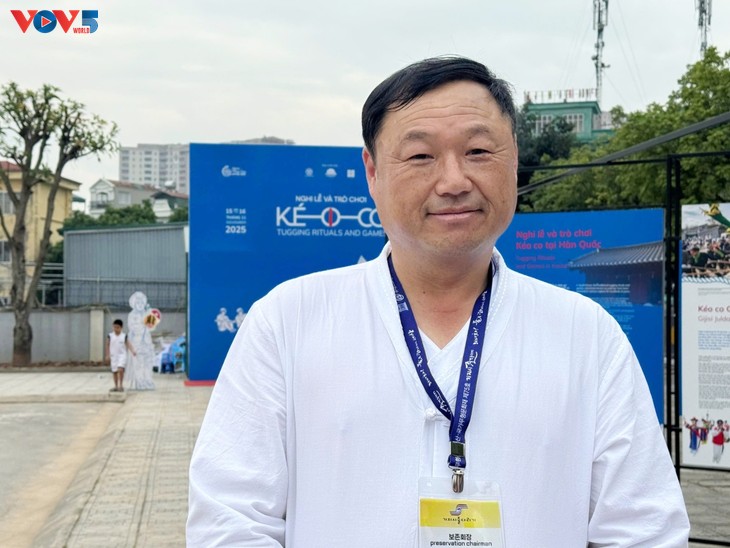 Ku Eunmo, President of the RoK Gijisi Tug-of-War Association (photo: Thuy Tien) Ku Eunmo, President of the RoK Gijisi Tug-of-War Association (photo: Thuy Tien) |
A highlight of this year’s program was the participation of foreign teams. Ku Eunmo, President of the Gijisi Tug-of-War Association led the South Korean members to the yard confidently with warm smiles. He said South Korea and Vietnam use different materials to make the ropes, but share the same spirit of unity among teams from different countries.
At the event, the Vietnam Tug-of-War Heritage Community Network made its debut, mandating to bridge communities and exchange experience in organizing and preserving heritage.