(VOVWORLD) - International cooperation and defense diplomacy to address war consequences have yielded positive results in recent years. These activities have helped heal the wounds of war, build trust, and establish a solid foundation for peace and sustainable national development.
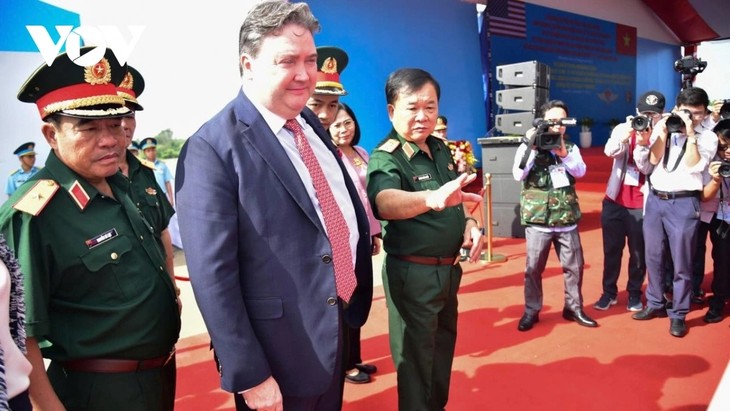 Vietnamese Deputy Minister of National Defense Hoang Xuan Chien and US Ambassador to Vietnam Marc Evans Knapper at Bien Hoa airport. (Photo: Duy Phuong) Vietnamese Deputy Minister of National Defense Hoang Xuan Chien and US Ambassador to Vietnam Marc Evans Knapper at Bien Hoa airport. (Photo: Duy Phuong) |
“We gather at Bien Hoa Airbase today to carry out dioxin decontamination activities. The fruitful cooperation results reaffirm our shared determination to overcome war’s consequences, with a spirit of setting aside the past and focusing on a future of peace and sustainable development,” said Deputy Defense Minister Hoang Xuan Chien.
Bien Hoa Airbase in Dong Nai province, a key wartime airbase and once the most heavily dioxin-contaminated spots in Vietnam, has become a symbol of humanitarian cooperation, reconciliation, and forward-looking partnership.
“Today's events are a sign of not just the US commitment to continue the work to address war legacy issues, but also a symbol of our two countries’ friendship and partnership, and how we've worked so hard over many, many years to get to this point today. These events today are incredibly visible symbol, the embodiment of our commitment to continue to work with the government of Vietnam and with the people of Vietnam,” said US Ambassador to Vietnam Marc Evans Knapper.
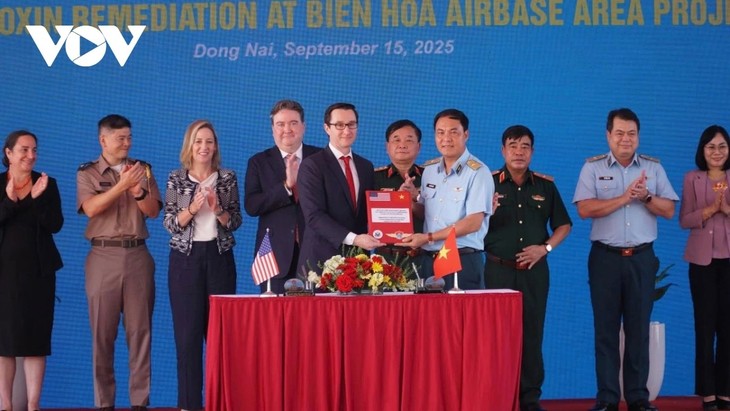 A ceremony on September 15, 2025, marks the handover of 6 hectares of dioxin-remediated land at Bien Hoa Airbase. (Photo: Duy Phuong/VOV) A ceremony on September 15, 2025, marks the handover of 6 hectares of dioxin-remediated land at Bien Hoa Airbase. (Photo: Duy Phuong/VOV) |
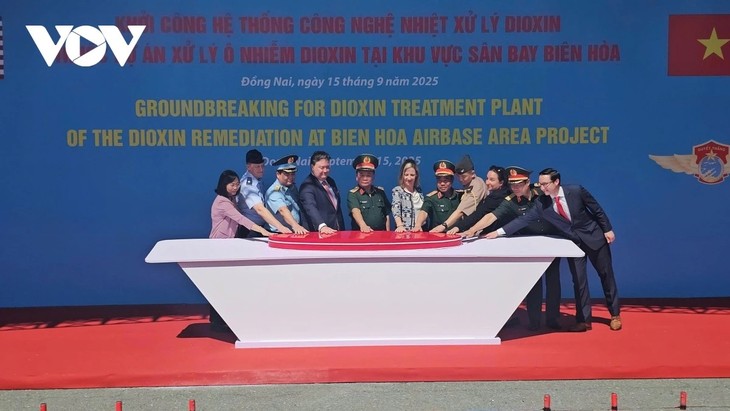
On September 15, Vietnamese Deputy Minister of National Defense Hoang Xuan Chien and US Ambassador to Vietnam Marc Evans Knapper witnessed the handover of remediated land, the groundbreaking ceremony for the construction and installation of the dioxin thermal treatment technology, and the signing of an additional 32 million USD in non-refundable aid from the US to continue war consequence remediation projects in Vietnam.
These activities are part of the dioxin remediation cooperation project at Bien Hoa Airbase between the Vietnam’s Ministry of National Defense and the US Agency for International Development (USAID), launched in 2019. To date, about 50% of the contaminated soil has been treated and handed over for socio-economic development and defense-security purposes.
Alongside dioxin cleanup projects, defense diplomacy has also rallied many international partners and organizations in unexploded ordnance clearance cooperation.
In Quang Tri province, once a fierce front line during the war, numerous international demining projects are now underway.
Every bomb or shell safely detected and removed means one more square meter of clean land, one more opportunity for local economic development.
“In the past, we could not farm on the land around our house because of unexploded ordnance. Thanks to the demining efforts, we can now cultivate and raise livestock safely. Life is much more stable,” said a local resident.
 (Photo: Duy Phuong/VOV) (Photo: Duy Phuong/VOV) |
Since 1993, the US has provided over 230 million USD to Vietnam for UXO clearance and dioxin detoxification. South Korea, through the Korea International Cooperation Agency (KOICA), channeled 20 million USD to the Korea-Vietnam Mine Action project from 2018 to 2024. Japan, Norway, Germany, and Australia have also cooperated with the Ministry of National Defense in drawing a national UXO contamination map, and offering technical assistance, equipment, expert training, and technology transfer. These international cooperation activities reflect humanitarian spirit – for the safety and well-being of the people.
That spirit has been raised high by Vietnamese peacekeepers in South Sudan and the Central African Republic through medical support, post-conflict recovery, disaster relief, and community assistance. These efforts have helped enhance Vietnam’s defense capacity and demonstrate the goodwill, international responsibility, and the image of Vietnamese soldiers.
“This is a peacetime mission, a noble and humanitarian task entrusted by the Party, the State, and the Vietnam People’s Army. It helps spread the image of Vietnamese soldiers in the eyes of international friends,” said Deputy Director of the Department of External Relations of the Ministry of National Defense, Colonel Nguyen Duy Minh.
Defense diplomacy and cooperation in resolving war consequences aim for the goals of building trust and preserving peace. As a nation that has gone through wars, Vietnam deeply understands the value of peace. It always takes the initiative to work with the international community in war remediation efforts, fostering friendship and trust, and actively participating in UN peacekeeping missions to spread a message of humanity and international responsibility.
“Obviously the role that Vietnam is playing in peacekeeping, supporting the UN and supporting our efforts, makes a difference for peace and especially makes a difference for the communities, the people who are affected by conflicts. Peacekeeping is very much about that, it's very much about supporting people, supporting peace efforts. We are very grateful to be able to count on Vietnam's support to these efforts,” UN Under-Secretary-General for Peace Operations, Jean-Pierre Lacroix, said.
In old bomb craters, green fields have now grown. On once lifeless lands, the laughter of children again now echoes. With humanity, defense diplomacy, and international friendship, Vietnam is writing a new story of peace, cooperation, and development.