(VOVWORLD) - On the stormy night of October 7, torrential rain swallowed Thai Nguyen province. Roads inundated, electricity flickered, and calls for help spread rapidly on social media. While rescue teams struggled to reach stranded families, a small group of young engineers quietly began building something that could save lives, a real-time digital map of rescue requests. Leading that effort was Nguyen Thi Mai Anh, a software developer who refused to wait until morning.
At nearly midnight, while most people in Thai Nguyen were battling rising floodwaters, Mai Anh was glued to her computer screen. Her Facebook feed was overflowing with desperate messages: “Our house is under water,” “Elderly people trapped,” “We need help on the rooftop.”
“The information was chaotic and getting lost. So around 11 pm, I contacted my friend, who had built a traffic app, and we decided to quickly adapt it as a rescue information platform. We worked from 11 pm to 3 am and launched thongtincuuho.org. It was an emergency situation and we couldn’t wait,” Mai Anh recalled.
 IT engineer Nguyen Thi Mai Anh (Photo courtesy of Mai Anh) IT engineer Nguyen Thi Mai Anh (Photo courtesy of Mai Anh) |
That spontaneous decision, made between two young engineers, Mai Anh, an IT engineer with ten years of experience in AI, big data, and automation, and Tat Huan, the developer behind a popular traffic app, gave birth to one of the most remarkable grassroots tech efforts Vietnam has seen in recent years: a real-time digital map for rescue operations.
“Speed was everything. We had only a few hours, only two people, and limited rescue operation experience. Our rule was simple: keep it simple and reuse what we already have. The first version didn’t need to be perfect. It just needed to work,” Mai Anh said.
By dawn, thongtincuuho.org went live and was quickly became viral among rescue forces. Within hours, hundreds of red pins appeared on the map, each representing a call for help.
Homes submerged, roads cut off, families stranded. Volunteers and local authorities began using the map to locate people in danger and coordinate rescue routes. On the first day alone, Google Maps charged the team over 300 dollars in server fees. A few days later, support arrived from Vietmap platform and US content delivery company Cloudflare. Their assistance allowed the rescue platform, whose backbone was a combination of artificial intelligence and human verification, to stay online through the critical days of flooding.
“Collecting and filtering information from social media comments was really hard. We used AI to cover about 80%, including extracting locations, categorizing needs, and removing duplicates. But we still needed volunteers to manually check everything, like verifying addresses, confirming real situations, and keeping information updated. Actually, more users made us more worried because it meant more people needed help. We just wanted the number on the map to drop to zero as soon as possible,” Mai Anh said.
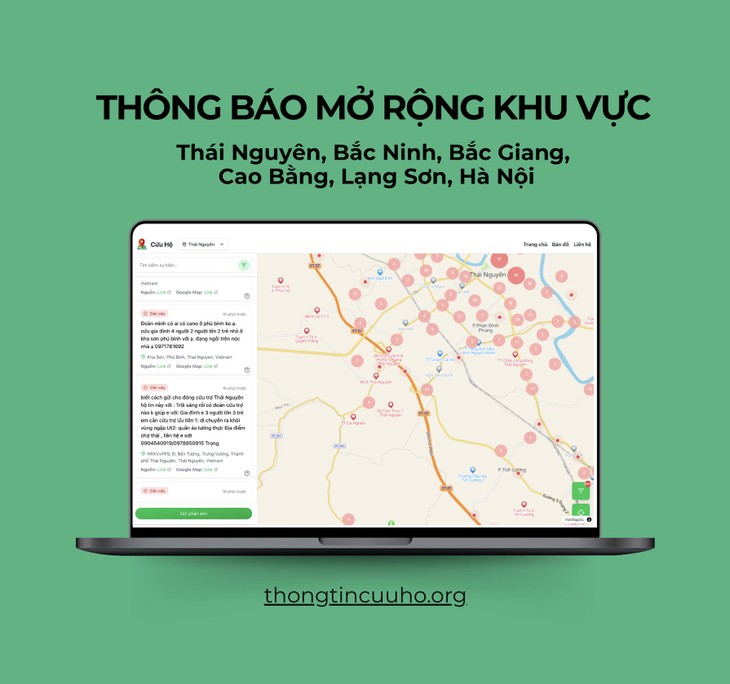 The platform thongtincuuho.org has been expanded to other provinces. (Photo: thongtincuuho.org) The platform thongtincuuho.org has been expanded to other provinces. (Photo: thongtincuuho.org) |
After the floods, the team began expanding the platform to other affected provinces like Bac Ninh and Lang Son. The goal was to create a flexible system that local authorities and volunteers could adapt to their own conditions, whether for floods, landslides, or other emergencies. As each province has its own geography, rescue networks, and communication culture, understanding their specific needs and coordinating with local teams are really challenging, said Mai Anh.
“We can keep this project running for the short term, but for the long term, we need more support and cooperation. Technology isn’t the hardest part. The real challenge is operations and human resources. We need people who have real expertise in rescue work, and a volunteer network that’s ready to act. Sometimes it’s best just to start. When people need help, you just do it,” she said.
This is a story about technology, yes, but even more it’s a story about empathy, urgency, and courage. As Mai Anh put it “When people need help, you just do it.” That’s one way everyday heroes can be made.