(VOVWORLD) - After the Politburo issued Resolution 72 on breakthrough solutions to improve public health in September, the National Assembly is about to adopt a Resolution establishing mechanisms and policies to implement this Resolution. All reflect Vietnam’s strong political consensus on investing in people, a pillar of sustainable development.
 Resolution 72 creates strategic breakthroughs for private healthcare development. (Illustrative photo: VGP) Resolution 72 creates strategic breakthroughs for private healthcare development. (Illustrative photo: VGP) |
As Vietnam deepens its international integration, public health becomes a decisive factor in its competitiveness, human resource quality, and global reputation.
Two Resolutions – one goal: rebuilding healthcare
Resolution 72 outlines six groups of solutions, including strengthening preventive medicine and grassroots healthcare, advancing human resources and medical ethics, promoting digital transformation and scientific innovation, and expanding private healthcare to build a diversified health ecosystem. The Resolution calls for mobilizing all available resources, accelerating international integration, and aligning with global standards, and includes a vision and strategy for Vietnam’s healthcare in the years ahead.
While the Politburo Resolution sets the strategic objectives, the National Assembly’s Resolution serves as the implementation blueprint for translating these objectives into tangible results. The draft reviews current bottlenecks and systemic challenges in the healthcare sector and addresses strategic and breakthrough issues.
Minister of Health Dao Hong Lan said: "A highlight is the group of policies aimed at reducing healthcare costs for citizens. Starting in 2026, at least one free annual health check-up per person will be carried out based on priority groups and phased implementation. Basic hospital fees will be eliminated within the coverage of health insurance according to an appropriate roadmap. More flexible and diverse health insurance packages will be piloted, including supplementary plans tailored to people’s needs."
The draft resolution creates a legal framework for mobilizing, coordinating, and overseeing the entire national healthcare system. This transforms the Politburo’s strategic guidance into legally binding policy applied consistently nationwide.
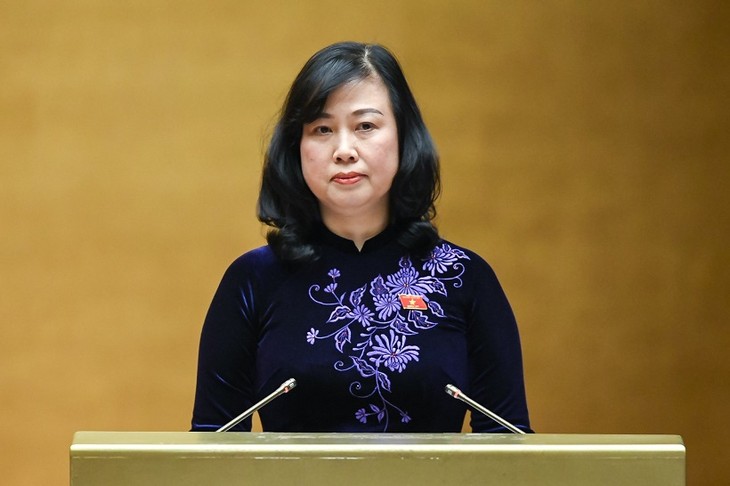 Minister of Health Dao Hong Lan (Photo: VGP) Minister of Health Dao Hong Lan (Photo: VGP) |
Expanding healthcare benefits, reducing medical costs
What people most expect from the new healthcare policies is easier access to medical services, lower costs, and higher-quality healthcare professionals. These priorities were enumerated by National Assembly deputies during debates on the draft resolution. Deputies proposed expanding access to high-quality healthcare services, making health insurance benefits more transparent, and standardizing specialist medical training in line with international practice.
Deputy Nguyen Anh Tri of Hanoi said: “This represents the State’s commitment to improving healthcare services by providing financial support and ensuring that every citizen receives one free health check-up per year. This is an opportunity to enhance the quality of medical care. The adoption of advanced medical technologies, digital transformation, and modern diagnostic and treatment protocols will elevate Vietnam’s healthcare standards to match those of developed countries. It’s time to remove barriers so that insured patients can receive medical services at any accredited facility.”
 (Illustrative photo: VGP) (Illustrative photo: VGP) |
Several deputies stressed the need to expand policies supporting private healthcare development, enabling efficient mobilization and use of resources for the sector. Over the past 30 years, private healthcare has made substantial and valuable contributions, yet it still accounts for only 7% of total hospital beds nationwide. Today, private providers deliver 14.55% of medical services, a modest figure compared to Germany (25%), France (35%), Australia (40%), the United States (80%), or Japan (over 80%).
Vietnam has an opportunity of restructuring its healthcare system on a scale unprecedented in decades. These two closely linked resolutions pave the way for the health sector to enter a new development phase to become modern, transparent, internationally aligned, and centered on the needs of the people.
If implemented decisively, the two resolutions could become a major policy breakthrough that enables more than 100 million Vietnamese citizens to benefit from a healthcare system that is better, safer, and more equitable.