(VOVWORLD) - As the world grapples with the impacts of climate change and growing competition over green standards, Vietnam cannot stand on the sidelines. Both the draft Political Report for the 14th National Party Congress and discussions at the just concluded Autumn Economic Forum in Ho Chi Minh City highlight a clear trend, that the green economy is emerging as a pillar of Vietnam’s national development strategy. It is a strategic choice to ensure the country does not fall behind and can adapt to mounting global economic pressures.
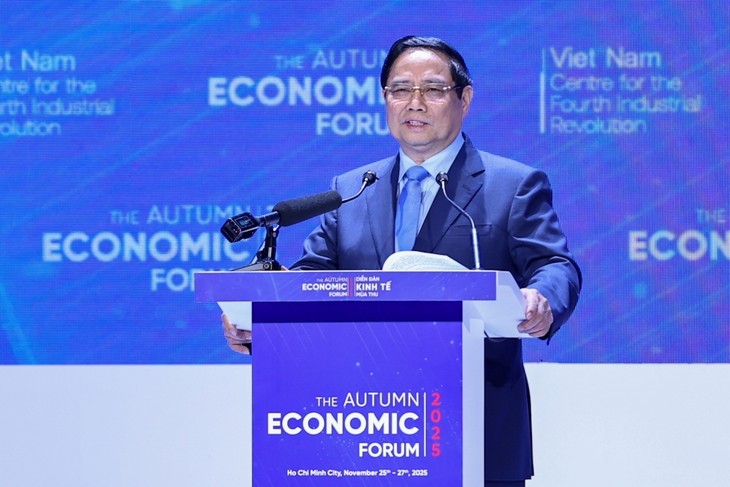 Prime Minister Pham Minh Chinh affirms Vietnam's consistent viewpoints in the process of "green transformation in the digital age" at the Autumn Economic Forum 2025. (Photo: VGP/Nhat Bac) Prime Minister Pham Minh Chinh affirms Vietnam's consistent viewpoints in the process of "green transformation in the digital age" at the Autumn Economic Forum 2025. (Photo: VGP/Nhat Bac) |
Transitioning to a green economy offers Vietnam a new growth momentum while safeguarding its competitive position in the decade ahead.
Green economy – a new driver of development
In the draft documents for the 14th National Party Congress, the green economy is not mentioned merely as a reference concept. It’s positioned as a new growth engine, closely linked with the three development pillars of digital transformation, innovation, and improved growth quality.
The draft documents identify three major directions for national development –the green economy, the circular economy, and the knowledge-based economy.
The goal of achieving net-zero emissions by 2050 is being translated into concrete policy tools, including a carbon tax, a carbon market, and green standards for public investment. Growth quality is prioritized over quantity, with a focus on high-tech industries, renewable energy, and clean production.
These shifts show that the Party recognizes an urgent reality – that if Vietnam aims to join the group of high-income countries by 2045, it can’t continue on the old development path.
In discussions with domestic and international companies and global partners at the 2025 Autumn Economic Forum, Prime Minister Pham Minh Chinh underscored the importance of green transition.
The Prime Minister said: “Green transition in the digital era is an inevitable trend, a strategic choice, an objective requirement, and a top priority for nations seeking rapid and sustainable development. We are committed to close cooperation with partners and enterprises for mutual growth.”
Vietnam possesses immense “green potential” that’s rare in the region, with an offshore wind power capacity of 600 GW, solar energy exceeding 300 GW, and green economic sectors projected to contribute 10-12% of GDP by 2030.
Much of this potential remains untapped, though. Many renewable energy projects have stalled due to incomplete legal frameworks and inadequate transmission infrastructure. Green investment capital is still limited, and the cost of green transition continues to rise. Without timely reforms, Vietnam risks missing the window of opportunity as global competition in clean technology and green standards intensifies.
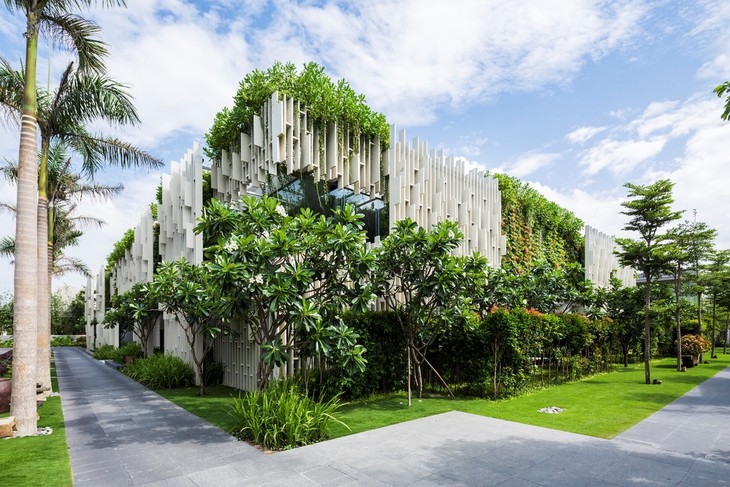 Green transformation in construction projects is always one of urgent issues. (Photo: vietnamarchi.vn) Green transformation in construction projects is always one of urgent issues. (Photo: vietnamarchi.vn) |
Strategic pathway forward
For Vietnam’s green transition to succeed, it must become a unified national strategy. The first priority is institutional reform, building a coherent legal framework for the circular economy, digital data, carbon emissions, and green finance that will enable businesses to invest with long-term confidence.
At the same time, the State must act as chief architect, guiding and shaping development. A transparent, open mechanism that encourages creativity will lay the foundation for green economic growth.
Digital infrastructure and green infrastructure must be developed as an integrated system.
Human capital is equally critical. Green and digital transformation requires a shift in mindset. Vietnam plans to train a workforce capable of working with data and artificial intelligence while upholding professional ethics and ecological responsibility.
Sustainable development doesn’t mean slowing down. In fact, it’s a way to move faster and farther once the foundation is solid. With strengthened institutions, digitized and greened infrastructure, and upgraded human resources, Vietnam can break through by following its own pathway: green, high-tech, knowledge-driven, and innovation-led development.
Globally, economic structures are being reshaped around two new standards: green and digital. Nations that lead on these two fronts will become centers of the new global value chain.
The draft Political Report for the 14th National Party Congress and recommendations from the 2025 Autumn Economic Forum converge on one message: the green transition is an investment in the future. If Vietnam seizes this opportunity, it can become a hub for renewable energy, attract large flows of green finance, and build a model of high-productivity and clean, sustainable growth.
In a decade marked by uncertainty, choosing green is the way to move, not just quickly, but far and in the right direction.