Awareness changes
At Sa Huynh Border Guard Station in Quang Ngai province, the “IUU prevention loudspeaker communication model” has brought about a positive change in fishermen’s compliance with regulations on marine resource exploitation.
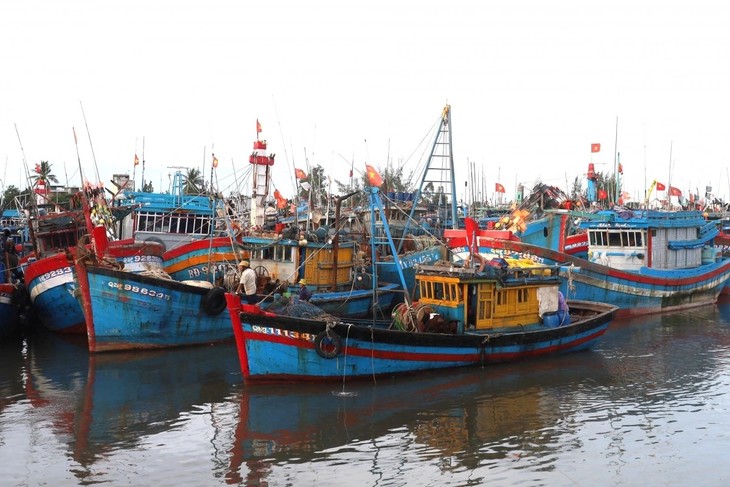 Fishing boats at Tinh Hoa fishing port, Quang Ngai province (Photo: Thanh Thang/VOV) Fishing boats at Tinh Hoa fishing port, Quang Ngai province (Photo: Thanh Thang/VOV) |
The legal regulations on IUU fishing broadcast from the Border Guard loudspeakers are remembered word for word by Mrs. Vo Thi Hong Hai, a resident of Duc Pho commune, Quang Ngai province. After each work shift at the port, she comes home and repeats the words of the broadcast to her husband. As a result, their family’s fishing boat sets a good example by strictly complying with the regulations on marine exploitation.
"I hear it all the time, so now I can pass the message on to my husband: we must not fish illegally in foreign waters. When we return from a trip, we have to submit the documents and ensure that our vessel’s tracking system is operating," said Mrs. Vo Thi Hong Hai.
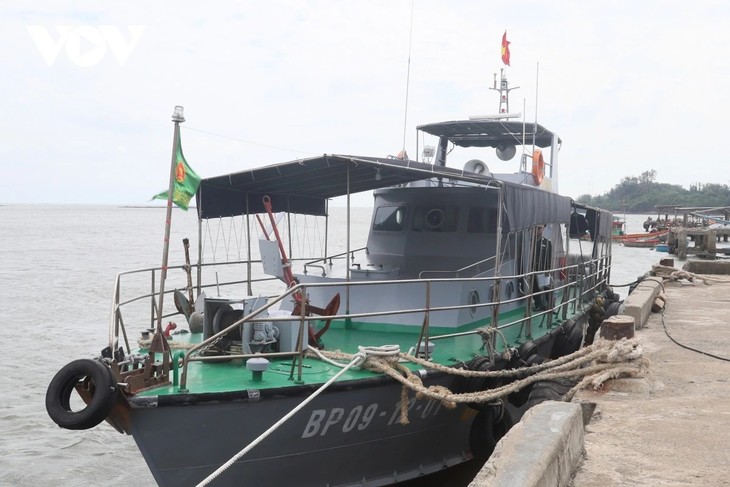 Ship BP-09-12-01 of Border Guard Squadron 2, Military Command of Quang Ngai province, is ready for the task of combating IUU fishing (Photo: Thanh Thang/VOV) Ship BP-09-12-01 of Border Guard Squadron 2, Military Command of Quang Ngai province, is ready for the task of combating IUU fishing (Photo: Thanh Thang/VOV) |
In addition to the loudspeaker communication model, border guard forces nationwide conduct patrols, distribute leaflets, and explain directly to the fishermen that failing to keep logbooks and crossing maritime boundaries harms themselves, the entire fisheries sector, and Vietnam’s reputation. In the past, many fishermen thought that keeping a logbook and turning on the vessel monitoring system were cumbersome formalities. Now they understand its importance and their own responsibility for it.
"Nowadays, fishermen going out to sea must have a vessel registration certificate, a fishing permit, a vessel monitoring system, a positioning device, long-range communication… everything must operate smoothly. Unlike in the past, fishermen now have to take responsibility and equip themselves with all the necessary devices and knowledge," said a fisherman.
"We’re fishermen working at sea and we comply with the regulations set by the government. When harvesting seafood, we follow the recommendations and only fish in designated waters, without crossing boundary lines. With the government creating favorable conditions, we’ll continue to go offshore, stay at sea, and contribute to safeguarding Vietnam’s maritime sovereignty," said a fisherman.
“Our vessel reports to the Border Guard every time we go out to sea, and I always attend the fishermen’s meetings. Now, with full vessel monitoring in place, no one dares to fish illegally in restricted areas. Compliance is very good," said a fisherman.
"I have to keep a logbook for each fishing trip so that when I return to shore, I can present it to the Border Guard at the fishing port. This makes it easier to sell seafood at the port, and the vessel monitoring device operates 24/7," said a fisherman.
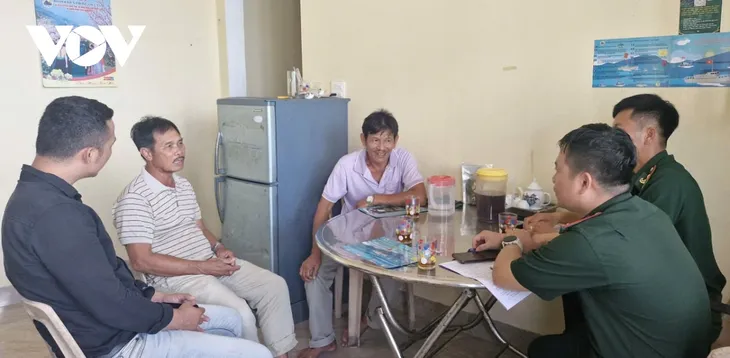 Bui Van An (second from left) is persuaded by officers of Nhon Ly Border Guard Station to bring the ship back to the dock to wait for deportation. (Photo: Nguyen Thao/VOV) Bui Van An (second from left) is persuaded by officers of Nhon Ly Border Guard Station to bring the ship back to the dock to wait for deportation. (Photo: Nguyen Thao/VOV) |
An offshore fisherman for over 36 years, Mr. Bui Van An, 60, of Ly Hoa village, Quy Nhon Dong ward, is one of 424 vessel owners in Gia Lai province who had to suspend operations because they did not meet the conditions to go to sea. Mr. An understands that if he were to go to sea anyway, not only would he face fines and a possible suspension, he would also harm Vietnam’s reputation and slow the efforts to have the “yellow card” removed.
"My vessel’s condition is such that the engine cannot be certified, so I cannot go fishing and have to suspend operations. That’s why I comply. I just keep the boat at the dock," said Mr. Bui Van An.
Since the beginning of 2025, coastal border guard stations have launched a nationwide campaign to inspect and tighten the management of fishing vessels, taken measures to prevent IUU fishing in accordance with regulations. Border guard units have assigned commanders and officers to directly participate in IUU prevention and control teams in coastal communes and wards.
They have coordinated with local authorities to raise awareness and encourage fishermen to strictly comply with the law. At the same time, inspection and supervision have been strengthened at border control stations, decisively refusing departure procedures for “three-no” vessels (no registration, no certification, and no fishing permit). Lieutenant Colonel Nguyen Quoc Hiep, Political Commissar of Nhơn Lý Border Guard Station, Gia Lai Border Guard Command, stated: " We encourage local people, especially vessel owners and captains, to sign commitments. For vessels that do not meet the requirements, we firmly refuse to process departure procedures. Because of this, over the past period, there have been no cases of IUU fishing violations in the maritime areas under our management."
Alongside the aggressive actions of the authorities, fishermen themselves have also promoted a sense of self-discipline, jointly monitoring compliance with regulations. Fisherman Huynh Minh Kiem from Đề Gi Commune, Gia Lai, together with other fishermen in the commune, participates in solidarity maritime teams, reminding one another to maintain sustainable fishing practices.
"Do not fish beyond the boundaries, fish properly, and never engage in illegal fishing. Seafood caught in foreign waters cannot be exported and seriously damages our reputation. Local people and I strictly comply with IUU prevention regulations and dare not fish in foreign waters," said Mr. Kiem.
In many fishing grounds, fishermen actively keep their VMS devices on around the clock, regularly monitor maritime boundaries, stay updated on new regulations, and strictly follow the guidance of the Border Guard, Coast Guard, and Fisheries Surveillance. Many fishermen share that they now have a clearer understanding of their responsibilities in protecting marine resources. Fishing in the correct areas and within allowed quotas not only helps avoid IUU violations but also preserves fishing grounds for future generations.
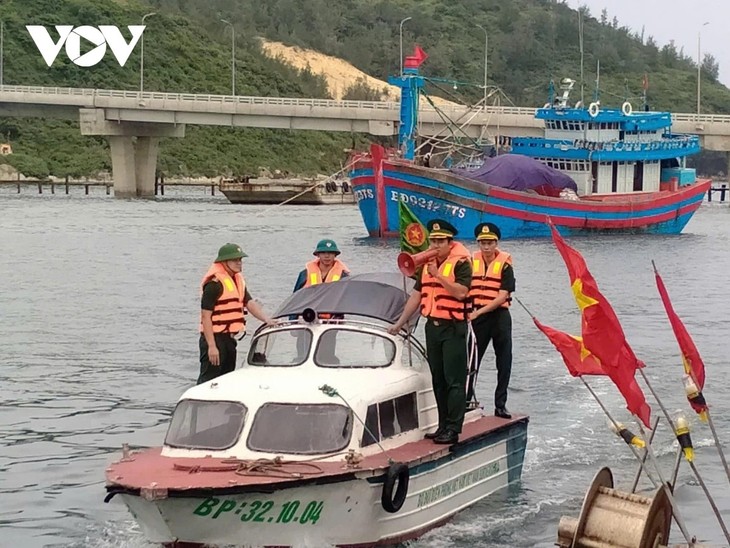 Gia Lai Border Guard carrying out a peak campaign to educate fishermen about IUU fishing. (Photo: Thanh Binh/VOV) Gia Lai Border Guard carrying out a peak campaign to educate fishermen about IUU fishing. (Photo: Thanh Binh/VOV) |
Moreover, fishermen also recognize practical benefits from compliance: safer trips at sea, easier access to assistance in emergencies, and smoother sales of products to businesses requiring transparent traceability.
From awareness to action, these positive changes among fishermen are becoming a crucial foundation contributing to the common goal: the determined removal of the EC’s “yellow card” and the development of a responsible, modern, and sustainable fishing industry.
The recent clear changes in fishermen’s awareness of IUU fishing prevention have been strongly supported by the Navy, Coast Guard, Border Guard, and Fisheries Surveillance. VOV talked to Colonel Dao Ba Viet, Deputy Chief of Staff of the Vietnam Coast Guard about the Coast Guard’s role.
Reporter: One of the key factors in addressing IUU fishing is changing fishermen’s awareness. How does the Vietnam Coast Guard carry out awareness-raising and communication activities for fishermen?
Colonel Dao Ba Viet: As the core force in combating IUU fishing at sea, we, together with other units of the armed forces, strictly implement directives, resolutions, and guidance from the Prime Minister, the Ministry of National Defense, and the Vietnam Coast Guard Command. We actively enforce coordination mechanisms between the Coast Guard and other forces. At the same time, we work closely with local authorities and media agencies to strengthen legal education and public awareness, especially for coastal fishing communities, regarding legal fishing areas, IUU prevention regulations, and other relevant legal provisions, including penalties for violations. This helps raise fishermen’s legal awareness.
It takes more than decisive action from central authorities and relevant sectors. The fishermen themselves must understand that this is about their survival. It’s not just a response to an EC inspection. Removing the IUU “yellow card” is the first step toward developing a sustainable fisheries industry.
Reporter: Vietnam has been preparing for the upcoming EC inspection in hopes of having the IUU “yellow card” lifted. What has the Vietnam Coast Guard been doing?
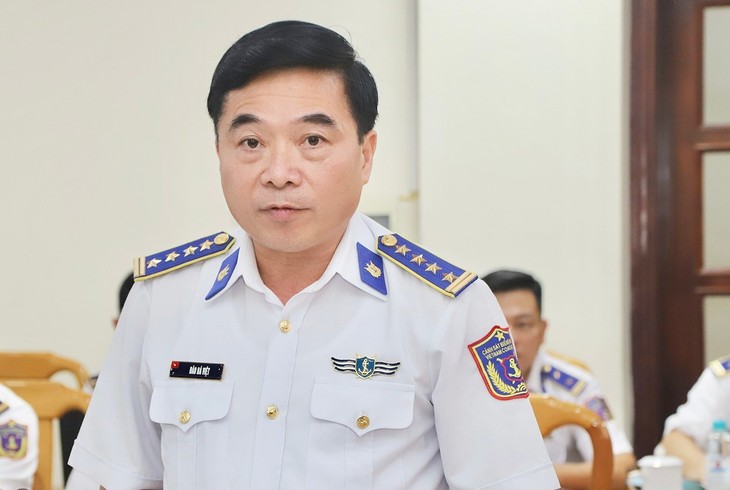 Colonel Dao Ba Viet, Deputy Chief of Staff of the Vietnam Coast Guard. (Photo: baohatinh.vn) Colonel Dao Ba Viet, Deputy Chief of Staff of the Vietnam Coast Guard. (Photo: baohatinh.vn) |
Colonel Dao Ba Viet: This EC inspection is considered a golden opportunity to have the yellow card lifted. Vietnam has been trying hard to implement the EC’s recommendations: improving the legal framework for fisheries management, taking strong measures to prevent illegal fishing in foreign waters, ensuring the traceability of seafood, handling IUU violations, raising public awareness, and strengthening coordination among forces.
Together with the entire political system, the Vietnam Coast Guard is taking responsibility, showing determination, and playing a core role in combating IUU fishing. We have implemented many effective coordinated solutions:
First, we have strengthened coordination in information dissemination and legal education to raise public awareness, especially among fishermen, about the harms of IUU fishing, the benefits of compliance, and the regulations and penalties for violations.
Second, we have enhanced the coordination capacity and responsibility of local authorities, media agencies, and relevant forces to create a closed-loop system for managing, monitoring, overseeing, and inspecting fishing vessels from shore to offshore, ensuring that 100% of operating vessels are tracked and monitored at sea.
Third, we maintain patrol and control forces in the field, strictly supervise vessel activities, have increased monitoring, detect vessels that have lost connection with their monitoring device, inspect vessels, deal strictly with vessels that violate IUU regulations, and prevent vessels from crossing into neighboring countries’ waters to fish illegally.
Fourth, we coordinate with local authorities and relevant forces to strictly control vessels entering and leaving ports, rivers, estuaries, and channels, particularly “three-no” vessels (vessels with no registration, no certification, and no fishing permit) that have been away from their home ports for a long time. We also cooperatively investigate and handle IUU-related violations to ensure strong deterrence.
Fifth, we organize joint operations with local authorities and units across the armed forces to conduct peak campaigns to strengthen IUU prevention.
Sixth, we launch emulation campaigns to combat IUU fishing throughout the Coast Guard force.
Reporter: What technologies does the Vietnam Coast Guard use to monitor fishing vessels and prevent IUU fishing?
Colonel Dao Ba Viet: The Vietnam Coast Guard uses modern monitoring technologies, intelligent data analysis, and other equipment on Coast Guard vessels, at Coast Guard command centers, and within units to track, monitor, and deal with IUU violations.
At Vietnam Coast Guard command centers, multiple data sources are integrated, regularly analyzed, cross-checked, and used to identify groups of vessels showing signs of violations or at high risk of violating regulations. Based on these analyses, we direct the command centers to share vessel information with patrol units at sea for timely inspection, verification, and handling.
Equipment such as long-range radar allows detection and positioning of targets during the day or night, and in complex weather conditions. Day-and-night infrared cameras record and monitor vessel activities at sea, and installed IOS systems detect and track surrounding vessels. With these tools, Coast Guard patrol and control units can quickly grasp the situation of nearby vessels, approach to identify violations, and promptly handle them on-site.
In the near future, we will continue upgrading electronic reconnaissance systems and improving big data analysis infrastructure, combining satellite technology, UAVs, and artificial intelligence (AI) to enhance monitoring capacity, identify IUU violations, protect maritime sovereignty, ensure security and safety in Vietnamese waters, and support the sustainable development of Vietnam’s fisheries.
Reporter: Thank you very much!
Determination to get IUU Yellow Card lifted and develop sustainable fisheries
uAt major fishing ports across the country, such as Quy Nhon, Ca Mau, Phú Yen, and Kien Giang, the management of vessel entry and exit, logbook recording, monitoring devices, and fishing permits, as well as seafood traceability procedures—including tracking, labeling, and confirming catch volumes—are carried out smoothly and effectively.
Nationwide, the rate of fishing vessels registered and updated in the national fisheries database has reached approximately 99.8% to 99.9% of the nearly 80,000 vessels. About 96.11% of over 77,000 licensed vessels have been issued fishing permits. Many provinces and cities have completed 100% of vessel marking and issuance of fishing permits.
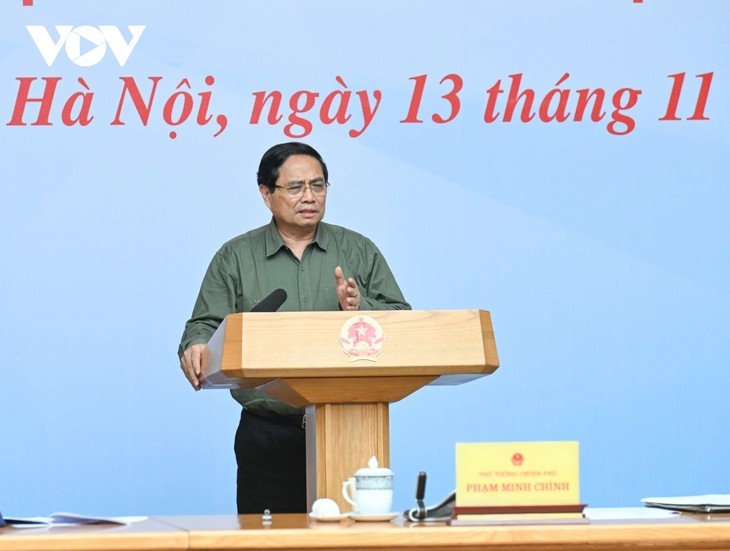 Prime Minister Pham Minh Chinh speaking at the meeting on November 13, 2025 (Photo: Lai Hoa/VOV) Prime Minister Pham Minh Chinh speaking at the meeting on November 13, 2025 (Photo: Lai Hoa/VOV) |
This represents a major effort by the entire political system, with Prime Minister Pham Minh Chinh directly instructing and presiding over weekly meetings with ministries and agencies. At the meeting held on November 13, the Prime Minister emphasized the following requirements: "The heads of ministries, sectors, and localities are held fully and directly accountable to the Government and the Prime Minister if fishing vessel violations recur or if progress in removing the IUU yellow card is delayed. Focus intensely on leadership and aggressively implement the peak month for IUU prevention, immediately put an end to violations at all costs, and build responsible, traceable fishing practices for the sustainable development of Vietnam’s fisheries, for the nation’s honor, and for the benefit of the people."
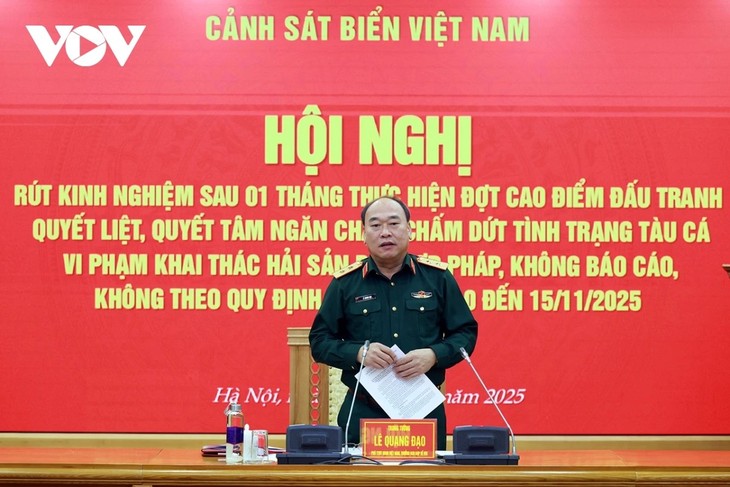 Lieutenant General Le Quang Dao, Deputy Chief of the General Staff of the Vietnam People's Army, speaks at a conference on combating IUU fishing, November 15, 2025. (Photo: Ha Phuong/VOV) Lieutenant General Le Quang Dao, Deputy Chief of the General Staff of the Vietnam People's Army, speaks at a conference on combating IUU fishing, November 15, 2025. (Photo: Ha Phuong/VOV) |
Alongside government directives, the application of technology and digital transformation has improved the effectiveness of IUU control. Viettel Military Industry and Telecom Group has strongly deployed vessel monitoring systems and positioning solutions, integrating data from local to central levels. The digital platform provided by Viettel allows real-time updates of fishing vessel journeys and issues alerts when a vessel loses signal or risks crossing maritime boundaries.
Deputy Chief of General Staff of the Vietnam People’s Army, Le Quang Dao, said: "Viettel Group, working with the Border Guard and the Ministry of Agriculture and Environment, has digitized all existing vessel data. Simultaneously, they are collaborating with the Ministry of Public Security to continue digitizing VneID data to fully control vessel entry and exit through electronic declarations at fishing ports."
Viettel’s data digitization process helps modernize fisheries management and enables Vietnam to take initiative in enhancing its monitoring capacity and gradually meeting all EC recommendations on combating IUU fishing.
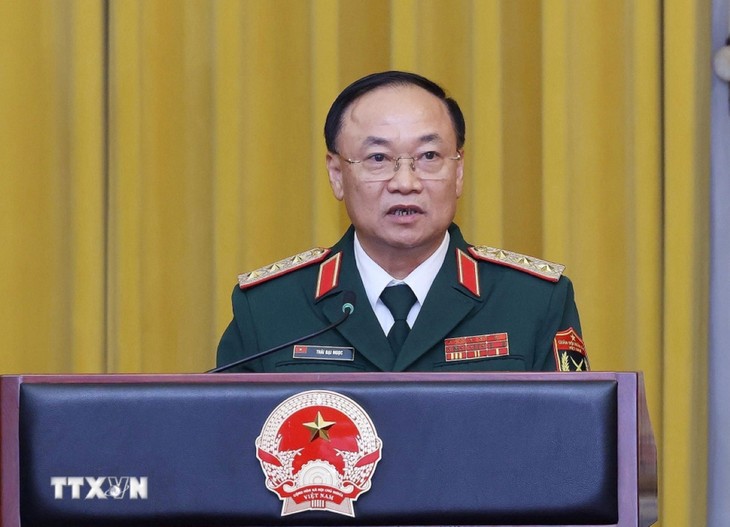 Senior Lieutenant General Thai Dai Ngoc, Deputy Chief of the General Staff of the Vietnam People's Army, Head of the Ministry of National Defense's Steering Committee on combating IUU fishing. (Photo: VNA) Senior Lieutenant General Thai Dai Ngoc, Deputy Chief of the General Staff of the Vietnam People's Army, Head of the Ministry of National Defense's Steering Committee on combating IUU fishing. (Photo: VNA) |
For maritime enforcement forces, the “Coast Guard accompanying fishermen” program is now entering its ninth year and has shown clear results. Through awareness-raising activities, fishermen gain confidence to go offshore and remain at sea, contributing to the protection of national security and maritime sovereignty.
Lieutenant General Thai Dai Ngoc, Deputy Chief of General Staff of the Vietnam People’s Army and Head of the Ministry of National Defense’s Steering Committee on IUU Prevention and Control, told VOV: "The Army closely coordinates with local authorities and relevant forces to strengthen communications and legal education, helping vessel owners, captains, and fishermen to be aware of and comply with the Party’s guidelines and State laws. We lead and coordinate with the Border Guard and Coast Guard to strictly manage “three-no” vessels (no registration, no certification, and no fishing permits), ensuring these vessels are not allowed to operate."
Joining other forces in achieving the goal of EC yellow card removal, coastal localities have worked on solutions such as offering career transition policies and decommissioning vessels that are no longer needed for fishing; issuing support policies for fishermen who own vessels that no longer meet fishing requirements or cannot continue operations; and reviewing and cleaning up vessel data in the national fisheries database.
The seamless coordination between military forces and local authorities is creating a combined strength that significantly reduces violations, strengthens fisheries management discipline, and reinforces fishermen’s trust as they venture offshore, contributing collectively to the EC’s IUU yellow card removal in the near future.
IUU fishing is not only a matter of the fisheries sector but also directly affects maritime security, national reputation, and the interests of the people. Combating IUU is a shared responsibility of the entire political system, with the military serving as the key force ensuring security, safety, sovereignty, and order at sea. The military’s involvement has sharply reduced violations, contributed to protecting sovereignty, stabilized fishing grounds, and created a safe and sustainable environment for fishermen to carry out long-term operations.