(VOVWORLD) - The 14th National Congress of the Communist Party of Vietnam will open a new era of development for Vietnam. In order to successfully carry out the key tasks set out by the 14th National Party Congress, localities have rolled out specific activities and expanded development space following administrative boundary mergers.
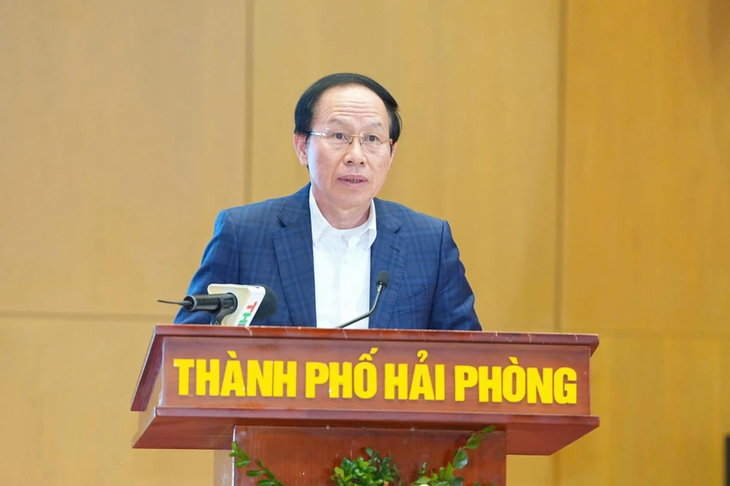 Le Tien Chau, Secretary of the Hai Phong municipal Party Committee, speaks at the conference reviewing socio-economic development tasks in 2025 and outlining tasks for 2026, January 9, 2026. (Photo: plo.vn) Le Tien Chau, Secretary of the Hai Phong municipal Party Committee, speaks at the conference reviewing socio-economic development tasks in 2025 and outlining tasks for 2026, January 9, 2026. (Photo: plo.vn) |
Last year, at the Party Congresses at all levels, localities set out comprehensive development targets in alignment with the country’s breakthrough growth orientations in the new period.
Consolidating the foundation
Hai Phong city, a key growth pole in northern Vietnam, is prioritizing the implementations of the Resolution of the 14th National Party Congress, aiming to consolidate of its role as an industrial production hub and a vital link in national and regional supply chains.
Last year, Hai Phong’s economy continued to affirm its leading position with GRDP growth reaching 11.81%, ranking second nationwide and marking the 11th consecutive year of achieving double-digit growth.
To date, Hai Phong has attracted 1,034 foreign direct investment (FDI) projects in its economic zones and industrial parks, with total registered capital of 43 billion USD.
The National Assembly’s Resolution on special mechanisms for Hai Phong gives it greater autonomy in land and budget management, serving as a “golden key” for the city to make breakthroughs in infrastructure and institutions.
Le Tien Chau, Secretary of the Hai Phong municipal Party Committee, said: “We are fully aware that Hai Phong’s development is not just its own story. We have closely built on existing growth drivers while unlocking new ones, carefully calculating resources. On that basis, we aim to increase Hai Phong’s GRDP growth to 13% or higher, at 14% during the 2026-2030 term.”
Hai Phong is transforming decisively to strengthen its fundamental advantages. The Southern Coastal Economic Zone covering over 20,000 hectares, the Free Trade Zone, deep-water ports at Lach Huyen, and 12 industrial parks established last year have generated outstanding advantages for the city in attracting investment.
Pham Van Thep, Head of the Hai Phong Economic Zone Management Board, said: “We have detailed planning for the coastal Dinh Vu-Cat Hai Economic Zone and the Southern Hai Phong Coastal Economic Zone, aiming to open up significant development space and potential for large-scale projects. Hai Phong has submitted to the Government a proposal of a 5,300-ha specialized economic zone in western part of the city, oriented to host specialized industries such as artificial intelligence applications, robotics, and pharmaceuticals.”
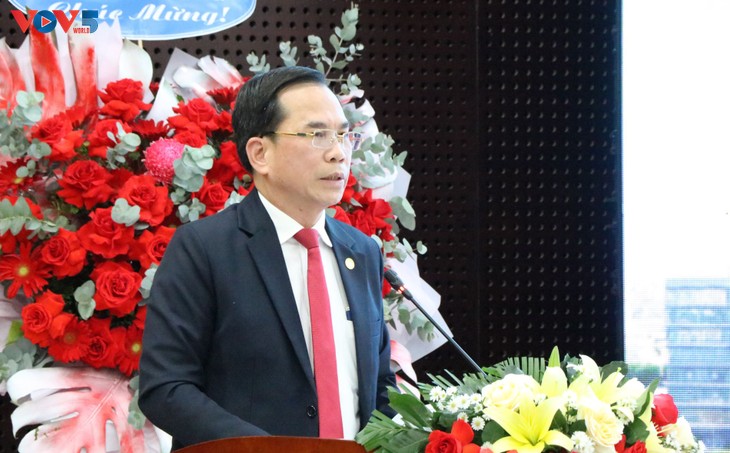 Nguyen Thanh Hong, Director of the Da Nang Department of Science and Technology, addresses the conference January 7, 2026, reviewing science, technology, innovation and digital transformation activities in 2025 and setting tasks for 2026. (Photo: Vinh Thong/VOV-Central Region) Nguyen Thanh Hong, Director of the Da Nang Department of Science and Technology, addresses the conference January 7, 2026, reviewing science, technology, innovation and digital transformation activities in 2025 and setting tasks for 2026. (Photo: Vinh Thong/VOV-Central Region) |
Establishing new growth drivers
For many other provinces and cities, the expanded development space following administrative boundary mergers has created new growth drivers. Following its merger of Soc Trang and Hau Giang provinces, the new Can Tho city has identified industrial development as a priority in the coming period.
Nguyen Van Hoa, Vice Chairman of the Can Tho municipal People’s Committee, said the city will accelerate industrial park planning, particularly the establishment of the Tran De Economic Zone, to make it a new development driver. This year, Can Tho will establish three new industrial parks and support the commencement and operation of six projects.
Mr. Hoa said: “The new development space of Can Tho city has now been zoned, with five economic regions and six socio-economic corridors defined based on the city’s current scale. We’ll also focus on developing agriculture, industry, urban areas, tourism, healthcare, education, science and technology, and logistics. Infrastructure development will focus on aviation infrastructure, railways, inland waterways, maritime routes, and ports.”
In the central region, the National Assembly’s Resolution on piloting specific mechanisms and policies for Da Nang city is the foundation for the city to establish new growth drivers based on innovation, the knowledge economy, technology, and high-quality human resources. The city aims to build a world-leading startup and innovation ecosystem, have at least one technology unicorn, and establish around 500 innovative startups.
Nguyen Thanh Hong, Director of the Da Nang Department of Science and Technology, said: “Da Nang is promoting innovative technologies in areas such as smart cities, healthcare, education, logistics, and tourism, forming a national innovation hub, and an AI testing center in the high-tech park, aiming to build a long-term, sustainable ecosystem in terms of human resources, science and technology, and innovation. Da Nang aims to become a leading growth and innovative startup hub of the country and even the region.”
The 14th National Party Congress is expected to open a new, comprehensive phase of national development, in which each province and city with its own strategic development space will tap into their strong potential to rise in the new era.