(VOVWORLD) - Prime Minister Pham Minh Chinh on Monday held separate meetings with Thai Prime Minister Anutin Charnvirakul and Philippine President Ferdinand Romualdez Marcos Jr. on the sidelines of the 47th ASEAN Summit in Malaysia.
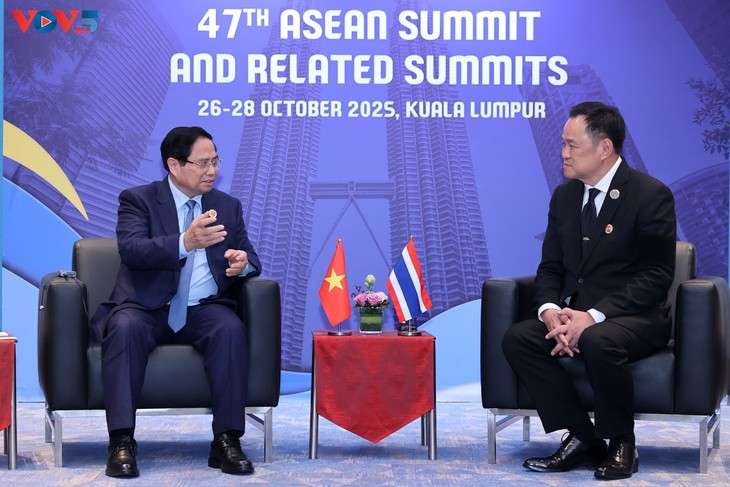 Prime Minister Pham Minh Chinh and Thai Prime Minister Anutin Charnvirakul (photo: VOV) Prime Minister Pham Minh Chinh and Thai Prime Minister Anutin Charnvirakul (photo: VOV) |
During his meeting with his Thai counterpart, Prime Minister Chinh proposed the two sides raising bilateral trade turnover to 25 billion USD in a balanced manner by facilitating greater market access and resolving trade obstacles. He also suggested exploring joint ventures to control prices, expand into new markets, and strengthen mutually beneficial cooperation, especially in adopting advanced technologies in oil and gas and liquefied natural gas exploitation.
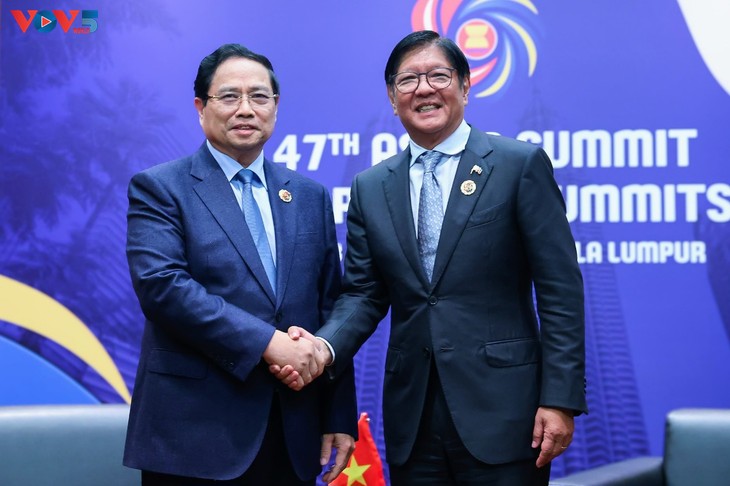 Prime Minister Pham Minh Chinh and Philippine President Ferdinand Romualdez Marcos Jr. (photo: VOV) Prime Minister Pham Minh Chinh and Philippine President Ferdinand Romualdez Marcos Jr. (photo: VOV) |
At his meeting with President Ferdinand Romualdez Marcos Jr., Prime Minister Chinh suggested enhancing high-level and all-level delegation exchanges, tap into potential cooperation areas such as digital transformation, food processing technology, high-tech agriculture, and infrastructure; explore supply chain cooperation based on each country’s strengths, including developing an ASEAN regional ecosystem for electric vehicle and battery production; and strengthen rice trade cooperation toward signing a long-term agreement to help ensure food security.
Both the Thai Prime Minister and Philippines President affirmed to coordinate and assist Vietnam in enhancing its illegal, unreported, and unregulated (IUU) fishing prevention capacity and support efforts to have the European’s “yellow card” removed.
The two leaders also agreed to strengthen cooperation and maintain solidarity and unity within ASEAN; promote ASEAN’s central role in addressing regional and international issues, including the sustainable management and use of the Mekong River’s water resources; and ensure peace, stability, security, safety, and freedom of navigation and overflight in the East Sea in line with international law, including the 1982 UN Convention on the Law of the Sea (UNCLOS). They also reaffirmed the need to fully and effectively implement the Declaration on the Conduct of Parties in the East Sea (DOC) and work toward an early conclusion of a Code of Conduct (COC) in the waters.