(VOVWORLD) - For 80 years, the radio waves of the Voice of Vietnam have resonated steadily, carrying the rhythm of the nation’s life to millions of listeners. Behind this perseverance are the quiet individuals who treat the technical room as their second home, and the waves as their very breath. Let’s step behind the scenes, where the technicians of VOV keep the signal beaming day and night.
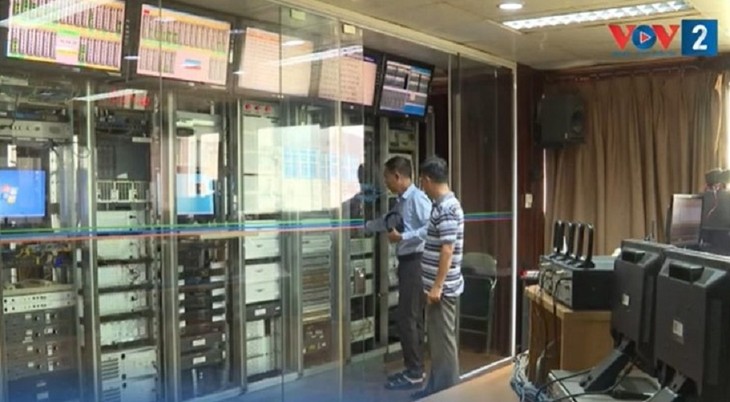 Technicians at VOV's Program Production and Archive Center. (Photo: VOV2) Technicians at VOV's Program Production and Archive Center. (Photo: VOV2) |
“Our work requires very precise timing, no matter the weather, we must always be at the office on time, making sure VOV’s waves remain absolutely safe,” said a female technician.
“I have worked at Pha Đin station for more than 15 years. It’s a remote location, covered in clouds all year round, making our travel difficult. My colleagues and I have to overcome these challenges to accomplish the tasks assigned to us,” another technician explained.
A third technician added: “When two people are on duty, we divide the work. One looks after one part, whilst the other takes care of another. We support each other and try to improve our skills.”
The three technical staff gave a glimpse into the kind of work they face at VOV. Adjusting audio signals with care or spending long nights alone with the equipment reveals their deep sense of dedication and responsibility.
At VOV’s Program Production and Archive Center, more than 100 engineers and technicians monitor the waves around the clock. According to Huynh Thang Long, Deputy Director of the Center, the workload is immense because radio programs must be produced daily for the Editorial Boards.
Once production is completed, the audio files are transferred to the transmission team for scheduling, then passed on to the master control room—the final stage of sound quality control before reaching listeners.
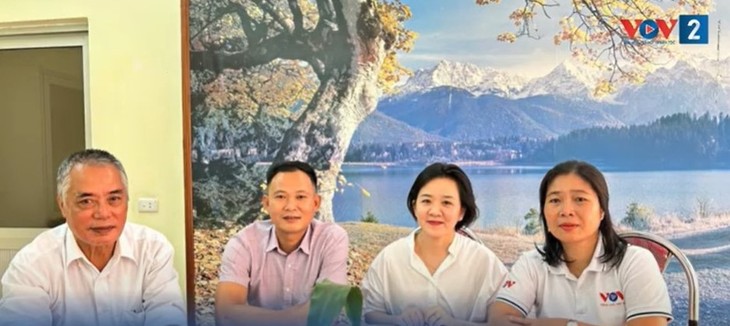 Reporter Pham Trang (second from right) talks with technicians at VOVWorld. (Photo: VOV2) Reporter Pham Trang (second from right) talks with technicians at VOVWorld. (Photo: VOV2)
|
“The greatest pressure for us is keeping the transmission uninterrupted and ensuring signal quality. Every engineer and technician must pay utmost attention to the smallest detail in program production and broadcast,” said Huynh Thang Long.
The daily work of the technical staff shows the weight of their responsibility. Just one small mistake could interrupt the broadcast signal, requiring technicians to respond quickly and precisely.
While notifying the studios to process the program, Bui Thi Thu Phuong, Head of the Sound Transmission Team, adjusted the airtime down to the exact second. “During a 4:45 to midnight schedule, a technician must arrange programs and the selected music so that every section runs on time. If there is a problem, it must be fixed within 10 seconds,” she said.
After programs are scheduled, the radio signal goes to the master control room, where technicians manage all program signals to ensure smooth, quality transmission.
“We manage 21 radio channels operating around the clock. The waves must be continuous, without interruption. The work is demanding and never simple,” said Bui Quoc Sung, Head of the control room with more than 20 years of experience.
Alongside the automatic system, master control room technicians constantly monitor the clocks displaying the signals of the radio channels, ready to react instantly to avoid signal loss.
Beyond their daily routines with complex machinery, the staff of the Program Production and Archive Center also handle signal recording and transmitting of major national political events - most recently the live broadcast marking the 80th anniversary of the August Revolution and National Day on September 2 at Ba Dinh Square.
“When equipment fails - for example, when the server system has problems - it takes technicians and engineers to fix it immediately. Our job is always to ensure airwave safety. No matter how advanced technology becomes, people remain the most important link in the chain of a radio station’s activity,” said Deputy Director Huynh Thang Long.
Every news bulletin, every program broadcast on the national airwaves reflects the effort and sense of duty of these unsung individuals. They may not be seen by the public, but they are the ones who keep the national radio beat steady and continuous.