(VOVWORLD) - The longhouse is a symbol of the matrilineal family structure of the E De ethnic minority people in Dak Lak province. It’s a shared living space for the extended family and clan, and a space where the sounds of gongs, songs, epics, and other cultural values of the E De are preserved.
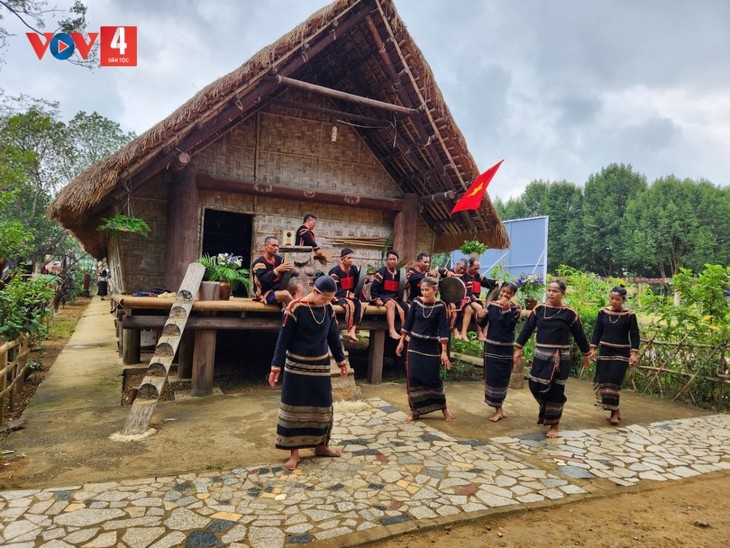 E de villagers gather in front of a longhouse. (Photo: Lam Thanh/VOV4) E de villagers gather in front of a longhouse. (Photo: Lam Thanh/VOV4) |
During a house warming ceremony in Tan Lap ward, the family of Y Yen Mlo performed a thanksgiving ritual, offering a male pig and five jars of rice liquor.
Shaman Ae Ti said building a longhouse is a ritual that connects humans with deities and enhances the community bond. To the sound of gongs, blessings are shared and the villagers celebrate together.
“The construction of a new longhouse must follow certain customs. We must perform a thanksgiving ritual for the deities and prepare a meal for the neighbors who come to help us celebrate. We believe the deities will bless our family with good health and prosperity only if we do this,” he explained.
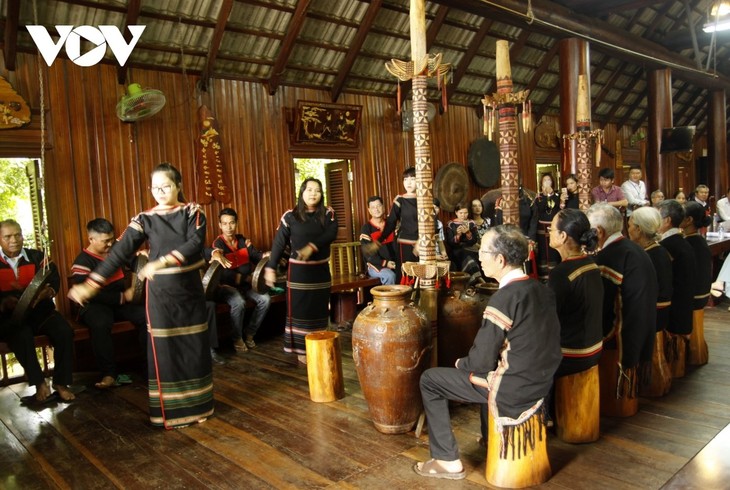 More than just a living space, the longhouse is also where E de people hold rituals and cultural activities. (Photo: H Xiu/VOV–Central Highlands) More than just a living space, the longhouse is also where E de people hold rituals and cultural activities. (Photo: H Xiu/VOV–Central Highlands) |
The owner of the house, Y Yen Mlo, said that, although his family has a concrete house, they built a traditional longhouse with a wood floor and walls furnished with a kpan bench, gongs, drums, and a woodstove.
Y Yen said the longhouse is a place to preserve memories and traditional values for future generations. “We’ll never abandon the longhouse or our customs. My parents told me to do my best to build one, so I worked hard and saved for three years.”
The E De celebrate many rituals, including the health blessing ceremony and the new rice celebration. These rituals must be held in a longhouse, accompanied by jars of rice liquor and the sound of gongs.
Y Ring Adrong of Buon Ho ward said the sound of gongs inside a longhouse creates a sacred atmosphere. “When I was little, whenever there was a ceremony, even if the offering was just a chicken, we had to play the gongs. You don’t need a pig in order to play the gongs. Just a chicken and two or three cups of rice liquor are enough to start a ritual.”
Traditionally, a longhouse is the shared living space of many generations of E De. Building a longhouse requires the participation of many people, perhaps all the villagers, to cut timber, build the walls and roof, and cook for all the participants.
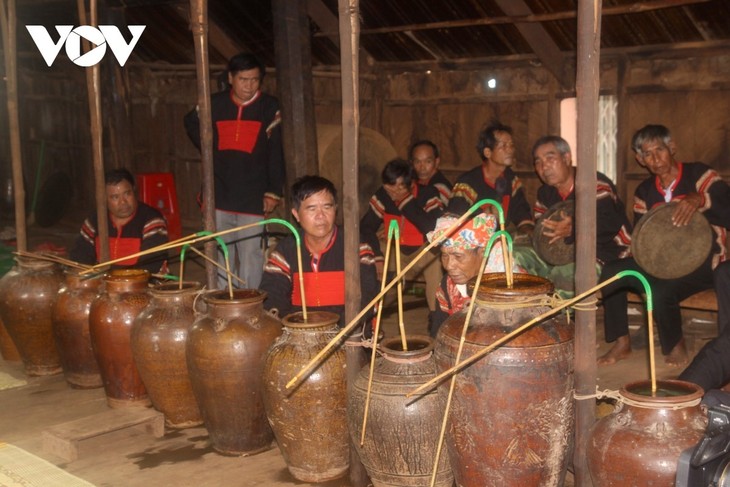 During rituals, hosts and guests celebrate around jars of rice liquor. (Photo: H Xiu/VOV–Central Highlands) During rituals, hosts and guests celebrate around jars of rice liquor. (Photo: H Xiu/VOV–Central Highlands) |
H Ngui Kbuor of Tan Lap ward said a house might belong to just one family, but building it is the work of the whole hamlet. “Neighbors come to help with the building and cooking, creating a lively atmosphere that strengthens family ties and brings villagers closer together.”
In Dak Lak province, 5,600 longhouses have been preserved. In many hamlets, the restoration and promotion of longhouses has been linked to community tourism.
H Nger Mlo of Buon Ho ward said her family repaired and upgraded their longhouse to accommodate guests. “We wanted to make the house warmer in winter, cooler in summer, and more beautiful. We have a concrete house, but we live in our longhouse because we want to keep its warmth alive. We always sleep in the longhouse.”
The younger E De generation is being encouraged to preserve the traditional E De longhouse, gong performances, songs, and dances to keep the clan’s culture alive despite the impact of modern life.