(VOVWORLD) - Brocade weaving is a typical cultural feature of the Thai ethnic community. The Thai in Hoa Tien hamlet, Chau Tien commune, Nghe An province, have improved brocade weaving techniques to produce colorful silk-brocade fabric imbued with their indigenous cultural identity.
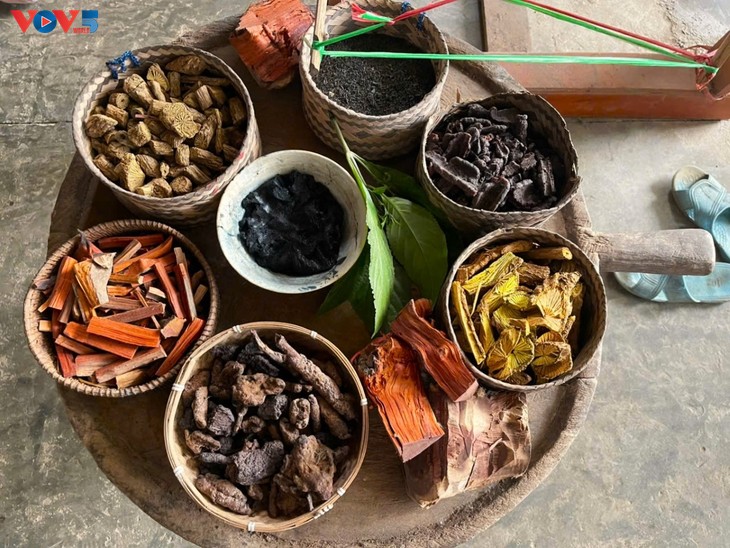 Thai people use natural materials to dye brocade fabric. (Photo: Vinh Phong/VOV5) Thai people use natural materials to dye brocade fabric. (Photo: Vinh Phong/VOV5) |
Every household has a loom in Hoa Tien hamlet, one of the oldest and best-known brocade weaving villages in Chau Tien commune. At an early age, Thai girls learn brocade weaving from their grandmothers and mothers and start creating their own weaving patterns.
Artisan Sam Thi Bich, Director of the Hoa Tien Brocade Craft Cooperative, said that some years ago brocade weaving was in danger of disappearing, but thanks to the determination of local authorities and residents, the craft has regained its place in the market.
“The brocade fabric is handmade by Thai women, exhibiting a wide variety. Its distinctive patterns were passed down from our ancestors,” said Bich.
In Hoa Tien, the Thai people carry out every stage of production, from growing and harvesting cotton to spinning and dyeing yarn to weaving the finished products.
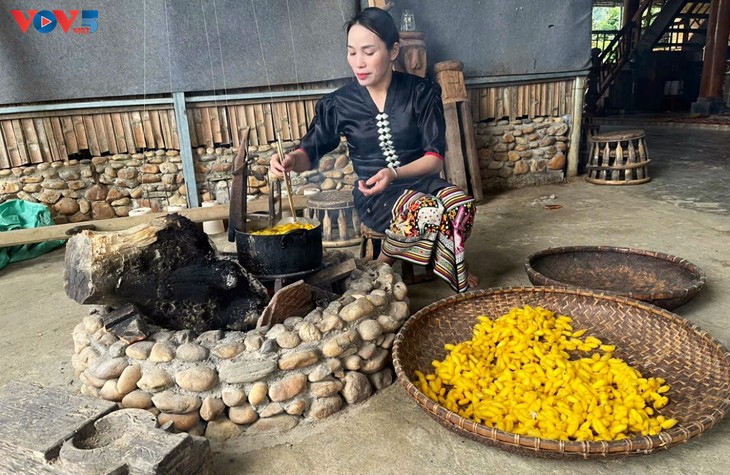 A Thai woman reels silk yarn. (Photo: Vinh Phong) A Thai woman reels silk yarn. (Photo: Vinh Phong) |
They also grow mulberry and raise silkworms to produce silk threads.
“We start growing the cotton in January, and harvest it in June. After picking the cotton, we remove the seeds and spin the cotton into yarn. The most difficult part is weaving. To produce the desired patterns, we have to manually tie the threads on the loom,” said a Thai woman named Sam Thi Xuyet.
La Ngoc Diem, another Thai woman in Hoa Tien commune, said it takes a month for the silkworms to produce cocoons for spinning yarn. We put the cocoons into hot water so they loosen and the threads stick together, then we can reel the silk yarn. When spinning, we must make sure the threads are smooth, even, and clean. I add more hot water and spin steadily so the threads don’t become too thick or pick up dirt.”
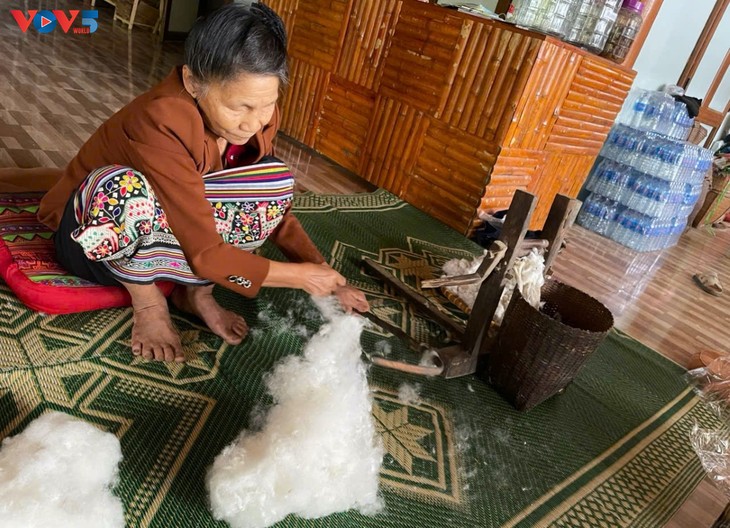 Cotton must be ginned before it can be spun into yarn. (Photo: Vinh Phong) Cotton must be ginned before it can be spun into yarn. (Photo: Vinh Phong) |
The loom determines the quality of brocade products. The Thai people in Hoa Tien use large looms with many components made of bamboo or durable wood. A sturdy loom with smoothly operating parts and well-coordinated foot and hand movements gives the weaver the comfortable feeling needed to produce beautiful brocade pieces.
The Thai weave geometric shapes, scripts, plants, flowers, and animals. They must carefully arrange the threads, pass the shuttle, and count the colored threads to create accurate patterns and harmonious designs.
“We have to think creatively to arrange the threads to create a motif or pattern. Popular patterns are deer, antelope, dragon, butterfly, moon, and sun. We have to count every thread to design a pattern. It’s difficult for beginners,” Sam Thi Xuyet said.
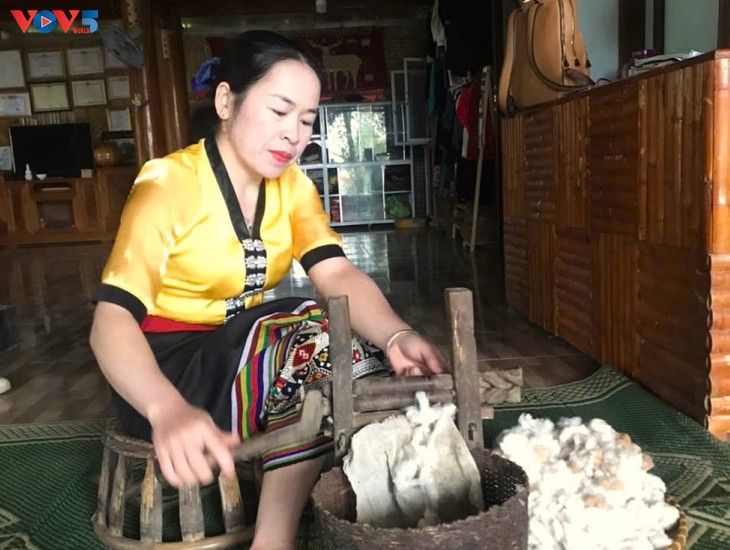 Cotton is dried before being spun into thread. (Photo: Vinh Phong) Cotton is dried before being spun into thread. (Photo: Vinh Phong) |
There are usually 7 basic brocade colors for other groups but Thai women in Hoa Tien have 52 colors they can apply to raw silk, refined silk, cotton fabric, or linen. They use meticulous techniques to produce long-lasting natural dyes.
“Colors like yellow, green, and indigo come from home-grown plants. Fabrics are boiled with natural dye material and left to dry,” villager Sam Thi Thoa said.
Hoa Tien hamlet has two brocade weaving cooperatives that help people sell their products. While preserving their cultural identity, the weavers also keep pace with modern trends and tastes by diversifying their products to include scarves, bags, blankets, pillows, decorative items, and souvenirs, which are sold at fairs and cultural events, and also exported to many countries.