(VOVWORLD) - Leaders of European Union countries held an informal summit in Copenhagen, Denmark, on Wednesday, to discuss security and defense issues and EU competitiveness, amid growing security concerns.
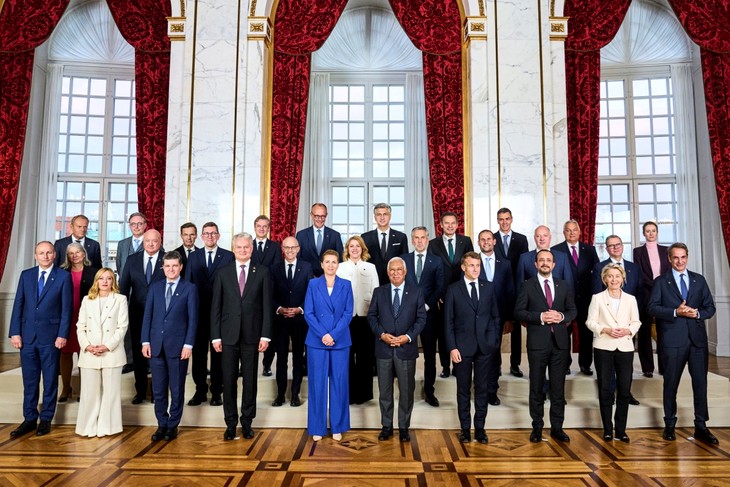 EU leaders attend the informal meeting at Christiansborg Palace in Copenhagen, October 1, 2025. (Photo: Ritzau Scanpix/Thomas Traasdahl/REUTERS) EU leaders attend the informal meeting at Christiansborg Palace in Copenhagen, October 1, 2025. (Photo: Ritzau Scanpix/Thomas Traasdahl/REUTERS) |
The gathering took place one day before the 7th European Political Community (EPC) Summit in Copenhagen, which brought together leaders from 27 EU countries and 17 EPC countries.
Unprecedented security challenges
As the Russia-Ukraine conflict continues, Poland, Estonia, Denmark, and Hungary have reported UAV incursions into their airspace and cyberattacks on critical infrastructure. Summit attendees devoted most of the meeting to discussing the security risks facing Europe and the urgent need to strengthen their defense capacity.
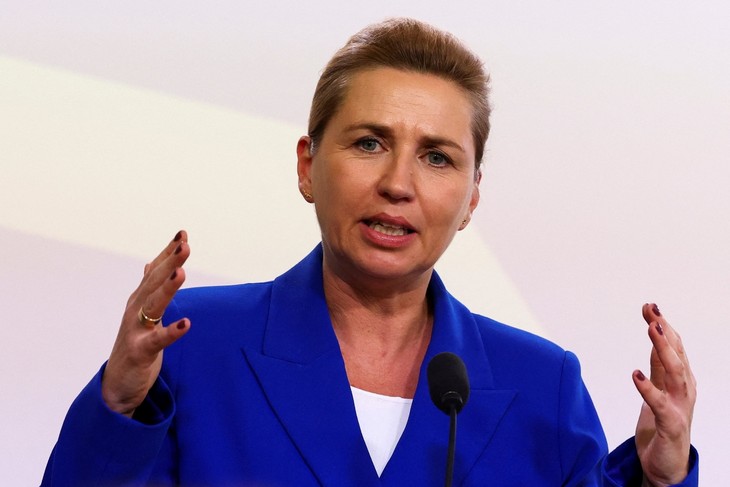 Danish Prime Minister Mette Frederiksen (Photo: Piroschka van de Wouw/ REUTERS) Danish Prime Minister Mette Frederiksen (Photo: Piroschka van de Wouw/ REUTERS) |
Danish Prime Minister Mette Frederiksen declared that Europe is in its most dangerous position since World War II, geopolitically and economically. As the current President of the European Council, she warned of permanent conflict and new forms of security threat.
“There is not only a hybrid attack, there is a hybrid war right now. It is part of re-arming ourselves because when I say re-arming Europe it means also make a more robust European society. We have to focus on cyber attacks and the risk of sabotage and anti-drone capacities. Therefore it was good that we had discussions with the European Union yesterday about building a kind of a drone wall that can be used especially when it comes to hybrid war,” said Frederiksen.
German Chancellor Friedrich Merz said Europe is not at war but no longer lives in peace. French President Emmanuel Macron acknowledged that the prolonged Russia-Ukraine conflict and its consequences have placed Europe and Russia in permanent confrontation.
Despite a shared view of current threats, the leaders could not make significant progress on four major defense projects: a drone wall, surveillance of the EU’s eastern flank, an air defense shield, and a space defense shield. The drone wall, one of the hottest recent topics, triggered disagreements over budget allocations and coordination mechanisms between the European Commission and major EU defense powers like France, Germany, and Italy.
German Defense Minister Boris Pistorius said the drone wall initiative is not a top priority and will be difficult to implement within the next few years. He said Europe must accelerate weapons and defense technology development to keep pace with global advances, rather than placing too much hope in a long-term project.
Concerns over competitiveness
While security, defense, and continued support for Ukraine dominated the discussion, economic challenges and strategic competition have pushed EU leaders to boost plans to stay competitive. A separate summit on this issue was held in Copenhagen with representatives of major industrial corporations.
Polish Prime Minister Donald Tusk pointed out that, due to the EU having the highest energy costs in the world, many companies are leaving the continent. The EU must quickly adopt emergency measures to protect European firms, including financial support, favorable policies, and removal of excessive barriers and regulations.
French President Emmanuel Macron emphasized six key sectors for Europe’s future competitiveness: innovation, quantum technology, artificial intelligence, healthcare, defense, and green technology. He criticized Europe’s lack of strong regulations to protect domestic companies in the European market.
“In Europe, this is the only place where you can finance with taxpayer money 100% non-European players. This is the only place where you put regulations on your players, but at the same time you negotiate the lifting of barriers with non-European players with a double standard,” said Macron.
Macron reiterated his long-standing proposal, supported by many EU countries, that Europe should build a European production and consumption strategy that prioritizes European companies and products. He warned that the US and China already have strategies, adding that Europe must act urgently on economic reforms if it wants to avoid losing further ground in global competition.