(VOVWORLD) - National Assembly deputies on Friday wrapped up a successful mid-year session marked by historic milestones. This crucial meeting institutionalized resolutions and conclusions of the Politburo, the Secretariat, and in particular the 11th plenum of the Party Central Committee, aiming at improving people's living standards and promoting national development in the new context.
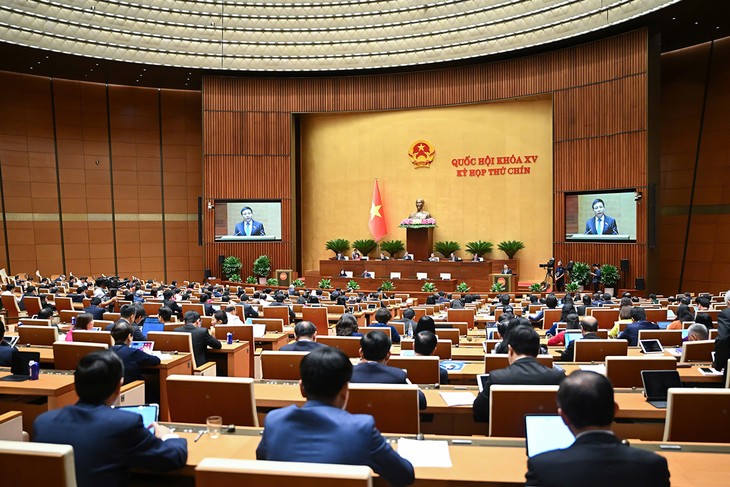 (Photo: quochoi.vn) (Photo: quochoi.vn) |
Decisions taken at this session laid a foundation for Vietnam in the next era, the era of national rise.
One of the highlights was the unanimous adoption of a resolution amending the 2013 Constitution. This historic vote ushered in broad institutional reforms and reflected a revolutionary mindset in national governance.
The amended Constitution institutionalizes the Party’s direction on streamlining the political system into a more efficient and effective structure, and provides a legal foundation for implementing a new two-tier local government model that replaces the old three-tier system, which has shown certain limitations in the current development context.
The resolution also provides a constitutional basis for restructuring the Vietnam Fatherland Front (VFF) and mass organizations to better serve the public. Article 9 of the amended 2013 Constitution states that the VFF is a venue to unite and promote the strength of national unity, present the will and aspirations of the people, promote their right of mastery, represent and protect the legitimate and lawful rights and interests of the people, and convey people’s opinions and recommendations to state agencies.
These constitutional amendments lay a foundation for building a prosperous and strong Vietnam with happy people.
“The resolution amending the 2013 Constitution is a significant political milestone that provides fresh momentum for Vietnam to soar,” said deputy Ha Sy Dong.
“It institutionalizes the Party's viewpoints and orientations, providing a strong legal basis for a streamlined, efficient, and effective administrative system that aims for national development and prosperity,” said deputy Nguyen Thi Thu Nguyet.
Another important resolution passed at the mid-year National Assembly session focuses on the rearrangement of provincial-level administrative units in 2025. It will be implemented starting July 1.
Deputy Nguyen Thi Ngoc Xuan said, “This historic decision will create new development space for the country and offers opportunities for localities to restructure and realign economic, cultural, social, defense, and security resources to generate opportunities for Vietnam in the new era.”
The Government’s strategic vision and breakthrough governance mindset were also reflected in the resolution on establishing an international financial center in Ho Chi Minh City and Da Nang. This development model tied to new growth engines will enhance Vietnam’s position in the new era.
Notable social welfare policies adopted were tuition exemption and support for preschool children and students in public general education institutions; the extension of the agricultural tax exemption until 2030; and the abolishment of the death penalty for eight crimes.
The mid-year session revised a record number of laws, addressing urgent issues with immediate impact, including issues related to investment and the implementation of a two-tier local government model.