(VOVWORLD) - A special exhibition in Hanoi vividly recreates the fierce struggle by Vietnam’s armed forces and people to defend the capital’s skies for 12 days and nights in December 53 years ago, which culminated in the historic victory known as “Dien Bien Phu in the Air”.
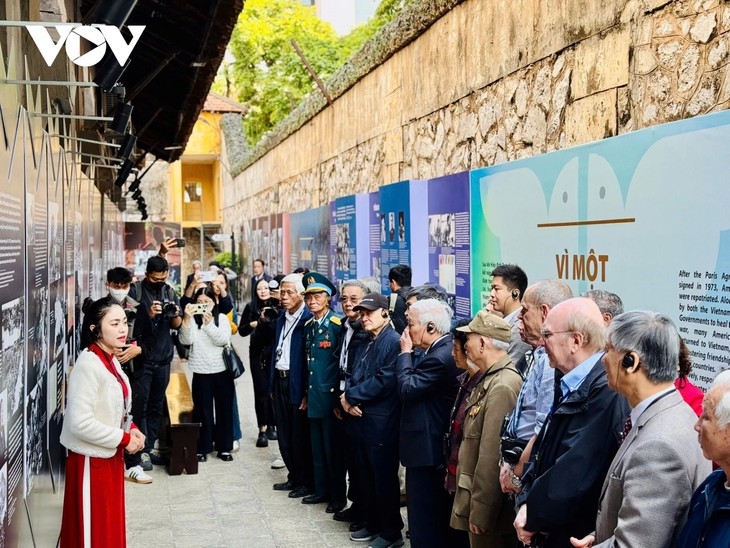 The exhibition "Aspiration for Peace" at the Hoa Lo Prison historical site (Photo: VOV) The exhibition "Aspiration for Peace" at the Hoa Lo Prison historical site (Photo: VOV) |
The exhibition “Aspiration for Peace” guides visitors at the Hoa Lo Prison Relic Site through three thematic sections called Fiery Memories, The Anti-War Movement, and For a Blue Sky.
The section Fiery Memories takes visitors back to northern Vietnam which was shaken by intense US air raids during Operation Linebacker II from December 18 to 29, 1972. B-52 bombers and US military tactical aircraft were deployed to bombard Hanoi, Hai Phong, and neighboring localities.
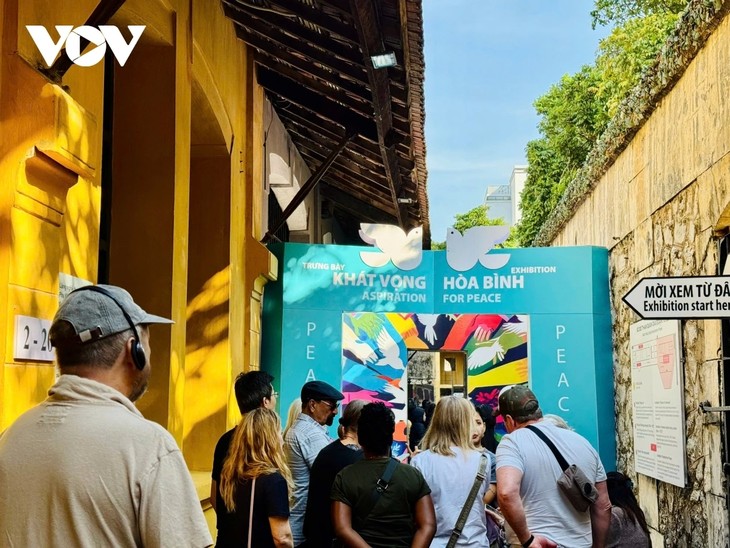 The exhibition attracts many domestic and international tourists. (Photo: VOV) The exhibition attracts many domestic and international tourists. (Photo: VOV) |
Radar units and air defense troops defended against the attacks with courage and creativity. More than five decades later, shooting down B-52s – America’s “flying fortresses” – remains deeply etched in the memory of Colonel Dinh The Van, Hero of the People’s Armed Forces.
Van said: “The B-52 had enormous firepower and carried 20 to 30 tons of bombs. Its weakness was its massive size. It was easy to detect, and produced a very bright signal. We used the half-angle crossing method to lock on and strike. The effectiveness reached 98 percent. In our lives, there has been no greater joy than shooting down a B-52, and no greater happiness than seeing the country reunified.”
To meet combat needs, the General Staff authorized the Capital Command to establish eight groups of workers temporarily withdrawn from production.
Recalling the mission to shoot down F-111 aircraft, Nguyen Van Trung, a member of the forces, said: “We were mobilized between 7 and 9 p.m. and were ready for combat. Around 10:30 that night, F-111 aircraft came in to make 12 attack runs. Above us, B-52s were being engaged by anti-aircraft guns and missiles, but down below the F-111s flew extremely low, skimming the river surface. With the naked eye we couldn’t see them. However, the Hanoi central command directly assigned us with this mission, and that was how we were able to achieve this victory.”
The Anti-War Movement section describes public protests in the US against the war in Vietnam. Americans took part in anti-war marches and their soldiers came to recognize the unjust nature of the conflict.
The section For a Blue Sky covers the period that followed the Paris Peace Accords signed on January 27, 1973. By this period, most US troops had returned home. In later years, many of them returned to Vietnam to contribute to reconciliation and friendship building between the two countries.
The “Aspiration for Peace” exhibition powerfully portrays the courage, resilience, and close coordination of Vietnamese forces that led to the victory of “Dien Bien Phu in the Air” in December 1972.