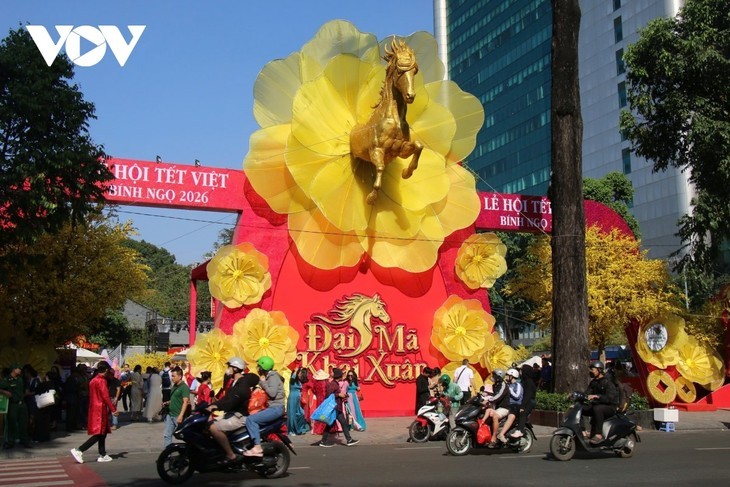
 Streets in HCM city are blanketed with the yellow colors of apricot blossoms, creating an inspiring New Year scene. (Photo: Vu Huong/ VOV–Ho Chi Minh City) Streets in HCM city are blanketed with the yellow colors of apricot blossoms, creating an inspiring New Year scene. (Photo: Vu Huong/ VOV–Ho Chi Minh City) |
B: Though the traditional Lunar New Year celebration is over, we continued to receive New Year greetings from listeners around the world.
A: Sou Sambath and Kim Sokha of Cambodia sent their wishes: “We wish you a new year full of health and energy to continue bringing fascinating stories about Vietnam to Cambodia and the world.”
B: Thank you! Your encouragement keeps us motivated. We’d also like to thank Peter Ng of Malaysia for sending us a beautiful New Year greeting card of horse with wishes for good luck, good health, and endless abundance all year long.
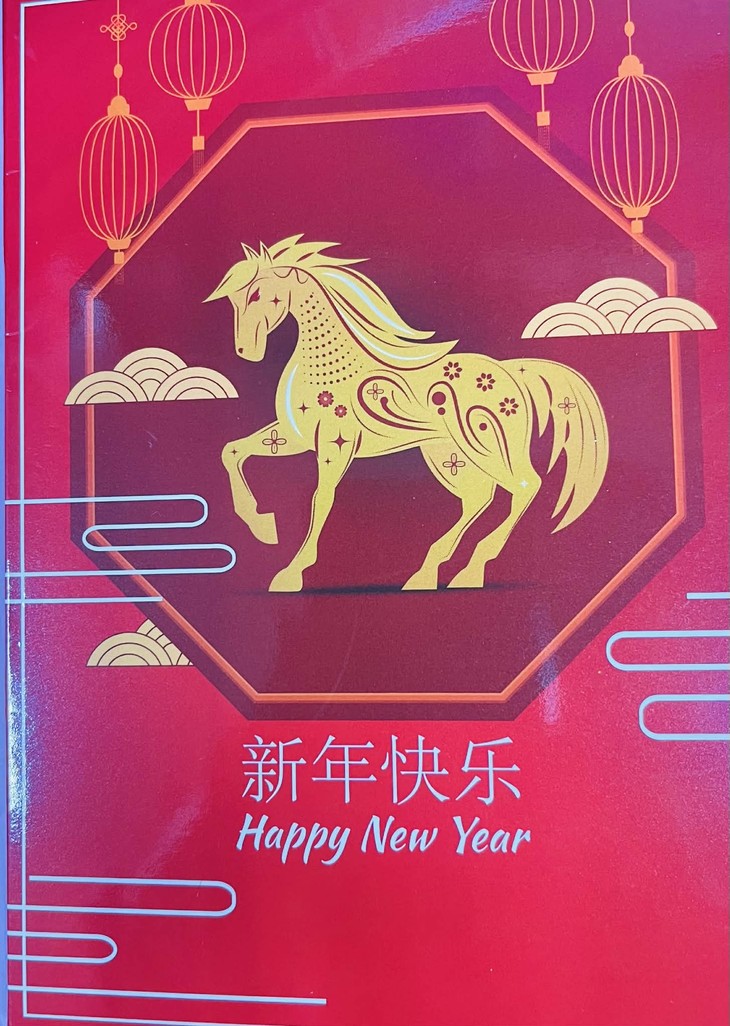 A New Year Greeting card from Peter Ng A New Year Greeting card from Peter Ng |
A: And speaking of Lunar New Year which we call Tet in Vietnamese, Phol Phanit from Takeo, Cambodia, enjoyed our program about the pen-brush opening custom at the beginning of the year.
B: For listeners who may not know, the “pen-brush opening” ceremony symbolizes respect for learning and knowledge. On the first days of Lunar New Year, scholars and students write beautiful calligraphy or meaningful words, wishing for wisdom and success.
A: Chu Van Hieu of A Sao commune in Hung Yen province came to the temple to ask for a calligraphic letter for his daughter in the early days of the Lunar New Year.
Hieu said: “I’ve brought my daughter here at the start of the year to offer incense and pray that she will study well and uphold Vietnam’s long-standing tradition of valuing education. Besides seeking blessings from Nguyen Binh Khiem, she is also performing the pen-brush opening ritual, hoping for good luck in her studies.”
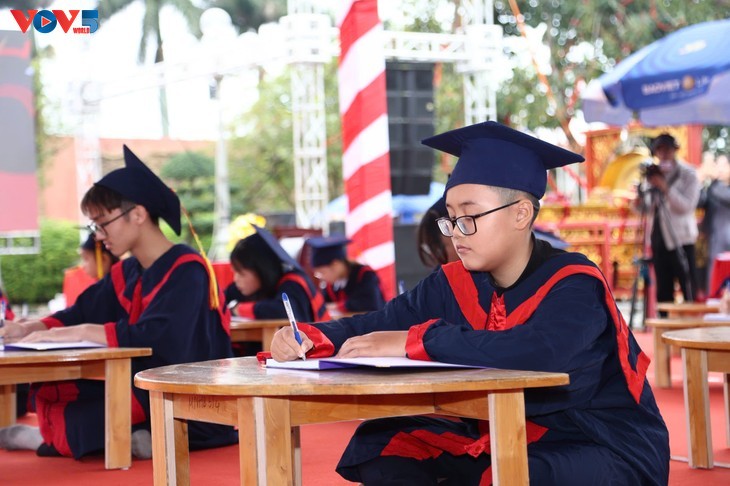 Students write their first words of the new lunar year. Students write their first words of the new lunar year. |
B: This tradition embodies the long-standing Vietnamese spirit of valuing education and honoring teachers. Though simple in form, the act of writing the first words of the year carries profound symbolic meaning. It marks not only the beginning of a new calendar cycle but also the renewal of intellectual and personal aspirations.
A: According to historical accounts, the origin of this custom is closely associated with the respected scholar and teacher Chu Văn An of the Tran Dynasty in the 14th century, who passed the highest imperial examination, chose teaching over official rank.
B: Legend has it that whenever his students visited him during the New Year, Chu Văn An would personally write a meaningful character for each of them. Through a single brushstroke, he conveyed encouragement, trust, and high expectations.
A: From this gesture, the practice of opening the pen at the beginning of spring gradually spread among scholars and intellectuals. Over time, it became a symbol of the Vietnamese tradition of respecting teachers and cherishing learning.
B: For the Vietnamese, the pen is more than a writing instrument. It represents the connection between intellect and soul. The act of pen-brush opening is therefore not merely a ritual; it is a tribute to knowledge and a reaffirmation of one’s determination to study, cultivate virtue, and strive for achievement. With the belief that knowledge opens the door to success and prosperity, the first pen stroke of spring carries hopes for a smooth, happy, and accomplished year ahead.
A: This week, we also received a delightful email from Fan Hong Jie in Zhejiang, China. He was pleasantly surprised to receive three New Year greeting cards from VOV5.
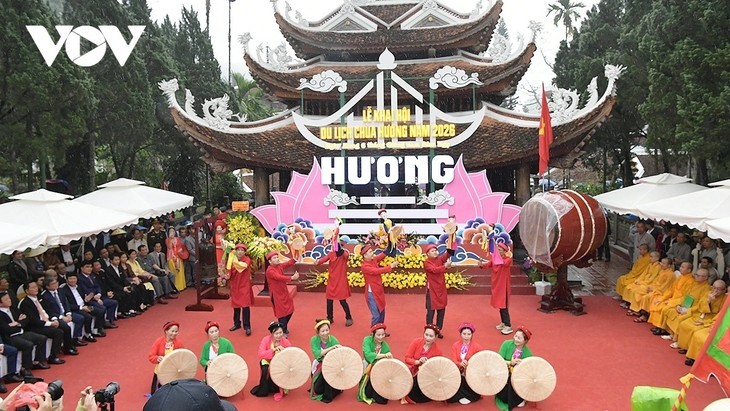 Huong pagoda festival opens on the 6th day of the 1st lunar month Huong pagoda festival opens on the 6th day of the 1st lunar month |
B: He described them vividly with landscapes and people on the front, and greetings in 13 languages on the back, along with our slogan: “Linking Vietnam with the world.”
A: Mr. Fan also asked: “What is the Tet atmosphere like in Hanoi? And as Vietnam is a multi-ethnic country, do different ethnic groups have different customs during Lunar New Year?”
B: Wonderful questions! In Hanoi, Tet vibe prevails weeks in advance. Streets are filled with peach blossoms, kumquat trees, and red decorations. Families clean their homes, prepare traditional dishes like banh chung (square sticky rice cake), and visit relatives.
A: Vietnam has 54 ethnic groups, each with unique traditions. The Hmong people celebrate with colorful costumes and flute performances. The Tay and Nung prepare special sticky rice dishes dyed in five colors. The Dao people organize community rituals to honor ancestors and pray for good harvests.
B: Mr. Fan, your suggestion for a program introducing these customs is excellent. We will certainly consider producing a special feature on ethnic Tet traditions.
A: In their correspondence to VOVWORLD this week, many share their interest in Vietnamese festivals and post-Tet festivals. Eddy Setiawan of Indonesia sent us a recorded question: “Does the Tet holiday in Vietnam last 15 days, and are there special festivals after the official holiday ends?”
B: Officially, the public holiday lasts about a week. However, culturally, the festive spirit extends through the first lunar month. After the main holiday, numerous spring festivals take place across the country.
A: For example, the Perfume Pagoda Festival near Hanoi begins on the 6th day in the first lunar month and lasts for three months. Pilgrims travel by boat and hike through scenic mountains to pray for blessings.
B: Another well-known event is the Lim Festival in Bac Ninh province, held on the 13th day of the first lunar month, where visitors enjoy quan ho folk singing—recognized by UNESCO as Intangible Cultural Heritage.
A: So Eddy, while Tet itself is shorter officially, the celebrations and festivals continue well beyond.
B: Vicentiu Gheorghe from Romania wanted to learn about the custom of going to pagodas at the beginning of the year.
A: Visiting pagodas during Tet is a spiritual tradition. People light incense, offer prayers, and seek peace and blessings for the new year. It’s not only a religious act but also a cultural moment for reflection and gratitude.
A: Families often combine it with a spring outing, enjoying temple architecture and nature. The atmosphere is serene yet festive.
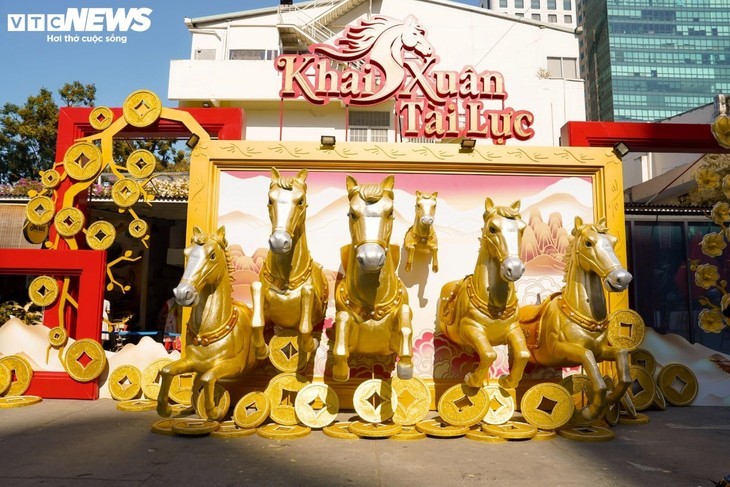 The Youth Cultural House in Ho Chi Minh City displays horse mascots symbolizing power, breakthrough, and success in the New Year. (Photo: Luong Y/ VTC News) The Youth Cultural House in Ho Chi Minh City displays horse mascots symbolizing power, breakthrough, and success in the New Year. (Photo: Luong Y/ VTC News) |
B: Omar Faruk from Bangladesh asked about the meaning of the horse image in Vietnamese culture.
A: The horse symbolizes strength, loyalty, speed, and perseverance. In traditional paintings and folk art, horses often represent success and advancement. There is also the famous expression “Ma dao thanh cong,” meaning “Success arrives as swiftly as a galloping horse.” During the Year of the Horse, people exchange paintings and decorations featuring horses to wish each other prosperity.
B: Let’s continue with a heartfelt message from Afghanistan. Dawood Jabarkhail wrote to say he is ready to provide updated and reliable information about the current situation in Afghanistan for VOV.
A: Dawood, thank you so much. Your willingness to contribute shows the spirit of global friendship that this program stands for. As broadcasters, we deeply value first-hand perspectives. If possible, please share your updates via email, and we will coordinate with our editorial team to verify and present them responsibly.
B: International solidarity also comes through strongly in the comments of Juan Diez from Santander, Spain. He shared detailed reflections on the visit to Russia by Vietnam’s Foreign Minister Le Hoai Trung and the broader geopolitical situation.
A: Juan wrote: “President Vladimir Putin deeply recognizes the success of the 14th National Congress of the Communist Party of Vietnam and appreciates Vietnam’s decision to continue entrusting comrade To Lam as General Secretary… In the context of rising tensions in Europe, the meeting between President Putin and Minister Trung is expected to carefully analyze the situation in Ukraine.”
B: Thank you, Juan, for your thoughtfully analytical letter. Vietnam consistently pursues an independent, self-reliant foreign policy of diversification and multilateralization. High-level diplomatic exchanges aim to strengthen cooperation while contributing to peace and stability.
A: Speaking of peace, Armando Francisco Higuera del Reyo from Mexico wrote passionately about Vietnam’s support for the Palestinian people. He emphasized that international solidarity must go beyond declarations and translate into timely humanitarian action, especially in Gaza.
B: Armando, your message reflects the humanitarian values shared by many of our listeners. Vietnam supports a peaceful, negotiated solution based on international law, ensuring the legitimate rights of all peoples. We appreciate your commitment to justice and global responsibility.
A: That’s it for this week’s Letter Box. Please continue sending your feedback, questions, and stories. Perhaps next week, your letter will be featured right here.
B: Until then, thank you for listening and for being part of our global family.
A: Goodbye, and see you next week on the Letter Box!