(VOVWORLD) - 75-year-old K’Brep of the K’Ho ethnic group in Bao Thuan commune, Lam Dong province, is a skilled artisan deeply committed to preserving and passing on the K’Ho people’s traditional weaving craft. He is also a pioneer of production who actively contributes to the local new rural development program.
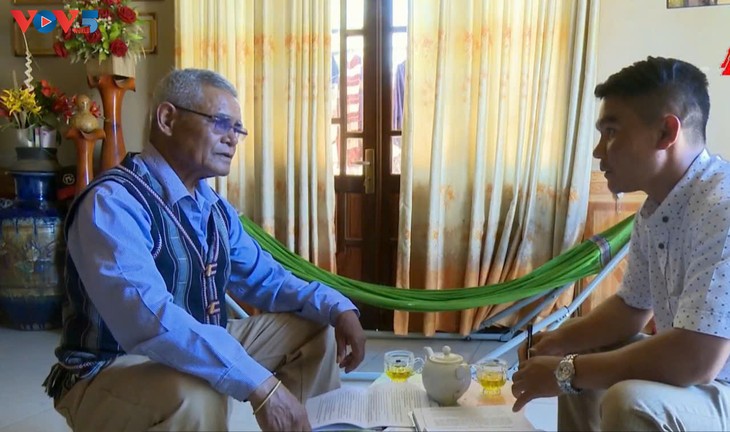 Elder K’Brep recounts donating land to build inter-village roads (Photo: K’Brop – VOV correspondent in the Central Highlands) Elder K’Brep recounts donating land to build inter-village roads (Photo: K’Brop – VOV correspondent in the Central Highlands) |
K’Brep is honored as the patriarch of Kala Krot village and recognized as an outstanding artisan of the K’Ho people’s traditional weaving craft.
With skilled hands, K’Brep transforms bamboo and rattan into baskets, trays, backpacks, and a variety of household items. Last year, when the locality organized a weaving training course for the K’Ho community, K’Brep taught more than 100 students.
“I make many kinds of woven products, including papooses, trays, and baskets. When a customer places an order, I tailor the item to their needs. This generates additional income,” K’Brep said. “To preserve the weaving craft, the locality established a weaving club so artisans can learn from one another, create more beautiful and refined products, and find stable outlets for their products.”
K’Brep is not just a talented artisan, he’s also a production role model. He was the first in the village to invest in new coffee varieties. His 5 hectares yield 12 tons of coffee beans per year. His family also earns income from durian and avocado intercropped with the coffee, and their 2 hectares of wet rice produce an output of more than 8 tonnes annually.
Inspired by his success, many villagers including K’Brao have studied and followed his example.
“Village elder K’Brep is a pioneer of production. In coffee cultivation, he was the first to apply technology such as proper fertilization, pest control, and irrigation, resulting in high yields. He is also an outstanding wet rice producer. He is highly respected by the community not only for his effective economic production but also for his manner of living,” K’Brao said.
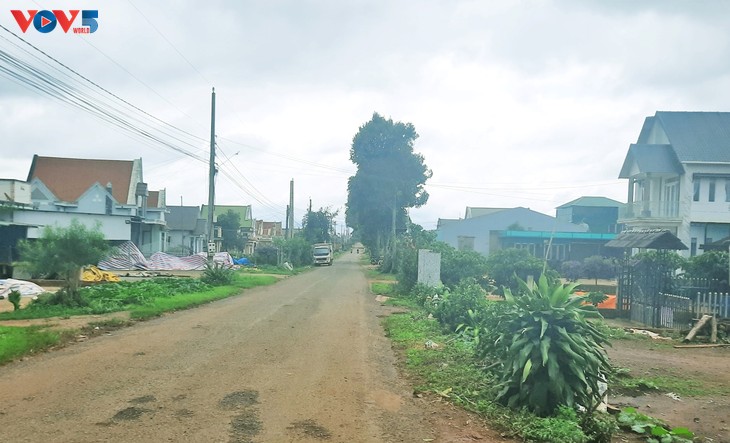 Kala Krot hamlet in Bao Thuan commune, Lam Dong province (Photo: K’Brop – VOV correspondent in the Central Highlands) Kala Krot hamlet in Bao Thuan commune, Lam Dong province (Photo: K’Brop – VOV correspondent in the Central Highlands) |
Elder K’Brep was the first to donate land to build inter-village roads. His family donated more than 300 square meters of land in front of their house, dismantled fences, and cut down coffee trees to widen the road. He also donated more than 1,000 square meters of farmland to expand access roads to production areas.
Following his example, the village joined hands – some donated land, some contributed labor, and some offered construction materials for rural infrastructure projects. Altogether villagers contributed about 24,000 USD to build paved roads and clean water facilities.
K’Breo of Kala Krot village said that thanks to K’Brep’s contribution, every local road and alley is now spacious and clean.
“In the past, during the rainy season, roads in our village were muddy and slippery, and in the dry season were dusty and difficult to travel, particularly when transporting agricultural products from the fields to home. Now clean, paved roads make transporting farm produce much easier,” said K’Breo.
In addition to mobilizing people to build new rural areas, K’Brep also actively communicates Party guidelines and State policies and helps mediate conflicts within the community.
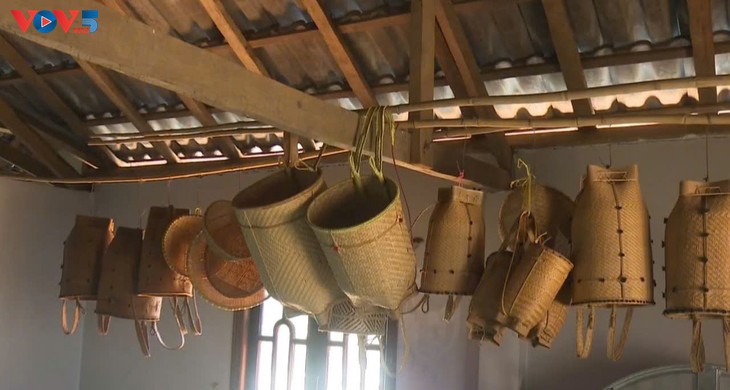 Woven handicraft products made by village elder K’ Brep locality (Photo: K’Brop – VOV correspondent in the Central Highlands) Woven handicraft products made by village elder K’ Brep locality (Photo: K’Brop – VOV correspondent in the Central Highlands) |
K’Huu, an official in Bao Thuan commune, said K’Brep has contributed to maintaining security and order and building a cultural lifestyle.
“Elder K’Brep is a highly respected figure in the community. In the new rural development program, he has lead initiatives to build roads and clean water systems. As a result, the village has become neater and more attractive, with well-maintained roads and lanes. He also serves as Chairman of the Kala parish council, where he encourages parishioners to embrace a new way of life,” said K’Huu.
Village elder K’Brep’s prestige, talent, and dedication have played a vital role in preserving and promoting the traditional craft of the K’Ho people and transforming the rural landscape of Kala Krot.