(VOVWORLD) - The Free Trade Agreement between Vietnam and the Eurasian Economic Union has proven to be a strong driving force in promoting trade and investment between both sides over the past decade.
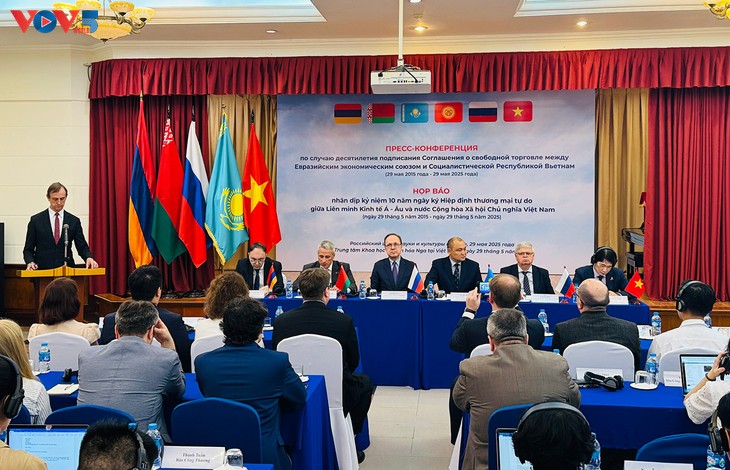 Press conference to mark the 10th anniversary of the signing of the Free Trade Agreement between Vietnam and the Eurasian Economic Union. (Photo: Thuy Ngoc/VOV) Press conference to mark the 10th anniversary of the signing of the Free Trade Agreement between Vietnam and the Eurasian Economic Union. (Photo: Thuy Ngoc/VOV) |
The statement was shared among representatives of the member countries during a press conference marking the 10th anniversary of the Agreement (2015–2025), held by the Russian Embassy in Hanoi on Thursday.
The Vietnam–Eurasian Economic Union Free Trade Agreement, comprising Russia, Belarus, Kazakhstan, Armenia, and Kyrgyzstan, was signed on May 29, 2015, and officially took effect on October 5, 2016. Notably, this was the first FTA signed by the Eurasian Economic Union with an external partner, underscoring the high level of trust and commitment to long-term cooperation between the two sides.
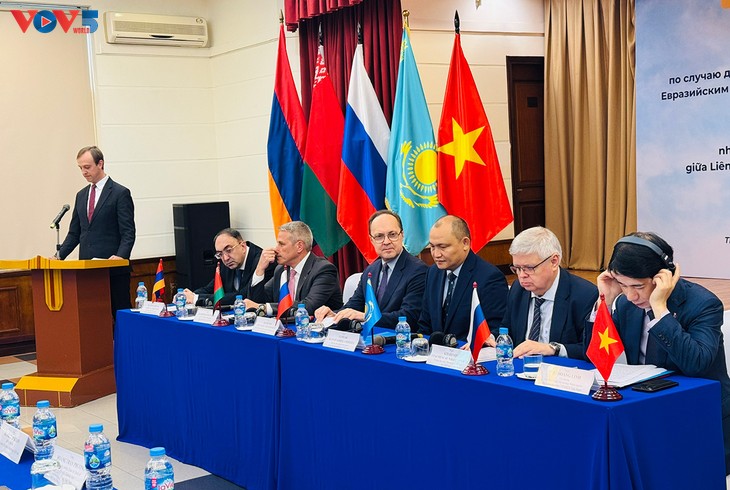 Representatives of member countries participating in the Agreement at the press conference. (Photo: Thuy Ngoc/VOV) Representatives of member countries participating in the Agreement at the press conference. (Photo: Thuy Ngoc/VOV) |
Over the past decade, despite complicated geopolitical developments and the global impact of the COVID-19 pandemic, the Agreement has continued to play a pivotal role in boosting trade and investment between Vietnam and Eurasian countries. Vietnam’s trade turnover with Russia increased 1.3 times, Belarus 34%, Kazakhstan 4.2 times, Kyrgyzstan 14.5 times; and Armenia 61 times. In 2024 alone, Vietnam's exports to the EAEU grew 30%, while imports from the bloc rose 20%.
Ta Hoang Linh, Director of the Department of Foreign Market Development under the Ministry of Industry and Trade, said: “The rate of utilizing preferential certificates of origin (C/O) under the Agreement is impressively high, about 78.5%, much higher than the average of other FTAs. This demonstrates that businesses are well aware of the opportunities the Agreement offers and are proactively capitalizing on them.”
At present, key cooperation areas between Vietnam and the Eurasian Economic Union include the management and quarantine of animals and plants, transport and logistics, and environmental protection. Both sides are also working together to develop an electronic system for certifying and verifying the origin of goods. In parallel, they are preparing to sign a Protocol and begin electronic data exchanges between Vietnam and the EAEU.