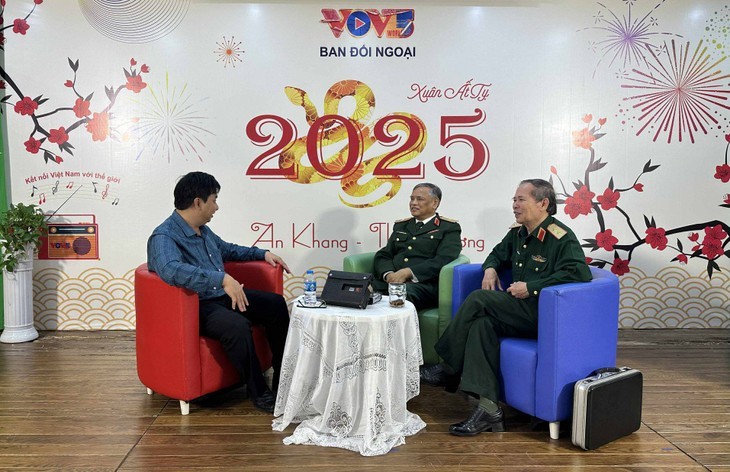
 Lieutenant General, Professor, Dr Nguyen Ngoc Thanh, former Deputy Director of the National Defense Academy, and Major General Nguyen Hong Quan, former Deputy Director of the Institute for Defense Strategy, at the talk show with VOV5. (Photo: VOV5) Lieutenant General, Professor, Dr Nguyen Ngoc Thanh, former Deputy Director of the National Defense Academy, and Major General Nguyen Hong Quan, former Deputy Director of the Institute for Defense Strategy, at the talk show with VOV5. (Photo: VOV5) |
MC: To begin, may I ask both of you to share with our audience the origins of Vietnam’s Four No’s defense policy and its strategic significance today?
Lt. Gen. Nguyen Ngoc Thanh: Thank you for the question. Vietnam’s Four No’s defense policy dates back to 1998, when Vietnam published its first National Defense White Paper. At that time, the policy contained three principles: first, no participation in military alliances; second, no aligning with one country against another; and third, no foreign military bases or use of Vietnamese territory to oppose other countries. In 2019, in response to new realities and requirements, a fourth principle was added: no use or threat of force in international relations. This was officially included in the 2019 National Defense White Paper and reaffirmed in the Resolution adopted at the 8th plenum of the 13th Party Central Committee in 2023 on the strategy for national defense in the new context.
Strategically, the Four No’s policy reflects the peaceful and defensive nature of Vietnam’s defense policy. It conveys the spirit of a peace-loving, humane nation seeking to be a friend and a reliable and responsible partner in the international community. This policy enables Vietnam to proactively prevent wars and defend the nation early and from afar, promote international integration and defense diplomacy, combining national strength with global strength to serve national construction and defense.
Maj. Gen. Nguyen Hong Quan: I’d like to add a practical perspective. The Four No’s does not mean passive or rigid neutrality. On the contrary, it allows Vietnam to act more proactively and confidently in international integration. Thanks to this policy, we have expanded defense relations with more than 100 countries, from strategic partners like the US, Russia, China, and Japan to traditional and special partners like Laos and Cambodia.
For example, we take part in UN peacekeeping missions, humanitarian exercises, search-and-rescue training, and border-defense exchanges. These activities elevate Vietnam’s international profile and provide our military with access to advanced technologies and global experience, demonstrating Vietnam’s responsibility toward the international community.
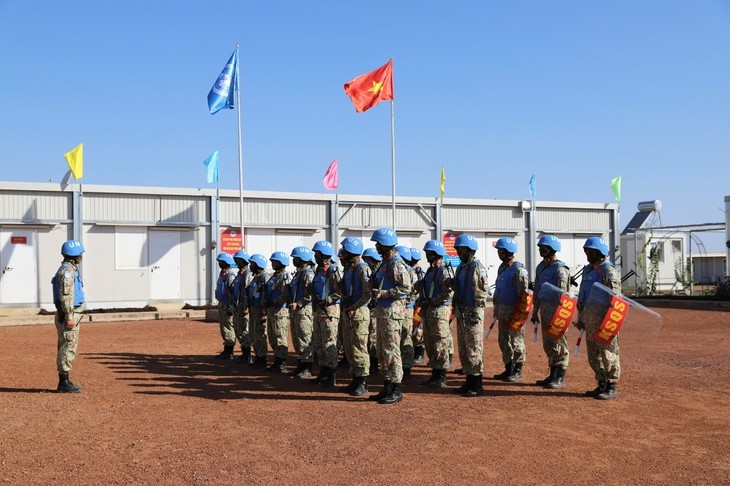 A training session on combat readiness for Vietnam's Engineering Unit Rotation 4 (EngCo 4) at the United Nations Interim Security Force for Abyei (UNISFA) Mission (Photo: Ministry of National Defence) A training session on combat readiness for Vietnam's Engineering Unit Rotation 4 (EngCo 4) at the United Nations Interim Security Force for Abyei (UNISFA) Mission (Photo: Ministry of National Defence) |
MC: Thank you. How has this policy been applied in practice to strengthen international cooperation, especially in peacekeeping, humanitarian response, and defense dialogue?
Maj. Gen. Nguyen Hong Quan: The Four No’s is implemented flexibly and effectively. First, in international cooperation, we avoid dependence on any single partner and diversify our relationships.
In defense industry cooperation, for instance, where we once relied on a small number of countries, Vietnam now works with a broad range of partners for procurement, upgrading, and domestic production of modern equipment. We send trainees to 60 to 70 countries, from Russia and the US to European nations, while also hosting foreign cadets at the National Defense Academy and other officer-training institutions.
In peacekeeping, Vietnam has deployed more than 1,100 officers as well as observers, Level-2 field hospitals, and engineering units to UN missions. We strictly follow UN Security Council standards and focus on areas aligned with our strengths - mainly medical and engineering tasks - rather than enforcement operations. Border-defense exchanges with China, Laos, and Cambodia are held 8 or 9 times per year. We also conduct joint naval patrols with these countries.
A prominent example is Cam Ranh International Port, inaugurated in 2013. It welcomes vessels from Singapore, Japan, the US, and China - not as a military base but as an international port - demonstrating openness while staying true to the Four No’s. Vietnamese coast guard ships have paid goodwill visits to Japan, India, and China, reflecting our proactive approach to defense cooperation.
Lt. Gen. Nguyen Ngoc Thanh: I would add that this policy facilitates our defense diplomacy. Vietnam participates in regional defense forums such as the Shangri-La Dialogue in Singapore, the Xiangshan Forum in China, and defense forums in Tokyo, Seoul, Indonesia, and Malaysia. These events allow us to assess regional dynamics and learn how other countries address strategic challenges, while proposing solutions suitable for Vietnam.
We have held bilateral strategic defense dialogues with major powers like Russia, China, the US, France, and Japan, as well as with ASEAN partners, thereby fostering strategic trust and contributing to regional peace.
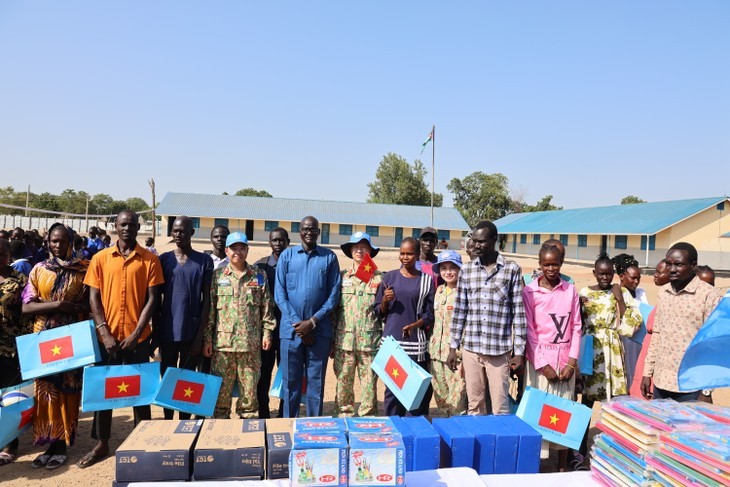 Members of the Vietnamese peacekeeping forces present gifts to local residents. (Photo: Ministry of National Defence) Members of the Vietnamese peacekeeping forces present gifts to local residents. (Photo: Ministry of National Defence) |
MC: To give our audience a clearer picture, we now bring you a report titled “Vietnam Strengthens International Cooperation for Peace and Sustainable Development.” This will highlight how the Four No’s policy is being implemented to shape Vietnam’s image as a peaceful, stable, and reliable partner.
In 2025, Vietnam’s defense cooperation made a strong impression, asserting a defense policy that’s peaceful, self-reliant, and responsible. Those efforts helped defend the nation early and from afar, maintain a peaceful and stable environment for development, and increase Vietnam’s international status and reputation.
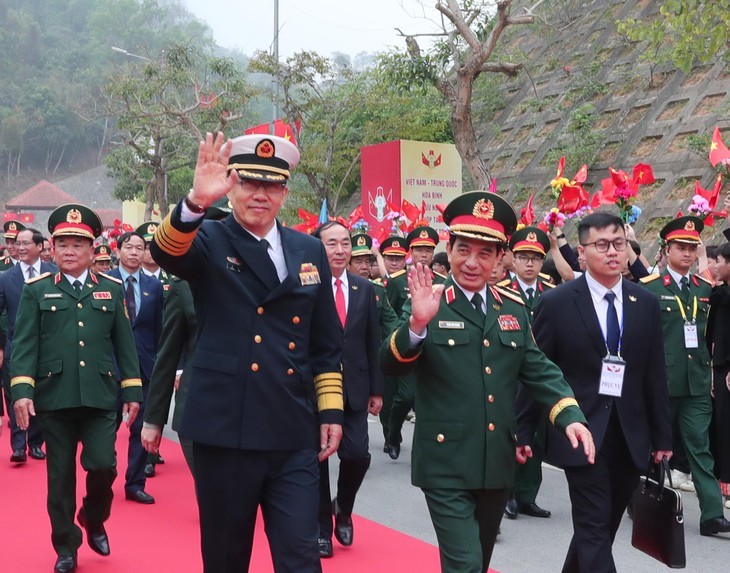 Delegates attend the 9th Vietnam-China Border Defense Friendship Exchange. (Photo: Ministry of National Defence) Delegates attend the 9th Vietnam-China Border Defense Friendship Exchange. (Photo: Ministry of National Defence) |
This April, Vietnam and China held a border defense friendship exchange at the Lang Son-Pingxiang border gate. Amid enthusiastic crowds from communities on both sides of the border, the image of the two defense ministers holding talks, and planting friendship trees, and of the two armies conducting joint patrols and providing medical care became a powerful symbol of traditional solidarity.
This is the ninth year that Vietnam and China have co-organized the event, strengthening cooperation in border management and protection.
“The two units maintain quarterly meetings, conduct joint patrols, exchange information through hotlines and border talks, and cooperate in combating illegal migration and smuggling, helping maintain security and order along the shared border,” Lieutenant Colonel Doan Duy Tien, head of the Border Guard Station at Vietnam’s Huu Nghi International Border Gate in Lang Son province, said.
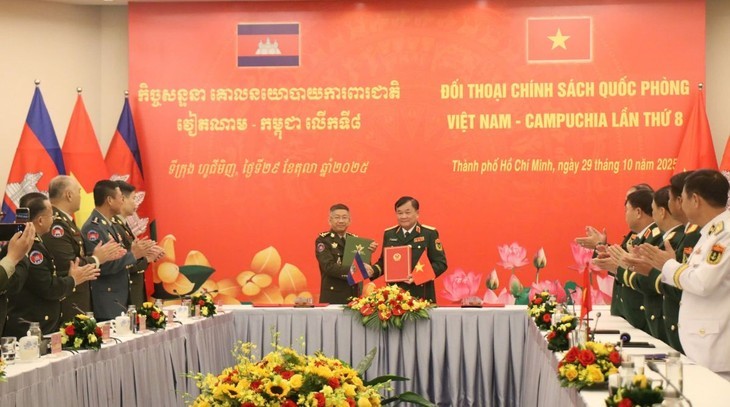 The 8th Vietnam-Cambodia Defense Policy Dialogue takes place in Ho Chi Minh City, October 23, 2025. (Photo: Ministry of National Defence) The 8th Vietnam-Cambodia Defense Policy Dialogue takes place in Ho Chi Minh City, October 23, 2025. (Photo: Ministry of National Defence) |
Similar exchanges with Laos and Cambodia reinforce solidarity, strengthen strategic trust, and ensure borders of peace, stability, cooperation, and development. Through joint patrols, twinning of border communities, and humanitarian support programs, these exchanges have improved border management and deepened bonds between the militaries and peoples of Vietnam and neighboring countries.
Regional cooperation mechanisms like the ASEAN Defense Ministers’ Meeting (ADMM), ADMM+, and the Xiangshan Forum allow Vietnam to emphasize its consistent principles of trust-building, peaceful dispute resolution, and practical cooperation against non-traditional security threats, ranging from natural disasters and cybersecurity to climate change and maritime security.
2025 saw major advances in training cooperation, expert exchanges, and military scientific research. Young officers have been sent to study abroad and exchange experience at leading military academies. Vietnam has hosted multiple high-level defense dialogues with ASEAN and its partners, underscoring its active role in the regional security architecture.
On the ground, Vietnam has organized multiple joint training programs on search and rescue, humanitarian assistance, and disaster relief with experts from other countries, improving capabilities and strengthening mutual trust and understanding. A highlight is Vietnam’s ongoing UN peacekeeping deployment. In remote regions like Abyei and South Sudan, Vietnamese peacekeepers have built roads, schools, wells, and clinics.
Every community project reveals Vietnam’s humane values.
“The conditions in these regions are very difficult, but each completed project brings joy and strengthens international trust in Vietnam,” said a Vietnamese peacekeeper.
Another elaborated, “Our mission is to support local communities in post-conflict areas and share Vietnam’s tradition of peace and humanity. We work closely with local authorities to spread these values.”
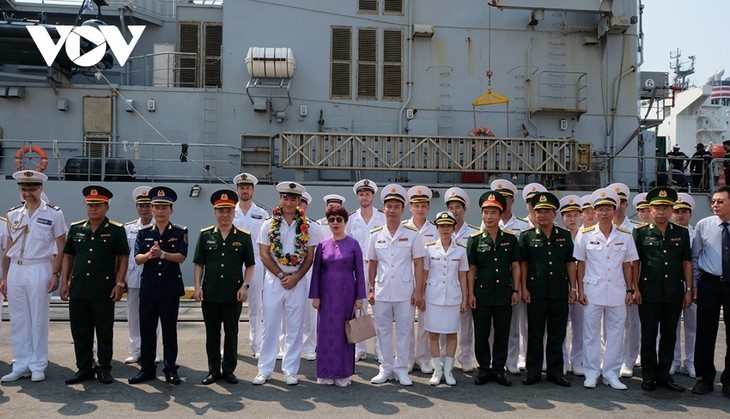 French Navy frigate Vendemiaire, led by lieutenant colonel Sebastien Drouelle, docks at Tien Sa port, commencing a courtesy visit to Da Nang from April 11 to 15, 2024. (Photo: Ministry of National Defence) French Navy frigate Vendemiaire, led by lieutenant colonel Sebastien Drouelle, docks at Tien Sa port, commencing a courtesy visit to Da Nang from April 11 to 15, 2024. (Photo: Ministry of National Defence) |
A UN representative praised Vietnam’s professional and responsible participation, “I'm very impressed with Vietnam's support to peacekeeping operations. Since 2014, you've deployed over a thousand soldiers on various missions, and then you have a rate of over 20% of female peacekeepers on individual deployments.”
Going beyond their professional duties, Vietnamese peacekeepers have supported local communities, demonstrating Vietnam’s compassion and responsibility.
Gabriel Gatduel, Principal of Banpa Primary School in South Sudan, said, “I would like to appreciate the Vietnam peacekeeping mission in South Sudan for their contributions to the education program in this country. We are asking your support to the education program and to the children and people in need in South Sudan. Thank you very much!”
In 2025, Vietnam accelerated cooperation on war legacy remediation - UXO clearance, victim assistance, and dioxin cleanup - with strong international support, especially from the US.
Many bilateral defense cooperation agreements with neighbors, comprehensive partners, and strategic partners were signed or upgraded, covering humanitarian aid, maritime security, officer training, and defense industry collaboration - all founded on Vietnam’s principle of respecting independence, sovereignty, and international law.
“International integration and defense diplomacy continue to be a bright spot, greatly contributing to the Party and State’s external activities and safeguarding the nation early and from afar. Once countries trust us in defense and security, cooperation in other fields becomes much easier,” said Prime Minister Pham Minh Chinh.
Vietnam’s proactive, steady and responsible approach to defense cooperation helps safeguard the nation early and from afar, build strategic trust, improve Vietnam’s international credibility and status, and maintain a peaceful and stable environment for development.
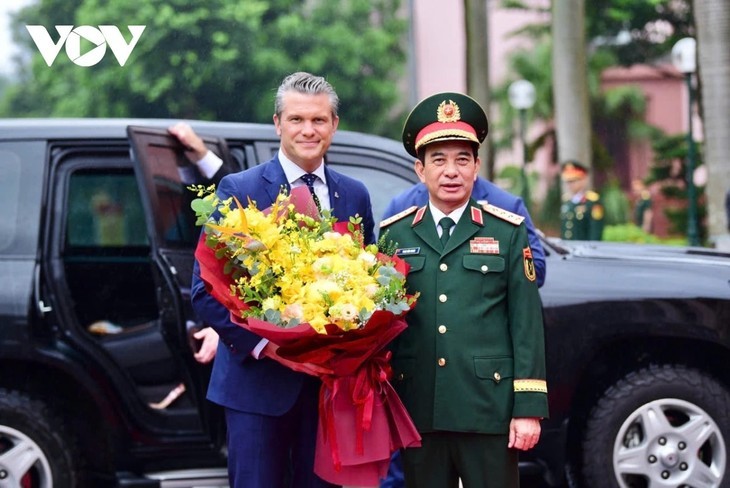 Minister of National Defense General Phan Van Giang welcomes US Secretary of War Pete Hegseth in Hanoi, November 2, 2025. Minister of National Defense General Phan Van Giang welcomes US Secretary of War Pete Hegseth in Hanoi, November 2, 2025. |
MC: As the report shows, the Four No’s policy is not merely a political declaration, it’s implemented comprehensively with real, measurable impact. In today’s environment of major-power competition and rising non-traditional security threats, how should Vietnam apply this policy to safeguard national interests?
Lt. Gen. Nguyen Ngoc Thanh: Vietnam faces complex challenges: great-power strategic competition placing pressure on smaller countries; armed conflicts, territorial disputes, the might makes right mindset; and non-traditional security issues like climate change, cyber threats, new-generation weapons, and AI. To apply the Four No’s, Vietnam must tailor defense relations with each partner based on mutual respect for independence and sovereignty, and the principle of non-interference in each other’s internal affairs. We must also expand multifaceted defense cooperation from training and defense industry to rescue operations and capacity-building; and resolve disputes peacefully and in accordance with international law, avoiding the use or threat of force. The goal is to avoid economic confrontation, diplomatic isolation, or political dependence while building strategic trust and preserving a peaceful environment for development.
Maj. Gen. Nguyen Hong Quan: Flexibility in implementing the policy is essential. We don’t take sides or align against any country, but we still engage widely, from the US, Russia, China, Japan, and India to other ASEAN members. In the ADMM and ADMM+, for example, Vietnam has played a central role, including hosting conferences with ASEAN member states and major partners. In 2010, Vietnam successfully organized the first ADMM+ in Hanoi, achieving consensus among the participants.
We participate in UN peacekeeping with medical units, engineers, and observers matching our strengths and meeting international criteria. Vietnam has provided disaster relief in Turkey, Myanmar, and Cambodia, and conducts regular border exchanges and joint patrols with neighboring countries. These activities improve regional peace, help Vietnam gain experience and access to advanced technologies, and strengthen our international standing.
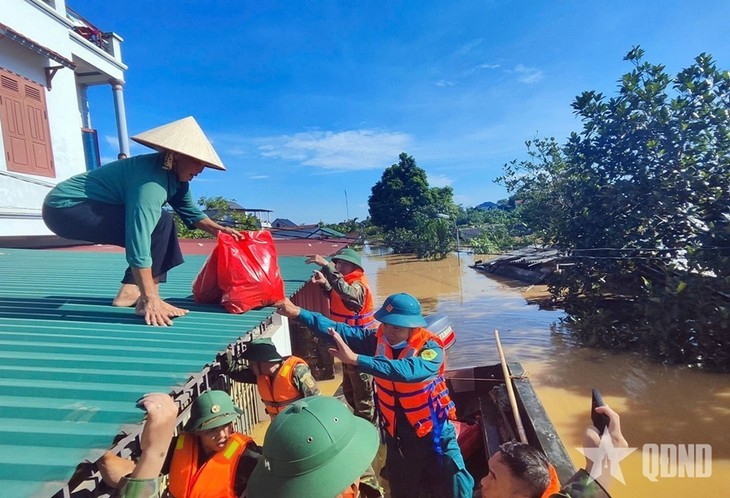 Soldiers evacuate residents of San hamlet in Tien Luc commune, Bac Ninh province, from deeply submerged and isolated areas. (Photo: qdnd.vn) Soldiers evacuate residents of San hamlet in Tien Luc commune, Bac Ninh province, from deeply submerged and isolated areas. (Photo: qdnd.vn) |
MC: Amid rising non-traditional security challenges, how are training and international cooperation being adapted to meet new requirements in international integration?
Lt. Gen. Nguyen Ngoc Thanh: The National Defense Academy has long been tasked with training both domestic and international students, with updated curricula covering climate change, cybersecurity, and disaster response. During the COVID-19 pandemic, the Vietnam Military Medical University deployed personnel to Ho Chi Minh City as if on a real battlefield, following directives from Minister of Defense Phan Văn Giang.
We have specialized programs for foreign students on global security, environmental disasters, and rescue operations. Each year, delegations from national defense academies worldwide come to Vietnam to exchange experience, especially in IT and non-traditional security.
Vietnam presented its “four-on-the-spot” model—on-site command, on-site manpower, on-site logistics, and on-site communication—at the Japan Defense Forum in 2010, receiving high international praise. These exchanges help Vietnamese officers absorb global best practices while sharing Vietnam’s own innovative models.
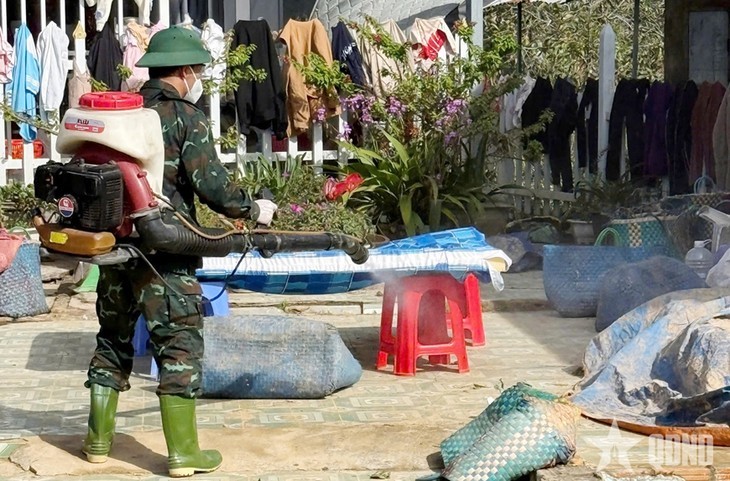 A preventive medicine team from Hospital 7A (Military Region 7) goes door-to-door to disinfect homes in Dran commune, Lam Dong province. (Photo: Bien Cuong/qdnd.vn) A preventive medicine team from Hospital 7A (Military Region 7) goes door-to-door to disinfect homes in Dran commune, Lam Dong province. (Photo: Bien Cuong/qdnd.vn) |
Maj. Gen. Nguyen Hong Quan: To respond effectively to new threats, we need specialized forces including well-trained engineers, medical units, and cyber-defense teams equipped with modern tools such as rescue drilling devices for tunnel landslides, and a tightly coordinated command system from central to local level.
In times of flooding or other disasters, Vietnam’s deployment of military and police personnel reflects a response model that is not always seen in nearby countries. Our four-on-the-spot tactic is a uniquely Vietnamese innovation, widely praised for its effectiveness even under limited resource conditions. The public must be trained in disaster-response skills and work in coordination with the military to maximize effectiveness. Specialized forces, such as military medical teams during COVID-19 or engineering units in rescue missions, must be equipped with modern tools and be well organized to remain fully ready during peacetime.
MC: How does the international community, particularly defense leaders, assess Vietnam’s Four No’s policy, especially at international forums and cooperation programs?
Maj. Gen. Nguyen Hong Quan: The Four No’s is internationally recognized as a transparent, defensive, peace-oriented commitment. In 2010, for example, Vietnam hosted the ADMM pand ADMM+ in Hanoi, bringing together for the first time all 10 ASEAN countries along with major partners including the United States, China, Russia, and Japan. Reaching consensus among such a diverse group was a significant achievement, underscoring Vietnam’s central role within ASEAN.
During a visit to Vietnam this year, General Songwit Noonpackdee, Chief of Defense Forces of the Royal Thai Armed Forces, praised the policy, noting that it allows Vietnam to be a friend to all—from Europe and Africa to Latin America. Countries that once viewed Vietnam cautiously now see a trustworthy, open, and responsible partner. This policy not only enhances the prestige of the Vietnam People’s Army but also helps project the image of a Vietnam of peace, stability, and development.
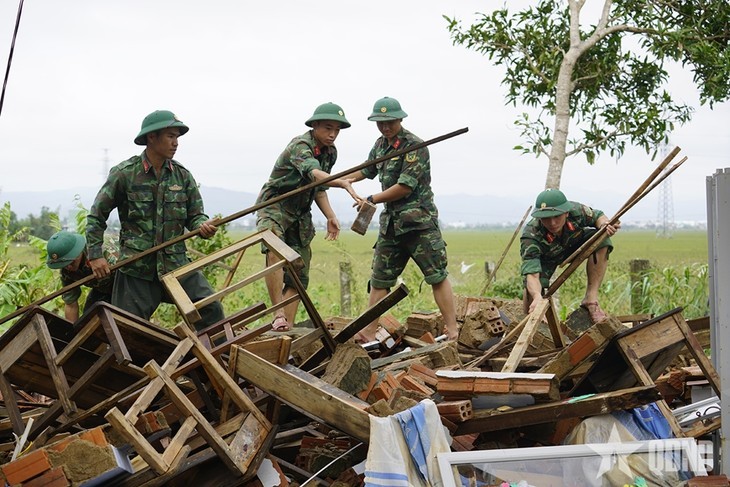 As floodwaters recede, thousands of military officers and soldiers help residents overcome the consequences of the natural disaster. (Photo: qdnd.vn) As floodwaters recede, thousands of military officers and soldiers help residents overcome the consequences of the natural disaster. (Photo: qdnd.vn) |
Lt. Gen. Nguyen Ngoc Thanh: The Four No’s demonstrates Vietnam’s wisdom and mettle, true to President Ho Chi Minh’s words: “Nothing is more precious than independence and freedom.” Through forums like ADMM+, Shangri-La, and Xiangshan, and through border exchanges and international aid missions, Vietnam has shown its active and responsible role, contributing to global peace. The policy safeguards Vietnam’s independence while ensuring stability for socio-economic development to achieve the goal of “prosperous people and a strong, equitable, democratic, and civilized country.”
MC: Thank you, Lieutenant General Nguyen Ngoc Thanh and Major General Nguyen Hong Quan, for your insights. Vietnam’s Four No’s policy stands as a guiding principle for national defense and a symbol of a modern, humane, and responsible nation.