(VOVWORLD) - On March 15, more than 73 million Vietnamese voters will elect deputies to the 16th National Assembly and People’s Councils at all levels for the 2026–2031 term. The choices made by the voters will shape Vietnam’s sustainable development over the next five years.
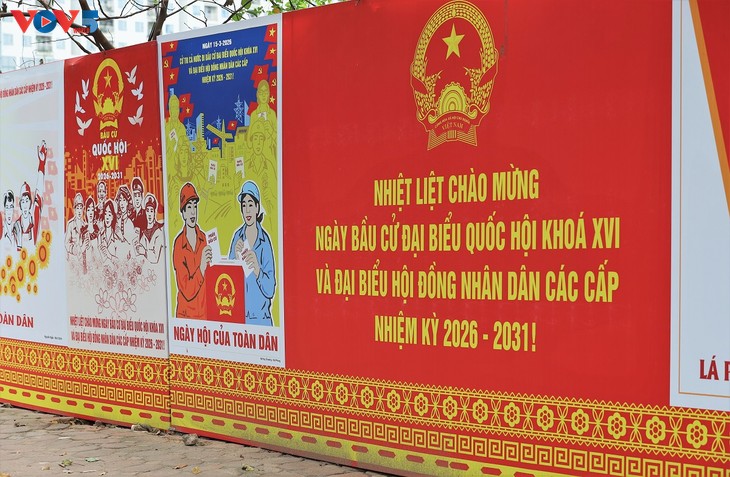 On March 15, 2026, more than 73 million Vietnamese voters will elect deputies to the 16th National Assembly and People's Councils at all levels for the 2026-2031 term. (Illustrative photo: Le Chi/VOV5) On March 15, 2026, more than 73 million Vietnamese voters will elect deputies to the 16th National Assembly and People's Councils at all levels for the 2026-2031 term. (Illustrative photo: Le Chi/VOV5) |
With Vietnam enjoying many new opportunities, the votes of its 73 million voters will be building blocks for a streamlined, effective state that truly serves the people.
Universality, equality and secret ballot
Every vote carries equal weight. Whether a farmer, worker, intellectual, or entrepreneur, whether living in an urban or a rural area, each citizen has the same right to choose and the same responsibility to choose carefully.
At Polling Station No. 2 in Hanoi’s Vinh Tuy ward some voters have spent hours studying the biographies and professional records of the candidates. Voter Tran Danh Dung believes every election is a time for citizens to practice a sacred political right that no one else can exercise on their behalf.
Mr. Dung said: “I’m now 75 years old. I started voting 52 years ago. Voting is a citizen’s right which is very sacred. I always go to vote in person. I study the list of candidates and their achievements and choose those I trust to represent me, voice the people’s concerns, and serve society better. I’ll elect persons who will represent my voice and who I trust.”
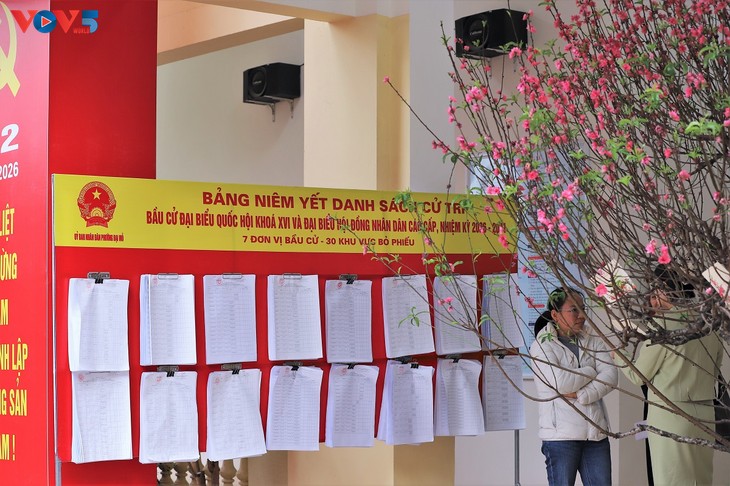 Polling stations in communes and wards in Hanoi have completed the posting of candidate lists and biographies, and voter lists. (Photo: Le Chi/VOV5) Polling stations in communes and wards in Hanoi have completed the posting of candidate lists and biographies, and voter lists. (Photo: Le Chi/VOV5) |
Voters can only exercise their rights fully if the election is conducted fairly and democratically. Nguyen Ngoc Ha, head of Residential Group No. 6 in Vinh Tuy ward, said: "We have publicly posted candidate biographies and voter lists and distributed information directly to households so residents can carefully review each candidate’s contributions before making their decision. Residential Group No. 6 has three public notice boards where we have posted the list of candidates. In addition, we have delivered to each household the lists of candidates running for the National Assembly, the city People’s Council, and the ward People’s Council."
"Every household receives three copies of these lists so the residents can learn about each candidate’s contributions and background, enabling them to select the most suitable representatives," said Ha.
Election preparations are being carried out throughout the country by 34 province-level and 3,321 commune-level election committees.
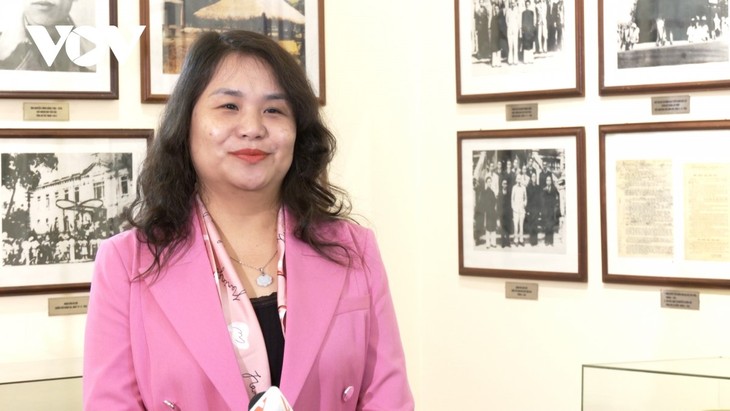 Nguyen Quynh Lien, a member of the Presidium and head of the Committee for Democracy, Supervision and Social Criticism at the Vietnam Fatherland Front (Photo: VOV) Nguyen Quynh Lien, a member of the Presidium and head of the Committee for Democracy, Supervision and Social Criticism at the Vietnam Fatherland Front (Photo: VOV) |
Nguyen Quynh Lien, a member of the Presidium and head of the Committee for Democracy, Supervision and Social Criticism at the Vietnam Fatherland Front, said: "The entire political system is working on the election to be held on March 15. Ensuring the success of the election reflects the principle of ‘placing the people at the center’ and the spirit of a State that is ‘of the people, by the people, and for the people’. The election aims to make people the masters and the driving force of governance. It’s a vivid expression of the people’s democratic right to elect their most outstanding representatives to the highest State authority at the central level — the National Assembly — and to People’s Councils at all levels."
Clear action programs
Candidates’ action programs play a crucial role in the election. They’re a legal requirement and a measure of vision, capability, responsibility, as well as a political commitment to voters.
At a voter meeting in Ho Chi Minh City on Tuesday, municipal Party Secretary Tran Luu Quang said the city aims to develop 27 urban railway lines by 2035, with three lines expected to be completed by 2030. It is also planning a Can Gio sea bridge or tunnel to Vung Tau to reduce traffic pressure on routes through Dong Nai province, while relocating universities and medical facilities to suburban areas.
"Educational institutions, including universities, colleges, and vocational training centers, will be relocated to suburban areas according to a phased roadmap. Medical facilities will establish secondary campuses and then progressively move operations outward. This approach addresses two challenges now facing the city: traffic congestion and environmental pollution," said Mr. Quang.
At a voter meeting in Khanh Hoa province on Wednesday, National Assembly Vice Chairman Nguyen Khac Dinh outlined his action program: "Khanh Hoa province will work with ministries and agencies to submit revisions to National Assembly Resolution 55 on special mechanisms and policies for Khanh Hoa’s development. The revisions introduce new policies as the province expands its development space, including plans for a huge investment in two nuclear power plants. This will make the locality a major growth center in central Vietnam."
The future of Vietnam will be decided on election day, March 15, when the will of the people is expressed directly, fairly, and transparently.