(VOVWORLD) - On July 1 Hung Yen began implementing a two-tier local government model consisting of province level and commune/ward level. This breakthrough reform of the state apparatus aligns with the Party’s guideline. After more than four months, positive changes have validated the correctness and timeliness of the guideline and demonstrated Hung Yen's determination to innovate and build a modern, efficient administration.
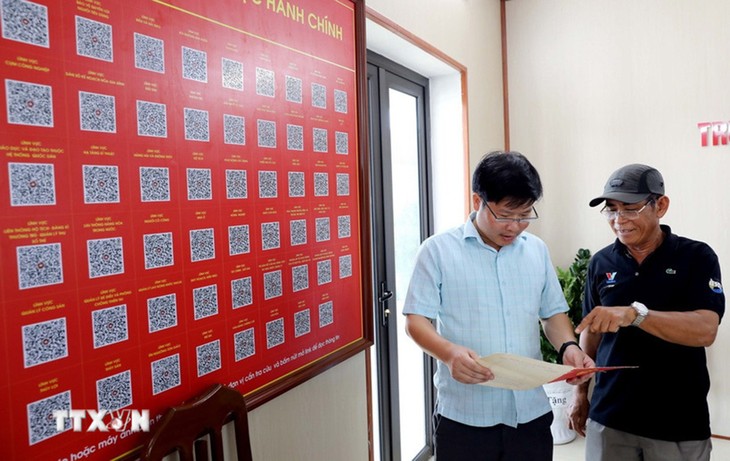 Documents required for administrative procedures are publicly listed via QR codes at Hung Yen’s Public Administrative Service Centers. (Photo: The Duyet/VNA) Documents required for administrative procedures are publicly listed via QR codes at Hung Yen’s Public Administrative Service Centers. (Photo: The Duyet/VNA) |
The first province in the Northern Delta to apply the two-tier model, Hung Yen has comprehensively reorganized its administrative agencies and public service units into a more streamlined and coordinated system.
Following the launch of the new model, new provincial and communal public service centers began operation. Citizens can now submit dossiers at any administrative point in the province regardless of administrative boundaries. This reform reflects a shift from being a "managing government" to being a "serving government."
Many citizens have expressed their satisfaction with faster processing times and a more professional and responsible attitude on the part of officials.
"The officers at the public administrative service center are enthusiastic and process documents much quicker than before. Upon arrival, an officer guides us directly to the person who can carry out the procedure that matches our exact purpose. Explanations and instructions are clear, so the process is very fast."
"When we came to the new office, they welcomed us enthusiastically and resolved the procedure quickly."
"I’m very pleased because the process is handled very fast, living up to the people’s aspirations."
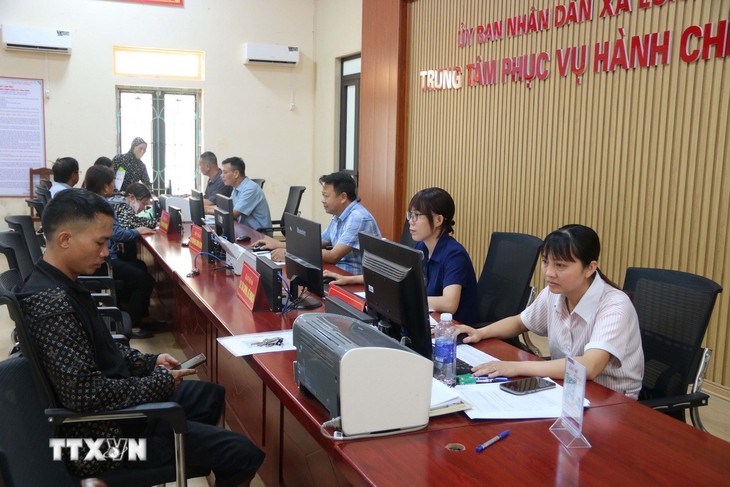 Long Hung commune Public Administrative Service Center (Photo: Thu Hoai/VNA) Long Hung commune Public Administrative Service Center (Photo: Thu Hoai/VNA) |
In the past, each commune had its own administrative apparatus, resulting in cumbersome management and limited financial resources, which hindered investment in new rural infrastructure. Now, after the merger, the administrative system is more streamlined and operational budgets have been reduced, allowing the locality to focus resources on development investment.
Nguyen Huu Duong, Chairman of the Tien Tien communal People's Committee, said, "To promote socio-economic development, especially to improve the quality of new rural criteria, we have reviewed all indicators, particularly the construction of village and hamlet roads, to ensure reasonable and effective capital allocation."
With a larger area and population after the merger, the communal-level authorities in Hung Yen now enjoy greater autonomy in spatial planning, mobilizing development resources, and implementing socio-economic programs.
Pham Van Phuong, Chairman of Hoang Hoa Tham communal People's Committee, told VOV, "Four months after the merger, thanks to the strong participation of the entire political system and practical leadership, all specialized units, officials, and public servants have worked in accordance with local directives, especially in administrative procedure reform serving the people. It can be said that operations so far are fundamentally on schedule."
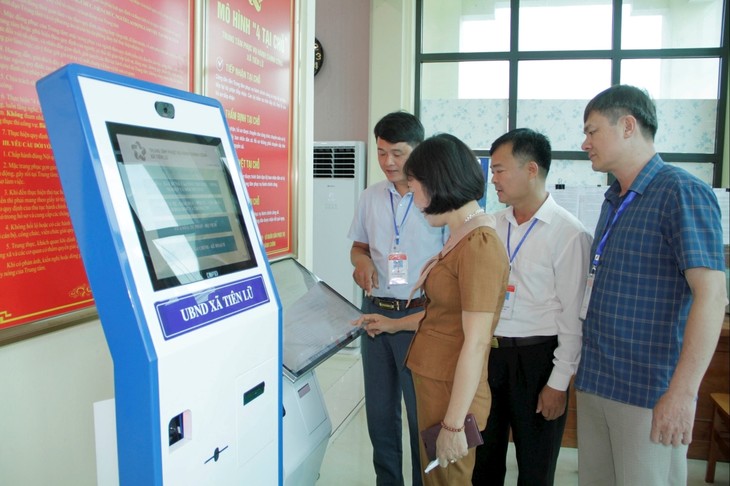 Officials at the Tien Lu Commune Public Administrative Service Center guiding a citizen to take a queue number. (Photo: diendandoanhnghiep.vn) Officials at the Tien Lu Commune Public Administrative Service Center guiding a citizen to take a queue number. (Photo: diendandoanhnghiep.vn) |
Thanks to the effective use of autonomy—particularly in investment attraction, land-use planning, and the development of upgraded urban and new rural areas—the new administrative units have management better aligned with the demands of industrial, urban, and service-sector growth.
The streamlined government model enables Hung Yen to harmonize development across urban, industrial, and rural areas. Planning has become more unified, coordination has improved, and fragmentation has been reduced, particularly in land-use planning, transport connectivity, investment attraction, and environmental protection.
Tran Quang Binh, a Party member in Tien Lu commune, said, “Initially there were concerns, but now Party members and the public have full confidence. After the merger, our administrative unit became larger, but we promptly developed action plans, so economic development continues."
The most evident shift in Hung Yen's two-tier local government operation is the combination of a streamlined administrative apparatus, modernized governance, and improved public service delivery. This gives Hung Yen a foundation for leveraging its advantages and becoming a modern, industrialized province within the capital region. The results so far have shown that the two-tier local government model matches the development requirements of the new era.