(VOVWORLD) - The clanging of electric trams, once a familiar part of daily life for generations of Hanoians, has been revived by the Metro Line 6 Project in the Ngu Xa-Truc Bach neighborhood. The project takes visitors several decades back in time, to a Hanoi with honeycomb coal stoves, ration coupons, wooden cupboards, and other everyday objects that stir the memories of older generations.
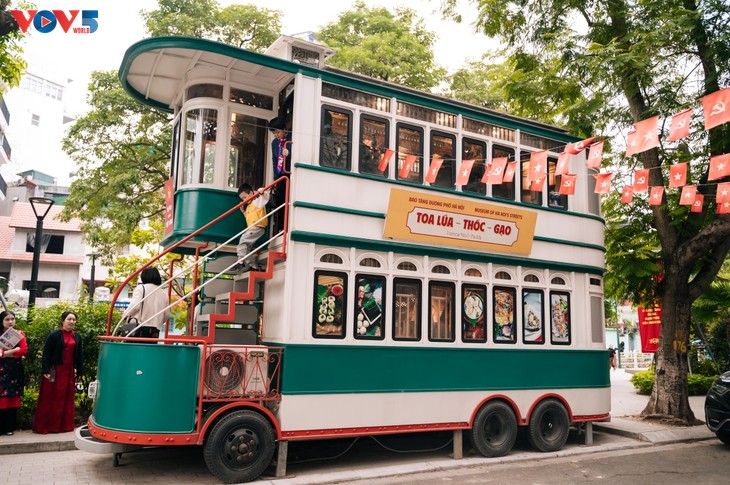 The Metro Line 6 Project is part of an initiative launched by the Ba Dinh ward People’s Committee that provides a space where Hanoi’s heritage can be revisited and celebrated. (Photo: Kim Lieu/ VOV5) The Metro Line 6 Project is part of an initiative launched by the Ba Dinh ward People’s Committee that provides a space where Hanoi’s heritage can be revisited and celebrated. (Photo: Kim Lieu/ VOV5) |
The Metro Line 6 Project is part of a model launched by the Ba Dinh ward People’s Committee that provides a space where Hanoi’s heritage can be revisited and celebrated. The project has built two-story tram carriages designed to be living museums where visitors can experience Hanoi with all five senses.
“Instead of asking young people to visit heritage sites, we bring heritage directly to them, making it more accessible and engaging. The spaces are designed to draw young people in and encourage them to explore further,” said Nguyen Huy Dan, Vice Chairman of the People’s Committee of Ba Dinh ward. “Once inside, they’re introduced to a world of tangible and intangible cultural heritages to help them understand, appreciate, and cherish the legacy passed down by previous generations.”
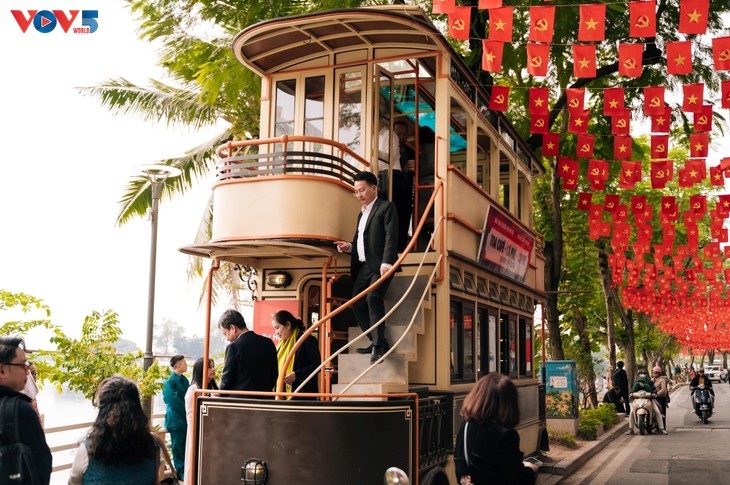 The Metro Line 6 Project is inspired by the iconic sound of Hanoi’s trams from 1901 to 1991. (Photo: Kim Lieu/VOV5) The Metro Line 6 Project is inspired by the iconic sound of Hanoi’s trams from 1901 to 1991. (Photo: Kim Lieu/VOV5) |
Ba Dinh ward has 5 heritage tramcars, 4 next to Truc Bạch Lake and one near the Hang Dau Water Tower. Each car is a self-contained world that retells stories of the past.
The Rice–Paddy–Grain Car takes visitors on a rice journey from sowing to harvesting to milling rice. The Kitchen–Cupboard–Tray Car recreates a Vietnamese kitchen of the subsidy era, where ration coupons and oil stoves recall a time of hardship and resilience.
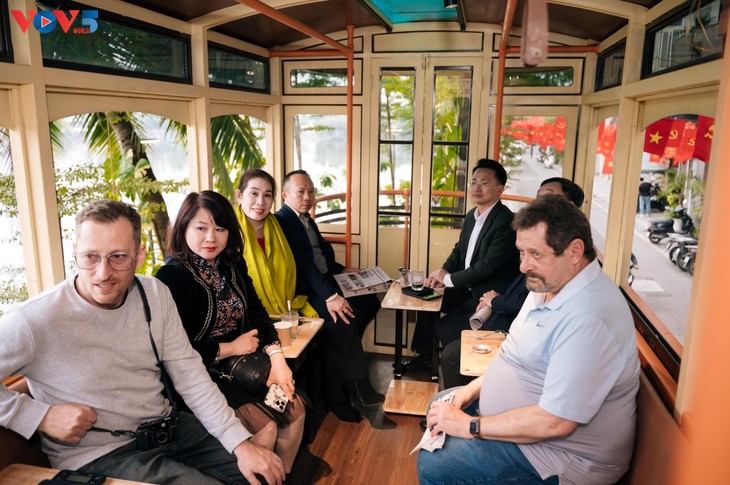
Visitors can brew their own cup of coffee in the Coffee Car. And in the Tea–Scholarly Pastimes Car they can immerse themselves in the refined culture in which royalty and scholars once combined tea drinking with scholarly arts like music, chess, poetry, painting, calligraphy, and flower arranging.
 (Photo: Kim Lieu/VOV5) (Photo: Kim Lieu/VOV5)
|
The Pho–Noodles Car tells culinary stories about Hanoi’s iconic pho and other noodle dishes from Vietnam’s three regions.
“Visitors can experience Hanoi with all five senses. They don’t just listen to explanations, they step inside a car where they can enjoy the the delicate aroma of pho and the bracing scent of coffee. Then they can savor some pho, coffee, traditional spring rolls, or tea,” Nguyen Tien Dat, Vice Chairman of the Hanoi Tourism Association, said.
Pham Thu Huong, a resident of O Cho Dua ward, was thrilled by this journey into the past. “My childhood took place in the subsidy period. Seeing the ration coupons, old wedding photos, gift thermos flasks, and bouquets of gladiolus flowers brought those memories rushing back.”
“I never imagined the organizers could gather so many artifacts from that time and arrange them in such a small space that feels both warm and true to the spirit of the subsidy era. Everything is modest and simple, and deeply familiar. These items are extremely difficult to find today,” said Huong.
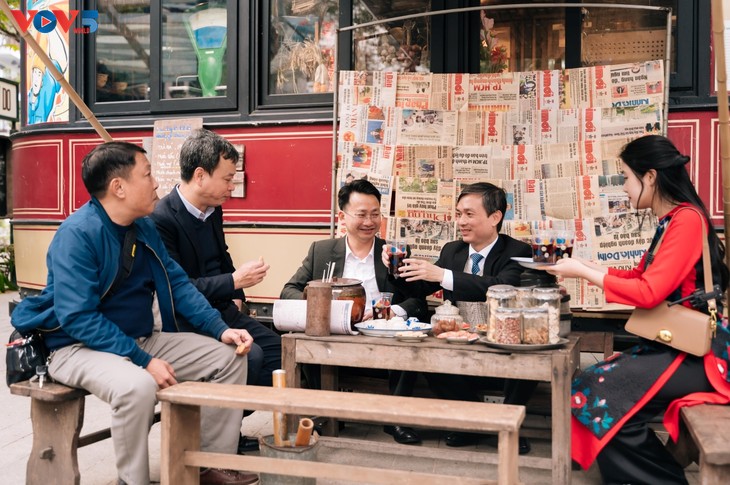 The nostalgic atmosphere is evoked not only through old objects but also through a sense of familiarity. (Photo: Kim Lieu/VOV5) The nostalgic atmosphere is evoked not only through old objects but also through a sense of familiarity. (Photo: Kim Lieu/VOV5) |
The ‘Bringing Heritage to the Street’ model has quickly attracted visitors, especially young people.
“My grandmother and mother are originally from Hanoi, but I was born and raised in Quy Nhon city. I only knew about old Hanoi through stories told by them, and never knew what that world really looked like. Today I saw pots, pans, and jars, everyday items I’d never seen before.”
“I saw many tools and household items that are no longer in use today. I hope models like this will be expanded further, so people who didn’t live in that historical period can see what previous generations went through and acquire a deeper love for Vietnamese culture.”