(VOVWORLD) - US President Donald Trump’s visits to Saudi Arabia, Qatar, and the United Arab Emirates (UAE) from Tuesday to Friday were widely regarded as a big economic success, securing economic deals worth trillions of US dollars and reasserting America’s geopolitical influence in the Middle East after a period of decline.
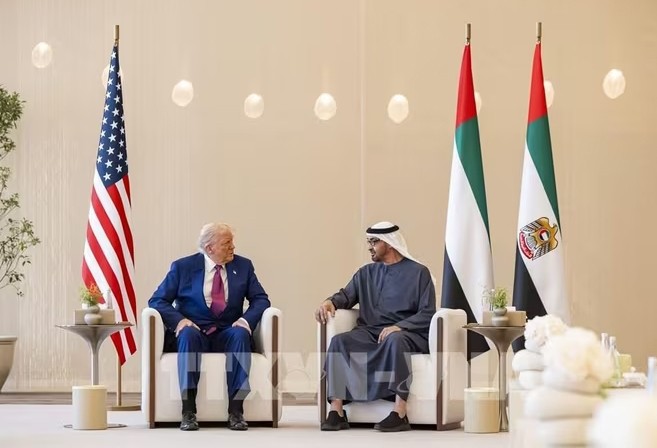 US President Donald Trump and UAE President Sheikh Mohamed bin Zayed Al Nahyan meet in Abu Dhabi on May 15, 2025. (Photo: VNA) US President Donald Trump and UAE President Sheikh Mohamed bin Zayed Al Nahyan meet in Abu Dhabi on May 15, 2025. (Photo: VNA) |
A rain of contracts
In Saudi Arabia, the first stop of his Middle East tour, President Trump and Saudi leaders signed agreements worth over 300 billion USD. Saudi Arabia committed to investing 600 billion USD in the US. President Trump and Crown Prince Mohammed Bin Salman signed a US-Saudi strategic economic partnership agreement, which includes memorandums of understanding and cooperation agreements on energy, mining, and defense. Notably, the deal includes a 142-billion-USD defense package aimed at modernizing Saudi Arabia’s armed forces.
In Qatar, Emir Sheikh Tamim bin Hamad Al-Thani and President Trump announced deals worth 1.2 trillion USD, including a landmark agreement between Qatar Airways and Boeing. Qatar Airways ordered 210 wide-body aircraft, the largest order in Boeing’s history. Trump said the deal is worth 200 billion USD.
The UAE signed multiple agreements in defense, energy, and technology and reaffirmed its March 2025 commitment to invest up to 1.4 trillion USD in the US over the next decade.
Economists said these agreements are a clear win for Trump. The US has enhanced its technology cooperation with those countries, will supply 18,000 advanced Nvidia AI chips to Saudi Arabia, and has promised to collaborate with the UAE in AI and 5G.
“People in this part of the world have always wanted to do more business with US companies and companies all around the world. But they have found it very difficult to get meaningful technology transfer, meaningful long-term investments from the US,” Imad Al-Abdulqader, a business and policy consultant with the DGA Group in Riyadh, said.
 Crown Prince Mohammed Bin Salman (3rd from right) and President Donald Trump meet in Riyadh on May 13, 2025. (Photo: VNA) Crown Prince Mohammed Bin Salman (3rd from right) and President Donald Trump meet in Riyadh on May 13, 2025. (Photo: VNA) |
Diplomatic results
Trump’s tour also made diplomatic progress. In Saudi Arabia, under Crown Prince Mohammed Bin Salman’s mediation, Trump met Syria’s new leader, Admed Al-Sharaa. It was the first meeting between the leaders of those two countries in 25 years. Prior to the meeting, Trump said he will lift long-standing US sanctions on Syria and encouraged Syria to normalize ties with its neighbors, including Israel.
Observers said it was a diplomatic win, not only for Trump, but also for Saudi Arabia and Turkey, who support Syria’s new leadership and are keen to accelerate the country’s reconstruction.
Trump’s offer to lift sanctions and consider early normalization with Syria was seen as a boost to US foreign policy in the Middle East, which has been criticized for its approach to the Israel-Hamas conflict in Gaza.
“There's a humanitarian reason to want the sanctions to be lifted, which is that the people of Syria have suffered under the sanctions. They've suffered from natural disasters in the past few years. There was an earthquake not very long ago, and levels of poverty are extremely high. If you want Syria to be able to make it as a country and not fall apart into a renewed civil war, it makes sense that you would want sanctions to be lifted," Rosemary Kelanic, Director of the Middle East Program at the Defense Priorities Organization, said.
Trump and the leaders of the three countries also discussed the Iran nuclear issue, a ceasefire between the US and the Houthis in Yemen, and the US’s vision for ending the Gaza conflict.
Trump reaffirmed a diplomatic approach to Iran’s nuclear program and emphasized the mediation roles of Qatar and the UAE. This was viewed as a positive sign, easing concerns about future tensions between the US, Israel, and Iran.