(VOVWORLD) - 2025 saw many significant advances in Vietnam’s foreign affairs, demonstrating its proactiveness, flexibility, and strategic vision in a rapidly changing world. Over the last year, Vietnam consolidated its traditional relationships and enhanced its influence and standing on the global stage.
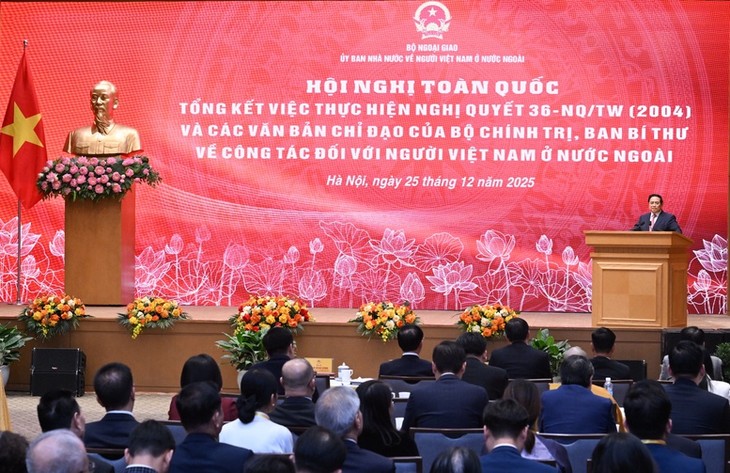 Prime Minister Pham Minh Chinh speaks at a national conference reviewing the implementation of documents issued by the Poliburo and Secretariat on overseas Vietnamese affairs. (Photo: VGP) Prime Minister Pham Minh Chinh speaks at a national conference reviewing the implementation of documents issued by the Poliburo and Secretariat on overseas Vietnamese affairs. (Photo: VGP) |
2025 has been the most successful year for Vietnamese diplomacy since the early 2020s, marked by an expansion of international relations and the signing of numerous strategic cooperation agreements.
Highlights
The number of high-level visits and dialogues between Vietnamese leaders and foreign partners in 2025 increased sharply from previous years, fostering a more sustainable strategic connectivity.
Vietnam upgraded relations with several major partners, bringing the total number of comprehensive strategic partnerships and strategic partnerships to 42. By establishing a comprehensive strategic partnership with the UK, Vietnam now has such a partnership with all five permanent members of the UN Security Council.
Vietnam’s diplomatic outreach in 2025 spanned the globe, highlighted by its hosting of the signing ceremony of the UN Convention against Cybercrime (the Hanoi Convention), which affirmed the international community’s trust in Vietnam’s coordinating role in addressing cybersecurity issues.
“Hosting the signing of the Convention provides us new cooperation opportunities in preventing and combatting transnational cybercrime as well as in other fields. Vietnam’s international standing and role are not measured by a single event. They are the result of a long-term process. We must continue to actively participate in global issues, under our foreign policy of being a responsible and active member of the international community," Deputy Minister of Foreign Affairs Dang Hoang Giang said.
Vietnam was re-elected to the UN Human Rights Council for the 2026-2028 term with the most votes in the Asia-Pacific region. This is the third time Vietnam has held that position, reaffirming its leading role in promoting and protecting human rights.
Amid intensifying global competition and rising protectionism, economic diplomacy has made a direct contribution to Vietnam’s GDP growth. Hundreds of major cooperation agreements were signed in multiple sectors. Export turnover exceeded 920 billion USD, placing Vietnam among the world’s 15 leading trading nations. The number of foreign direct investment projects rose 22%, mainly in science, technology, innovation, artificial intelligence, and energy, areas that Vietnam identifies as strategic breakthroughs in the new development era.
In cultural diplomacy, the Cultures of the World Festival, held for the first time in Hanoi, helped Vietnam affirm its position and leverage soft power. The festival went beyond conventional cultural and artistic exchanges to become a celebration of solidarity and culture for peace. A number of national anniversary celebrations promoted Vietnam’s rich culture and openness to international cooperation and sustainable development.
A new strategic position
Diplomatic achievements in 2025 laid a solid foundation for Vietnam to enter 2026 with greater confidence and international standing.
“Foreign affairs are of strategic importance as we enter a new era with a new mindset, status, and the capacity to proactively shape our position, create a favorable environment for national development, identify new opportunities for participation in higher-quality supply chains, and build international rules aligning with Vietnam’s laws and interests,” former Deputy Minister of Foreign Affairs Pham Quang Vinh said.
Strengthened political trust with major partners, expanded space for economic and trade cooperation, and an increasingly prominent role in multilateral mechanisms have given Vietnam more room for development.
To adapt to global fluctuations and seize opportunities, Prime Minister Pham Minh Chinh emphasized new requirements for the foreign affairs sector.
“We must further strengthen bilateral diplomacy to connect economies, cultures, digital technologies, and people. It is crucial to better fulfill our international missions and promote Vietnam’s role, position, and participation in reforming global governance, especially at multilateral forums and mechanisms.”
2026 will see the transformation of 2025’s diplomatic achievements into driving forces to fulfill national development goals and open a new phase of growth with strong internal capacity and confidence in global integration.