(VOVWORLD) -The resurgence of traditional threats and the emergence of new risks in the high-tech era are jeopardizing global maritime security. The UN Security Council made the warning amid mounting global instability.
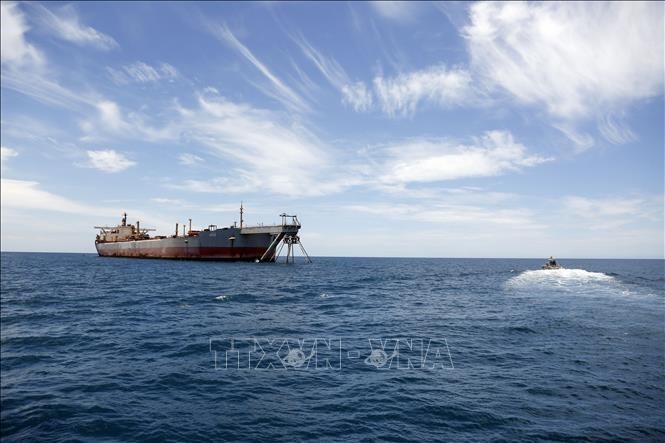 An oil tanker on the Red Sea (Photo: Xinhua/VNA) An oil tanker on the Red Sea (Photo: Xinhua/VNA) |
The UN Security Council on Monday held a high-level open debate on maritime security, focusing on prevention, innovation, and international cooperation to address emerging challenges. This was the second UNSC meeting on maritime security in two months, a move reflecting the international community’s growing concern over challenges in the maritime industry, which plays a vital role in the global economy.
Traditional threats
José Raúl Mulino, President of Panama, which holds the rotating presidency of the UNSC in August, said 80% of world commerce is transported over sea routes, making maritime security crucial to the global economy.
However, recent reports from the UN and the International Maritime Organization (IMO) show alarming instability in maritime security. Piracy and armed robbery incidents reported in the first quarter of 2025 surged 47.5% compared to the same period last year. Certain hotspots are particularly concerning, such as the Gulf of Guinea in West Africa, which recorded 44 maritime attacks on commercial vessels in the first two months of this year, the most in 13 months.
IMO Secretary-General Arsenio Dominguez said: “The safety and security of the maritime sector is fundamental to economic stability, sustainable maritime development and to livelihoods. Threats to shipping are ever-present. 2024 alone, nearly 150 incidents of piracy and armed robbery were reported.”
Interpol Secretary-General Valdecy Urquiza said traditional maritime threats like piracy and armed robbery are surging in many areas, including the Gulf of Guinea, the Strait of Malacca, and the Red Sea.
The situation in Southeast Asia has worsened significantly as vessel attacks have sharply increased. Even more troubling, these threats are becoming more complex as criminal networks, moving beyond isolated ship attacks and cargo theft, forge links with terrorist organizations and financial crime groups.
Urquiza urged for closer monitoring, saying “We also continue to see the crime-terror nexus play out at sea, where groups are taping into criminal supply chains, moving weapons, operatives, and illicit goods to finance their activities. These trends point to a broader shift. What were once isolated offenses have evolved into converging maritime threats, carried out through the same command structures, routes, and financial flows.”
Technological challenges
Technology-related risks are generating new challenges for maritime security. Cyberattacks can disrupt ship routes, threaten safety at sea, expose sensitive commercial data, and cause environmental disasters. Criminals’ increased use of tracking technology makes vessels more easily detected and targeted. Even seaports are not immune to these new threats.
“As ports go digital with automated vessel management, cargo tracking and logistics, vulnerabilities are emerging faster than they can be secured. Ports are facing a wave of cyber intrusions, targeting the power, communication and logistics systems they rely on. Cyber criminals can weaponize artificial intelligence to attack with greater speed, scale and precision,” said Interpol chief Urquiza.
Geopolitical instability is another unpredictable threat to maritime security. Attacks by Yemen’s Houthi forces on commercial ships in the Red Sea since late 2023 after fighting erupted in Gaza have driven up global maritime trade costs.
In early July, Houthis attacked the Magic Seas and the Eternity C, killing at least four people and forcing hundreds of others to divert their route. Osama Rabie, Chairman of Egypt’s Suez Canal Authority (SCA), said on August 1 that Houthi attacks have severely disrupted navigation through the Suez Canal, which links the Mediterranean Sea to the Red Sea. The number of transiting ships has dropped from 70-80 ships per day to just 30-35, and the canal’s revenue fell more than 60% last year, from a record 10.25 billion USD in 2023 to 3.99 billion USD, severely impacting Egypt’s economy.
Panamanian President Mulino said that to cope with and mitigate the impact of geopolitical tensions, countries should abide by and defend international rules and regulations, and ensure equal access to key maritime routes. He cited the example of the Panama Canal, where this approach has doubled its ship-handling capacity and strengthened security over the past 25 years.