(VOVWORLD) - As Vietnam prepares for the 14th National Party Congress, digital transformation and green transition have been identified as cross-cutting goals. Within this strategic framework, building a green and sustainable marine economy is a clear, long-term vision, aimed at unlocking the full potential of the seas while protecting the environment, marine ecosystems, and ensuring lasting livelihoods for future generations.
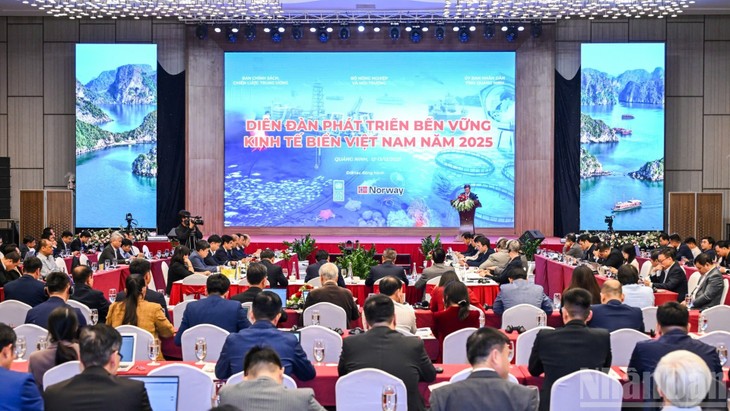 A view of the Vietnam Marine Economic Sustainable Development Forum 2025. (Photo: nhandan.vn) A view of the Vietnam Marine Economic Sustainable Development Forum 2025. (Photo: nhandan.vn) |
Vietnam is a maritime nation, with more than 3,000 kilometers of coastline, a vast exclusive economic zone, and thousands of islands. The sea is a living space, a strategic defense line, and a key driver of the country’s socio-economic development.
Harnessing marine potential to create new growth drivers
Moving away from the model of raw resource extraction, Vietnam is prioritizing high-value-added, green marine industries, green shipping, sustainable tourism, high-tech aquaculture, and offshore renewable energy. Green marine economic development is closely linked to safeguarding livelihoods and improving living standards for coastal and island communities.
At a forum on Vietnam’s sustainable marine economic development, held in Quang Ninh province last week, Hang Thanh Vinh, Program Manager with the UN Development Program, praised Vietnam’s efforts to establish marine aquaculture industrial clusters.
Vinh said: “Forming marine aquaculture clusters allows local people to participate much like in industrial parks, creating solid infrastructure with stable inputs and outputs. This is a very important direction.”
Vietnam places strong emphasis on protecting the marine environment and ecosystems. Marine management and conservation have been strengthened; fisheries are strictly controlled; and illegal, unreported and unregulated (IUU) fishing is being eliminated to protect resources and meet international integration requirements. Efforts to restore mangrove forests and coral reefs and reduce marine plastic waste are creating a “green shield” for coastal areas.
Green shipping, another trend, is boosting competitiveness and increasing the resilience and adaptability of businesses.
Dao Trong Khoa, Vice Chairman of the Vietnam Logistics Business Association, said: “Green requirements and rapid adaptability are two essential components of any supply chain amid geopolitical uncertainties and rising global demand for decarbonization. The journey toward green and agile logistics will contribute significantly to reducing carbon emissions in Vietnam’s maritime logistics sector.”
Growth, security, environment, and international standing
To advance a green marine economy, Vietnam is steadily improving institutions and rolling out national strategies on green growth and the circular economy, while integrating environmental protection goals into socio-economic development planning. A key policy framework is Resolution 36 on a sustainable development strategy for Vietnam’s marine economy to 2030, with a vision to 2045.
Positive momentum is evident across sectors. Renewable energy, particularly offshore wind, where Vietnam has an estimated potential of over 600 GW, is reshaping the energy mix and reducing reliance on fossil fuels. At the same time, Vietnam is mastering technologies to develop the marine economy with a green mindset.
To form green marine growth poles and connect economic centers, Vietnam stands ready to cooperate, participate, and contribute actively to global ocean networks.
At the United Nations Ocean Conference in France last September, Prime Minister Pham Minh Chinh said: “As a marine nation, Vietnam is committed to being a reliable partner, ready to join global efforts to protect the ocean, and an active partner willing to help lead cooperation mechanisms for green and sustainable marine development. Vietnam stands ready to contribute initiatives on fair and sustainable blue finance, step up investment in marine science research and application, and promote technology transfer, research cooperation, experience sharing, and the effective pursuit of sustainable marine economic development.”
Developing the marine economy in a green and sustainable manner is inevitable for Vietnam, a way to generate wealth from the sea while preserving a vital living space and making a meaningful contribution to global sustainable development goals.