 (Photo: VGP) (Photo: VGP) |
Vietnam - a destination of high-level dialogue and global initiatives
Amid global volatility, stability has become one of the most valuable strategic assets. Against this backdrop, Vietnam is emerging as a venue for dialogue, long-term cooperation, and forward-looking global initiatives.
Vietnam’s foreign policy of independence, self-reliance, multilateralisation and diversification, anchored in cooperation and dialogue, has shaped its image as a reliable partner, a place where major ideas can begin and spread.
In October 2025, Hanoi welcomed the United Nations Secretary-General, representatives from nearly 190 UN member states, and international and regional organizations to the signing ceremony for the first comprehensive international convention on preventing and combating cybercrime.
 Vietnamese President Luong Cuong speaks at the signing ceremony of the Hanoi Convention, October 25, 2025. Vietnamese President Luong Cuong speaks at the signing ceremony of the Hanoi Convention, October 25, 2025. |
At a time when cyberspace has become a new frontline for transnational crime, the selection of Hanoi for signing the convention reflects the international community’s trust in Vietnam. Here’s what some participants had to say:
“We see Vietnam not only with the capacity, the competence to deal with and to contribute for a global response to cyber security, but as a country that is respected and a country that has a growing role in international relations. I'm very happy that we are signing this Convention here in Vietnam. We couldn't find a better place.”
“For our Secretary General, to put that trust and faith in the Vietnamese Government to celebrate the 80th anniversary of the United Nations here in Hanoi, it cannot show in a stronger way the trust that we have in the Vietnamese Government and its role in terms of multilateralism within the United Nations. The fact that they've put their hand up and the commitment that they've shown in bringing us to this point in this signing ceremony is a testament to their strong placement within the international setting at the moment.”
“I want to thank and commend the Government of Vietnam for their leadership on global cybercrime responses and for hosting the conference. The efforts and resources invested by Vietnam to ensure a successful conference are admirable and the UN Office on Drugs and Crime is proud to work with them on this ambitious endeavor.”
The “Hanoi Convention” opens a new chapter in global cooperation on cybersecurity and stands as a symbol of cooperation, dialogue, and international responsibility which represents the impact that Vietnam has made throughout its participation in the United Nations.
 UN Deputy Secretary-General Amina Mohammed addresses the Partnering for Green Growth and the Global Goals 2030 (P4G) Summit, Hanoi, April 2025. UN Deputy Secretary-General Amina Mohammed addresses the Partnering for Green Growth and the Global Goals 2030 (P4G) Summit, Hanoi, April 2025. |
In 2025, Vietnam hosted the Partnering for Green Growth and the Global Goals 2030 (P4G) Summit. Addressing more than 1,000 international delegates at the event, UN Deputy Secretary-General Amina Mohammed said that Vietnam is demonstrating that attracting investments even in these challenging times is not only possible but achievable.
“With FDI reaching impressive new levels of two to three billion dollars every month, Vietnam stands as a powerful example for others to follow. New models and genuine partnerships can mobilize finance at a scale to drive commitments on climate and sustainable development.”
Vietnam has also been a destination for high-level visits and strategic dialogues. In April 2025, Party General Secretary and President of China Xi Jinping paid a State visit to Vietnam, his fourth visit in his capacity as China’s top leader.
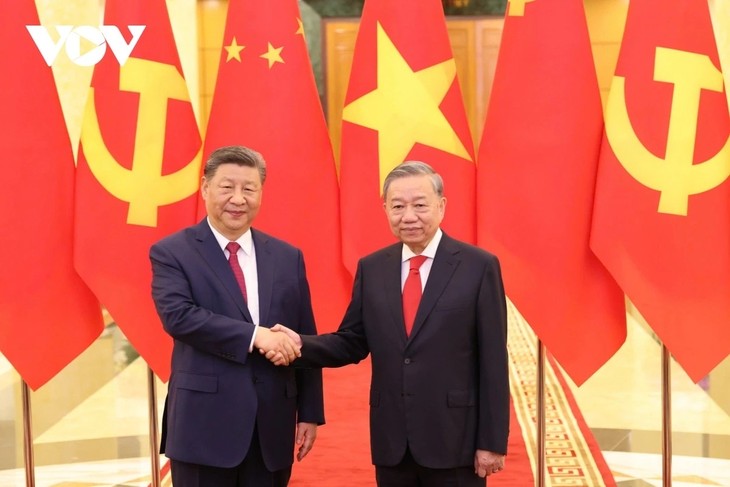 Party leader To Lam Party and Party General Secretary and President of China Xi Jinping Party leader To Lam Party and Party General Secretary and President of China Xi Jinping |
The two sides achieved remarkable outcomes, which are the most substantial results among all of Mr. Xi’s visits to Vietnam, said Professor Xu Libin, Director of the Center for Southeast Asian Studies at the Chinese Academy of Social Sciences.
“45 cooperation agreements were signed, covering a wide range of areas, from infrastructure connectivity, especially railways, to artificial intelligence, human resource training, border quarantine, the digital economy, the green economy, culture, and social welfare. This reflects both the breadth and depth of relations between the two Parties and countries,” he added.
Vietnam’s improved and expanded partnership with China in strategic sectors has become a defining feature of bilateral relations, as both countries enter a new era of development.
In 2025, Vietnam welcomed 21 million international arrivals, exceeding pre-COVID-19 levels and underscoring the country’s appeal as a safe, friendly and culturally rich destination.
From the Hanoi Convention and global forums to high-level diplomatic exchanges, Vietnam is positioned as a stable anchor in the international community’s long-term strategies.
Vietnam - a key link in the new value chain
Vietnam's role in the global value chain will change dramatically in 2026. Once known for low-cost manufacturing, Vietnam is now valued for its product quality, technology, and reliability. Global firms today see Vietnam not as a “world’s factory,” but as a partner in value creation and long-term investment.
The global supply chains are shifting. The world isn’t just seeking low-cost, but safe, flexible, and sustainable manufacturers. Vietnam is in one of the world's most dynamic regions, with favorable geo-economics. It is transitioning, from an assembler, into a value-added partner, making it an attractive choice.
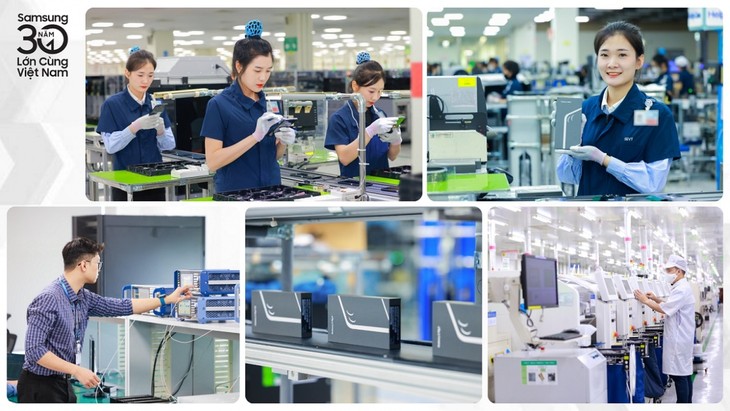 Vietnam becomes one of Samsung’s most important hubs worldwide. Vietnam becomes one of Samsung’s most important hubs worldwide. |
By mid-December, Vietnam's exports of electronics, computers, and components reached nearly 102 billion USD, making them the first export category to break the 100 billion USD mark in 2025. This result showed that Vietnam is playing an increasingly important role in the global production and supply network, especially in high-tech fields, and not just as a final assembly point.
Another example of this trend can be found in Vietnam's foreign direct investment (FDI) inflows. Implemented FDI in the January-November period was estimated at 23.6 billion USD, with manufacturing and processing accounting for 83%. This demonstrates that global investors are bringing bigger, high-tech projects to Vietnam, in line with the country’s industrialization and modernization goals.
Capital inflows no longer stop at factories, but are expanding into research and development, and innovation. As a result, more and more big techs are looking to Vietnam for projects that involve "core technologies".
“We are actively investing in the Vietnam future. We opened our office in Hanoi and now we are growing this team to become a leading R&D center in Vietnam. We are investing in Vietnam because we believe in the ambition of the Vietnamese Government. And we are particularly aligned with the national strategy on the AI development in this decade. And we are committed to be long-term partner of Vietnam,” said NVIDIA Chief Technology Officer, Michael Kagan.
Kagan’s assessment shows that global techs now see Vietnam as more than a source of low-cost labor. They value Vietnam's skilled workforce and capabilities in cutting-edge technologies like artificial intelligence (AI).
AI, in particular, is emerging as a new pillar of Vietnam's strategy to upgrade its value chain. According to international consultants, AI has the potential to drive a structural change in the economy.
“In Vietnam, I think the AI economy is at its initial stage but is ramping fast with the first use cases being deployed nationwide by the Government and also the private sector. And we see, at stake, by 2040, a 120 billion USD economic value for Vietnam, which is around 25% of today's GDP. So it's a sizable gain at stake for Vietnam to unlock this value through AI, mostly through value creation revenue, but also efficiency,” said Boston Consulting Group's Managing Director and Partner, Arnaud Ginolin.
 Boston Consulting Group's Managing Director and Partner, Arnaud Ginolin (Photo: VGP/Nhat Bac) Boston Consulting Group's Managing Director and Partner, Arnaud Ginolin (Photo: VGP/Nhat Bac) |
Beyond its role as a potential driver of economic growth, AI can lead to strategic shifts in the global supply chains, especially semiconductors, software, and automation. Vietnam is seen as an emerging destination in these fields.
As Vietnam is at a critical turning point where it's moving from being a pure technology adopter to a technology innovator, the world is watching to see whether it can make that leap, said AITOMATIC CEO & Co-Founder, Christopher Nguyen.
“Vietnam stands to produce a very large talent pool that could become experts in AI and semiconductors. The second is essentially the strategic supply chain shift. Vietnam is benefiting greatly from that shift. The third key factor is, of course, policy and industry momentum. There's a strong alignment now between government initiatives and R&D investments, FDIs and so on,” he said.
A strong investment environment and modern infrastructure are essential to realizing these opportunities. Vietnam has been highly rated by international organizations on both.
Vietnam has become one of the fastest growing hubs for information technology and innovation in Asia. With a highly educated workforce, modern infrastructure, and strong trade agreements, the country offers significant opportunities for businesses looking to invest in technology and digital industries, said Executive Director of the International Trade Centre (ITC), Pamela Coke-Hamilton.
The Government has invested heavily in expanding industrial parks and technology zones, ensuring modern facilities for companies in software development, cloud computing, and data centers, she noted. “Major cities like Ho Chi Minh City, Hanoi, and Da Nang have well-developed digital ecosystems, attracting global technology firms. Infrastructure improvements including modern highways, deep-sea ports, and reliable power grids make operations smooth and efficient.”
In addition to infrastructure, Vietnam's domestic market and digital readiness are driving the digital economy and make the country a potential market for technology products and services.
“Roughly 80% of Vietnamese people own a cell phone. The level of internet penetration, smartphone coverage is very, very high. I feel that Vietnam has the ability to leapfrog other countries when it comes to the digital space. You have the fastest growing digital economy in ASEAN, and you're number two behind Indonesia when it comes to the number of digital transactions that people do from a digital shopping perspective. So the foundation is there. You have a young population that's willing to accept technology. I think the future looks bright,” said HSBC Bank Vietnam's CEO, Tim Evans.
These developments are thanks to long-term policy planning. According to economist Nguyen Minh Phong, Vietnam early identified digital economy development as one of its strategic pillars.
“Vietnam is one of the few countries to have shaped a digital economy development path at an early stage. This consistent policy is reflected in many of the government's directives. The digital economy is expected to contribute more to Vietnam’s GDP by 2030. And we have been successful in several regards,” said Phong.
Vietnam is developing a long-term ecosystem, rather than relying on isolated projects for its transition, as noted by a number of companies with core technologies.
“We are a creator of ecosystems. When we go to a certain country, certain region, we partner with the leaders and then together we innovate. So this is us committing to Vietnam, us bringing our innovation to Vietnam. There's a lot of talent in Vietnam. There is a lot of engineering resources, strong technical background, which is what Qualcomm is always focused on,” said Qualcomm's CFO & COO, Akash Palkhiwala.
Vietnam is making use of technological developments, AI, and the digital economy to carve out its new role in the global supply chain - a partner of international corporations in innovation and sustainable development. These factors will help Vietnam move away from being a "world's factory" and become a value-added manufacturing partner.
Amid global economic restructuring, Vietnam emerges as a strategic destination for investment and a player in a new supply chain. Foreign investors choose Vietnam not only for its low cost or geo-economic advantages, but because they have long-term confidence in Vietnam's growth prospects, governance, and sustainable development plans.
A report by the European Chamber of Commerce in Vietnam (EuroCham) for Q3 2025 revealed a "renewed surge of optimism among European firms operating in Vietnam" over the next five years. We spoke to EuroCham's Board Member André de Jong about this report.
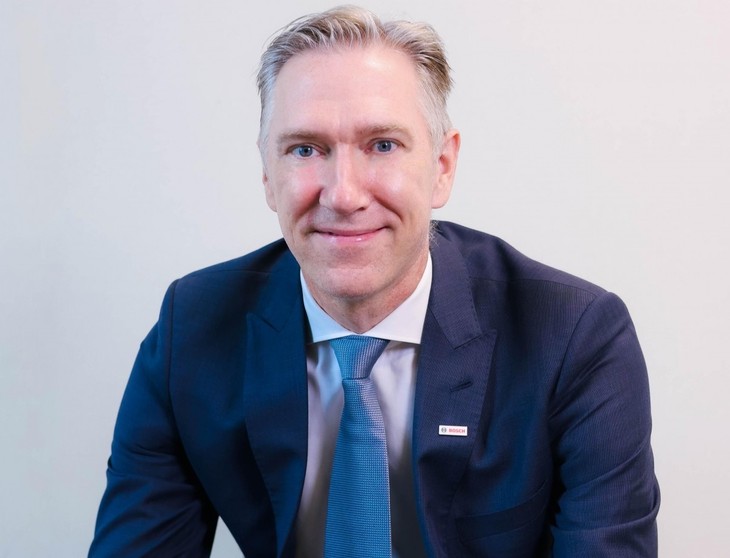 EuroCham's Board Member André de Jong (Photo: congthuong.vn) EuroCham's Board Member André de Jong (Photo: congthuong.vn) |
Question: EuroCham's latest Business Confidence Index (BCI) report shows that European firms' confidence in Vietnam reached its highest in three years. What drove such a climb?
André de Jong: Yeah, so yeah. 100% correct, the BCI climbed to 66.5, which is the highest level in three years, even surpassing the pre-tariff levels and marking a really strong rebound in sentiment and also among the European investors. And I can share with you some key drivers. And we truly believe that the active government reforms is really helping us. For example, with work permits, visa procedures, and also digital administration.
Question: The green transition is now a key factor. What challenges and opportunities are Vietnam facing when attracting green investment from European investors?
André de Jong: And the BCI also revealed that one in four European companies in Vietnam has already implemented green initiatives. 42% report improved customer trust and market access. Because we believe that if you are a green company, you also give trust out to the market and to your customers. And also, 39% report higher operational efficiencies implementing green initiatives in their company. And even 32% say we have financial gains, measurable financial gains. To be compliant with those European standards such as CBAN or the EUDR, these are some standards, is still also challenging. Anyway, the EuroCham will continue to bridge European expertise with the Vietnam green ambition. And there we continue to shape change and build green future.
Question: What do European investors expect from Vietnam’s economy in 2026?
André de Jong: EuroCham and also European companies... they are European investors. They expect Vietnam's strong GDP growth to continue. Some believe it can even be higher than 8%, can be accelerated. But it is really driven by also regulatory changes, leaner governments, leaner provinces, but also very much about the infrastructure investment and institutional reform. We expect that the digital government will continue to expand and continue to reform, simplify certain procedures, and this will boost also the competitiveness of Vietnam. We always believe that strengthening public-private partnerships, PPP, is important also to accelerate developments in key industries and to attract bigger investments into the country. So I think, all in all, Vietnam's openness, the resilience, the momentum that is currently happening really inspires many investors and also future investors.
"Vietnamization of the world": how Vietnam tries to stand out during integration
“Vietnam – the chosen nation” is defined by the country’s economic potential, strategic position, and culture rich in identity, which focuses on human-centered values, stability, and a spirit of sustainable cooperation. Entering 2026, Vietnam will place special emphasis on nurturing and spreading cultural values, connecting with the world through soft power, identity, humanity, and an open spirit.
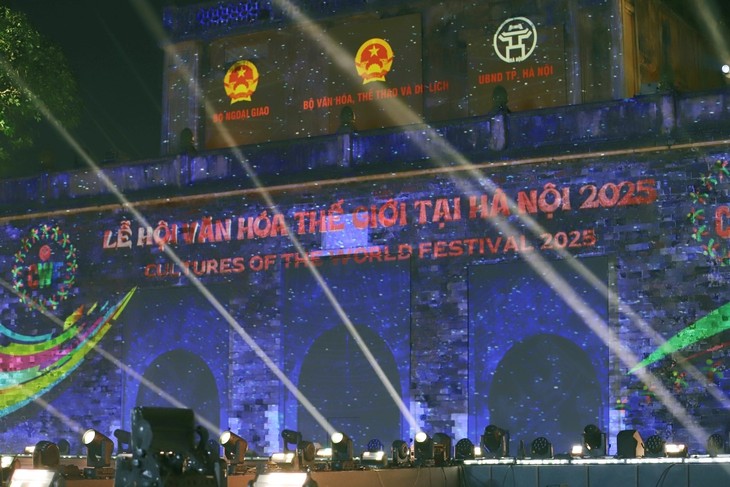 Vietnam’s first Cultures of the World Festival opens in Hanoi on October 10, 2025. Vietnam’s first Cultures of the World Festival opens in Hanoi on October 10, 2025. |
The Cultures of the World Festival, held for the first time in Hanoi in October 2025, attracted 48 countries and went beyond the framework of a conventional cultural exchange to become a national brand of cultural diplomacy.
“This festival brings together artists communities and nations to share their traditions and innovations to listen to one another and to reaffirm that our cultures do not divide us, but in fact bring us together. UNESCO is proud to accompany Vietnam on this meaningful journey. Let this festival be remembered not only for its colors and performances, but also for its message that when culture connects, humanity unites,” said Jonathan Wallace Baker, UNESCO Representative to Vietnam.
Vietnam, and Hanoi in particular, have become a global rendezvous where peoples and nations meet, engage in dialogue, and move toward a peaceful future, said Minister of Culture, Sports and Tourism Nguyen Van Hung.
“Together, we share and learn to overcome all barriers of language and geographical distance, drawing closer to one another. We have joined efforts to maintain international peace and security by strengthening cooperation between nations through culture, in accordance with UNESCO’s principles of culture for peace, building bridges of friendship, and achieving the Sustainable Development Goals for shared prosperity,” he noted.
 Vietnamese and international artists at the Cultures of the World Festival 2025 Vietnamese and international artists at the Cultures of the World Festival 2025 |
In Hanoi, independent art spaces are flourishing, creating an environment for experimentation and creative dialogue. Ho Chi Minh City is emerging with large-scale art events marked by strong regional and international connectivity.
“Exchange programs and creative residency models have been implemented very effectively. Artists and creators from other countries can come to Hanoi, Ho Chi Minh City, Da Lat, and Hoi An to exchange, learn, and create projects and works that reflect common themes set forth by Vietnam,” said Nguyen Thi Thu Ha, Director of the Center for Cultural Industries and Contemporary Art.
Vietnam’s appeal also lies in the unique creative context of each city, whether it is the historical intersections and cultural depth of Hanoi, the rich treasury of folklore in Hoi An, or the dynamic urban growth of Ho Chi Minh City. These cities are key actors in unlocking such values, providing international artists with materials to create works that are both deeply rooted in identity and global in spirit.
Associate Professor Dr. Nguyen Thi Thu Phuong, Director of the Vietnam Institute for Culture, Arts, Sports and Tourism, said the goal goes beyond building individual creative destinations. “We aim to shape an ecosystem of creative destinations across Vietnam, from urban to rural areas, from highlands to coastal regions, and to create sustainable connectivity within Asia and, more broadly, with the entire world.”
Vietnam is gradually transforming from a nation rich in heritage into a new creative hub in Asia, where local identity blends harmoniously with the global spirit, opening up opportunities for sustainable development in the creative era.
”We regard culture as the goal and the driving force of socio-economic development, and the regulatory framework for that development,” said Bui Hoai Son, a member of the National Assembly’s Committee for Culture and Education.
Cultural industries are considered a spearhead and a breakthrough for socio-economic growth, improving soft power, and conveying beautiful images and meaningful messages of the nation to the world, he said. “Incorporating cultural industry development strategies into Party resolutions demonstrates our determination to establish national cultural sovereignty.”
Vietnam is developing a project titled “Vietnamization of the world”, aimed at positioning national identity within the flow of international integration, enabling Vietnam to step onto the global stage with its distinctive values.
According to Professor Dr. Pham Hong Tung, Chairman of the Science and Training Council of the Institute of Vietnamese Studies and Development Science, amid countless influences in the digital age, Vietnamese identity is a magnet for attracting the world and driving development.
“In the past, our goal was to integrate without dissolving or losing our identity. Now is the time to integrate in order to shine. To this end, there are only two paths: Vietnamese culture and intellect. We must transform the culture, intelligence, and character of the Vietnamese people into precious assets in a globalized world, creating unique values for us to shine,” he said.
Vietnam is steadily asserting its position as a global cultural destination. This journey is expanding in both scale and depth, with a clear goal of making culture the spiritual foundation and the gateway bringing Vietnam closer to friends across all five continents.
“Vietnam – the chosen nation” embodies a journey of continuous innovation, national mettle, and an enduring aspiration to rise. In a volatile world, Vietnam has been asserting itself as a destination of trust, cooperation, and a future imbued with cultural identity.