(VOVWORLD) - In October Hanoi launched the “Mobile Public Service Model,” an initiative designed to deliver the best possible public services to residents. These mobile, fully digital vehicles travel throughout the city, bringing public services to local communities.
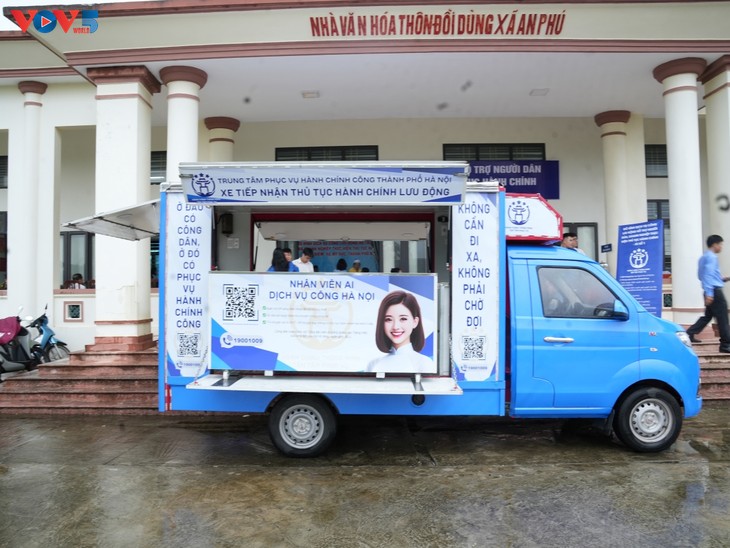 The Mobile Public Service vehicle assisting residents at the community cultural house in Doi Hung hamlet, My Duc commune (Photo: Huy Nam/VOV) The Mobile Public Service vehicle assisting residents at the community cultural house in Doi Hung hamlet, My Duc commune (Photo: Huy Nam/VOV) |
The first destination was the House of Culture in Doi Dung hamlet, My Duc commune, a poor area with a large Muong ethnic minority population. For the local residents, having officials come in person to the hamlet to assist with administrative procedures is unprecedented.
Most local residents say that they feel very moved and happy because they’ve never had anything like this before and expressed their hope the mobile service vehicles can come once a month to ease the burden on residents.
The Mobile Public Service Model is an innovative solution that builds on the experience of mobile units long used in healthcare and social services for blood donation drives and on-site medical checkups.
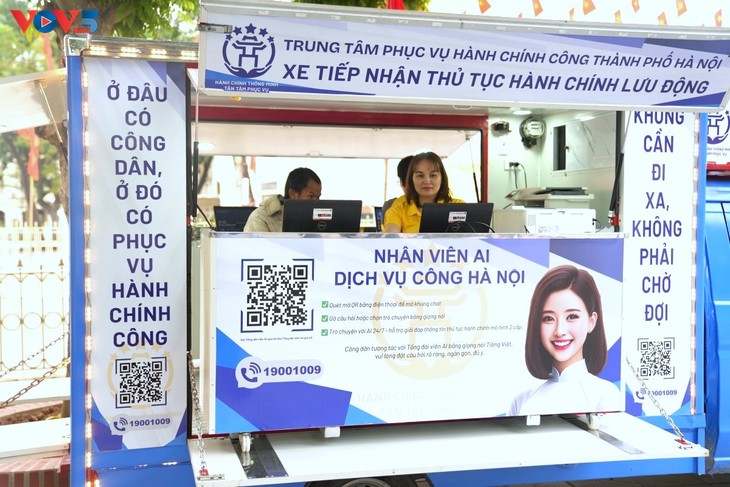
The vehicles are modified to serve as mobile administrative offices, bringing public services to remote residential areas and industrial parks. The model is especially helpful for the elderly, people with disabilities, and factory workers.
 (Photo: Huy Nam/VOV) (Photo: Huy Nam/VOV) |
Hoang Hong Nhung, a resident of My Duc, said she now no longer has to travel a long distance and wait for hours as she did before.
“Normally I have to go dozens of kilometers to get to the commune office, and then I can’t finish everything in one morning. I have a small child, so traveling is very inconvenient. Today, it took me just five minutes to reach the cultural house and the procedures I needed were handled very quickly,” Nhung told VOV.
The vehicle operates on a fixed schedule of two or three trips per week to each locality, and a public announcement is made at least three days in advance. In addition to receiving and processing administrative applications, the mobile units also serve as communication and training hubs, help residents develop digital skills, and promote online public services.
Pham Trong Cua, Vice Chairman of the My Duc commune People’s Committee, said, “When the mobile public services model was deployed, residents were very pleased. In the meantime, we still maintain a fixed administrative office.”
With this model, supported procedures include civil status, land administration, finance, labor and employment, social welfare, services for people of merit, and digital-support services such as document digitization, online payments, and registration for postal delivery of results.
People can also get free legal consultation, digital skills training, and assistance with registering for electronic identification (VNeID) and digital signatures.
People get timely support, ensuring that everyone has equal access to public services, according to Hoang Van Bang, Deputy Director of Hanoi’s Public Administrative Service Center. “We will evaluate the model’s effectiveness and may increase the frequency of visits.”
The Mobile Public Service Model marks a significant shift in Hanoi’s administrative mindset: the government is taking the initiative in connecting with the public. The initiative is a demonstration of the city’s commitment to administrative reform, innovation, and giving all citizens online access to public services.