(VOVWORLD) -There is a land where the moment you arrive, everything feels different – the air, the space, the scenery, and the rhythm of local life. It’s the U Minh Ha freshwater forest in Ca Mau province, a place whose quiet beauty and rustic charm linger long after you leave.
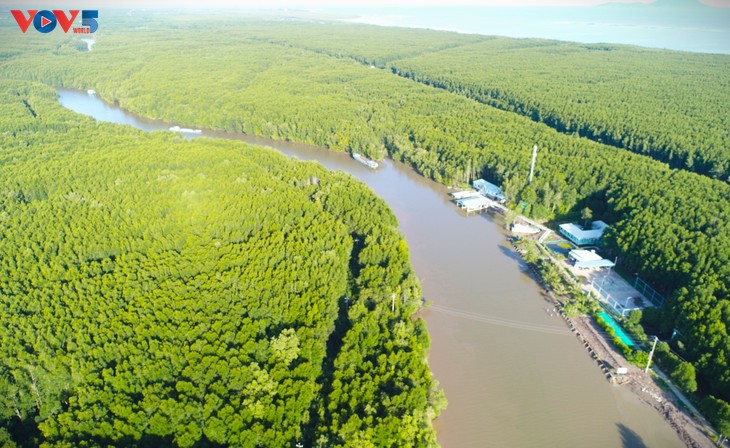 An aeriel view of the U Minh Ha forest (Photo: Tran Hieu/VOV-Mekong Delta) An aeriel view of the U Minh Ha forest (Photo: Tran Hieu/VOV-Mekong Delta) |
A small wooden sampan slowly carries visitors along a narrow canal into the cajuput forest. Hearing only bird songs and the splash of oars against the water, visitors relax in the tranquil beauty of the deep cajuput forest as it enters its flowering season. Low reeds form a narrow path leading to it.
Boatman Pham Duy Khanh has lived in the forest for 30 years and has been working as a tourist guide for 10 years. He introduced: “This shrine is dedicated to the forest deity. Local people stop here to offer incense whenever they go into the forest to work, catch fish, pick vegetables and honey, or take tourists sightseeing. We pray for strength and safety.”
“This is a completely natural ecosystem. These cajuput trees are 50 to 70 years old. These canopies are not as large as others because the fallen leaves form a layer of organic matter on the water surface, so the trees are not firmly rooted and sway in the wind. It would take over 20 years more for the roots to grow firmly,” Khanh explained.
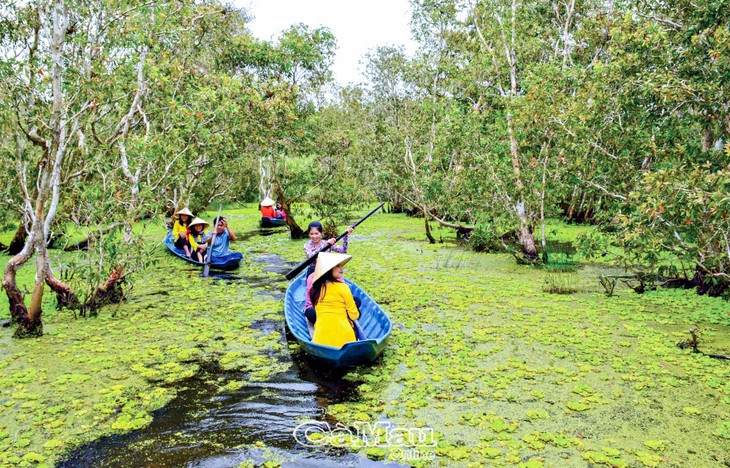 Wood sampans take tourists to explore the flooded forest ecosystem. (Photo: baocamau.vn) Wood sampans take tourists to explore the flooded forest ecosystem. (Photo: baocamau.vn) |
During the war, this canal led to the weapons workshop of Mr. Ba the Blacksmith – the Ca Mau Military Ordnance Workshop, which produced thousands of tons of rudimentary weapons for the resistance.
In the dry season, as water levels recede, bomb craters and other traces of combat emerge. These craters are now home to fish, eels, and other indigenous species of the freshwater forest, a natural source of aquatic food for the locals.
Khanh says his family has been engaged in community-based tourism for almost a decade. He talks to visitors about conserving the forests and the distinctive lifestyle of Mekong Delta people, which is closely tied to the rivers and waterways.
 The cajuput forest system interwoven with canals and waterways gives visitors a close-to-nature feel. (Photo: Tran Hieu/VOV-Mekong Delta) The cajuput forest system interwoven with canals and waterways gives visitors a close-to-nature feel. (Photo: Tran Hieu/VOV-Mekong Delta) |
“Our activities reflect our love for our homeland. Recently, we have gotten involved in a fish-farming project in the U Minh Ha forest. Early in the mating season, fish breed in large numbers. We gather small fish into nets, feed them until they grow, and use light to help them hunt for food by themselves. After a certain time, we release them back into the natural environment. This fish-fostering model in U Minh has proven to be very effective,” Khanh said.
Trying to catch fish using simple gear is a fun experience for tourists. Then they can take a rest in one of the small huts in the forests, surrounded by crisscrossing waterways and cajuput trees, grill their fish, and and enjoy the peaceful atmosphere.
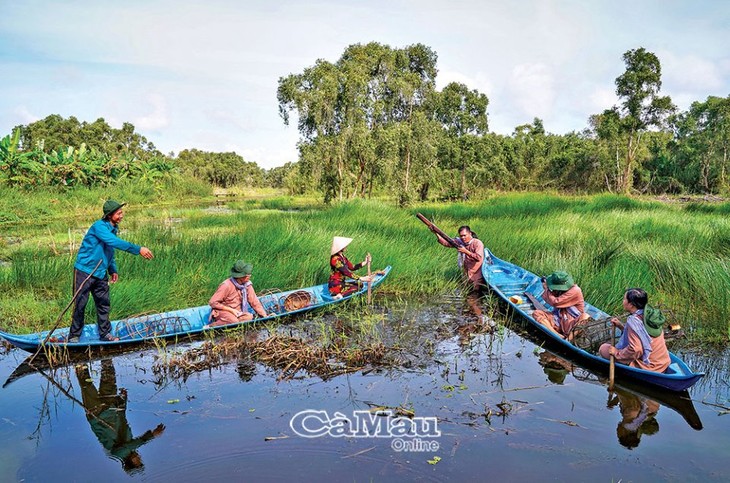 Tourists take part in hands-on farming experiences, catching fish in the riverine region. (Photo: baocamau.vn) Tourists take part in hands-on farming experiences, catching fish in the riverine region. (Photo: baocamau.vn) |
Le Nguyen Thuy Tien, a visitor from Dong Thap, said, “We got to experience how local people live and work in Ca Mau. There are creatures I had never seen before. We caught fish and eels ourselves and grilled them, enjoying how fresh and delicious they were. The experience made me more aware of the importance of preserving a green, clean environment.”
Do Nguyen Nhu Quynh from Dong Nai said the warmth and simplicity of the local people made her feel as if she were returning to her hometown. “We were warmly welcomed here, went boating, caught fish, checked eel traps, and cooked our own meal. I felt cozy, like I was with my family. The unspoiled scenery made me feel like I was at home. I used to think the forest was dull, but it turned out to be beautiful and full of interesting experiences,” said Quynh.
The U Minh Ha forest has appeared in many literary works and films. But only by visiting and experiencing it can one fully appreciate its beauty. Many visitors hope to return and once again sit in a small wooden sampan, glide through the cajuput trees, and slow to the peaceful, unhurried rhythm of life here.