(VOVWORLD) - Half a century after Vietnam’s reunification, the H9 resistance base, located Đắk Lắk province, symbolizes the area’s heroic past. From 1965 to 1975, this site was the strategic command center of Dak Lak and played a vital role in supplying men and ammunition to the southern battlefield. It was a key stronghold that contributed to the historic Buon Ma Thuot victory on March 10, 1975, which paved the way for the great Spring Offensive that led to the reunification of Vietnam. H9 Resistance Base has been recognized as a National Historic Site, a significant location for inspiring patriotism and the revolutionary spirit.
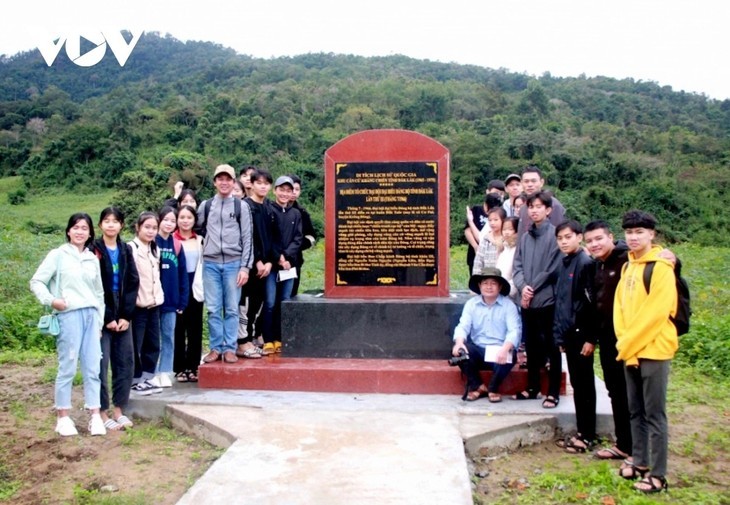 The former revolutionary base is now a "red address" for people to learn about revolutionary tradition. (Photo: H’Xíu/VOV) The former revolutionary base is now a "red address" for people to learn about revolutionary tradition. (Photo: H’Xíu/VOV) |
The Dak Lak resistance base, also called H9 Krong Bong Base, or simply H9 Base, is located on Cu Yang Sin mountain in Krong Bong district. During the war for national reunification, it was the headquarters of the Dak Lak provincial Party Committee and several provincial departments and agencies. It was also a crucial station on the North-South and East-West strategic supply routes for the southern battlefields. The base hosted the Dak Lak provincial Party Congress in 1966, 1969, and 1971.
This year Dak Lak is celebrating the 50th anniversary of its liberation, and Krong Bong district is feeling a festive vibe. Streets are lined with red flags, and tourism sites have been spruced up for the occasion. The mountains, forests, and ethnic villages of the Cu Yang Sin mountain range compete for the attention of the tourists who come here to learn about Dak Lak’s decade-long resistance war from 1965 to 1975.
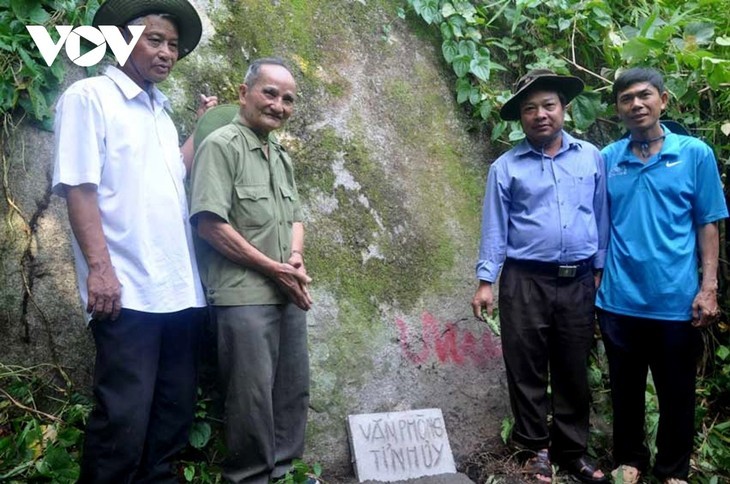 100-year-old Le Chi Quyet (second from left) still remembers every places at this base. (Photo: H’Xíu/VOV) 100-year-old Le Chi Quyet (second from left) still remembers every places at this base. (Photo: H’Xíu/VOV) |
100-year-old Le Chi Quyet, former Deputy Secretary of the Dak Lak provincial Party Committee, remembers his ten years of service at this base. “The first session of the provincial Party Committee held at this base discussed two key tasks. The primary task was to repel enemy raids to safeguard the Southern Base and keep it from falling into enemy hands. At the same time, a stronghold was built as part of a comprehensive resistance base that spanned the province from the north to the south," Quyet said.
Ha Ngoc Dao reminisced about the time living and working at H9 Base. As a young teacher assigned to Dak Lak, he and his colleagues took on three crucial responsibilities: educating students, growing food, and fighting the enemy.
Mr. Dao recalled: “I arrived here in 1965 and stayed for 10 years until the day of liberation. Many people came of age here, including Hero Y Ơn, who grew up in the revolutionary and guerrilla movement of Krong Bong district, and Hero Ama Lê, a distinguished figure of the armed forces. Returning here fills me with strong emotions and memories of my comrades, friends, local people, and the battlefield.”
During the war, the people of Cu Yang Sin made personal sacrifices to defend the resistance area and expand the liberation area. They sheltered soldiers and revolutionary cadres and ensured the security of three provincial Party Congresses.
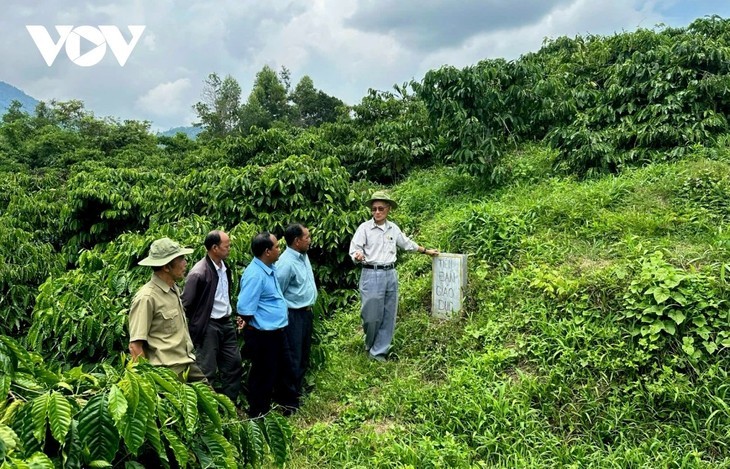 Teacher Ha Ngoc Dao (first from right) revisits the former battlefield half a century after the country’s reunification. (Photo: H’Xíu/VOV) Teacher Ha Ngoc Dao (first from right) revisits the former battlefield half a century after the country’s reunification. (Photo: H’Xíu/VOV) |
Y Suom Nie of Hoa Phong commune told us: “Everyone performed tasks matched to their abilities. Children made hundreds of bamboo spikes, while adults made thousands. These spikes were then planted along the border between enemy territory and the revolutionary forces. We also grew cassava, cut it into small pieces, dried it, and gave it to the soldiers to eat on the battlefield.”
The unity and determination of both the soldiers and the local ethnic communities enabled the Dak Lak provincial Party Committee to lead the resistance from one victory to another. These triumphs paved the way for the historic Buon Ma Thuot victory and the liberation of Dak Lak province, and ultimately contributed to the Victory of the Spring of 1975 which unified the nation.
In 2017, the Dak Lak Resistance Base was recognized as a National Historical Site by the Ministry of Culture, Sports, and Tourism.
Y Thuc Eban, Vice Chairman of the Krong Bong district People's Committee, said: "The Resistance Base is an educational hub for rekindling revolutionary traditions, particularly for young people. We’ll continue carrying out initiatives to enhance tourism and promote the history of this area. Youth groups will organize activities to honor traditions and pay tribute to our predecessors who bravely fought for the independence and peace of our homeland."
The remnants of the war have become historical landmarks, a source of pride for the people of Krong Bong, commemorating the courageous struggles of past generations.