(VOVWORLD) -As global trade shifts rapidly to digital environments, cross-border e-commerce has emerged as a vital engine shaping the future of Vietnam’s economy. Vietnam is steadily demonstrating its determination to build a sustainable export model based on technology, international standards, and long-term value.
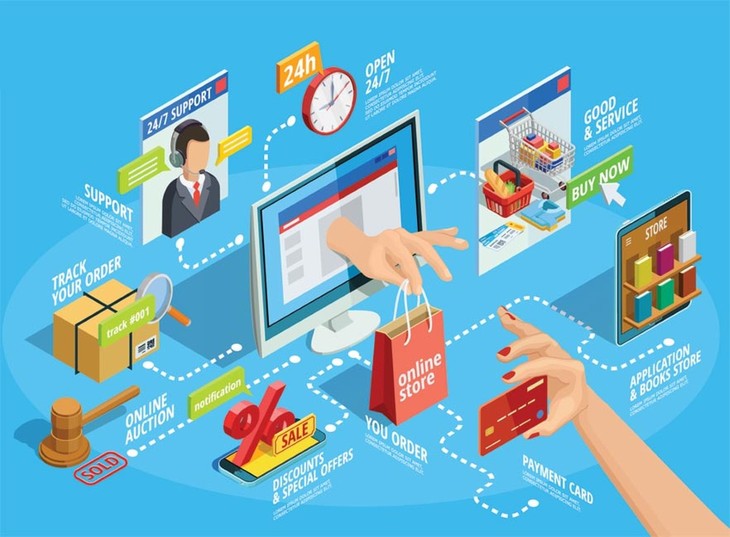 (Illustration photo: huflit.edu.vn) (Illustration photo: huflit.edu.vn) |
Vietnam has been strengthening its capacity to participate in the global e-commerce arena. Thousands of Vietnamese businesses—particularly small and medium-sized enterprises (SMEs), individual households, cooperatives, and craft villages—have established a presence on international platforms such as Amazon, Alibaba, Shopee Global, and TikTok Shop.
In addition to providing direct access to global consumers, these export channels help Vietnamese businesses reduce their reliance on intermediaries, increase profit margins, and build the reputation of Vietnamese goods. Tran Thanh Hai, Deputy Director of the Agency of Foreign Trade at the Ministry of Industry and Trade, said, “We are witnessing a shift in the cross-border e-commerce model, under which we can now access buyers directly without intermediaries. In addition, we can obtain customer feedback and data to help refine and improve our products.”
Last year, Vietnam recorded a total import-export turnover of 930 billion USD, with e-commerce accounting for a significant share—approximately 165 billion USD. This performance has helped Vietnam maintain its position among the world’s Top 10 fastest-growing e-commerce markets and rank 3rd in market size within ASEAN, after Indonesia and Thailand.
The robust growth of e-commerce has laid a foundation for Vietnamese businesses to “go global” through digitalization. But an export-import strategy cannot focus solely on scale; it must also prioritize sustainability, market balance, and resilience to external shocks.
 Tran Thanh Hai is Deputy Director of the Agency of Foreign Trade at the Ministry of Industry and Trade Tran Thanh Hai is Deputy Director of the Agency of Foreign Trade at the Ministry of Industry and Trade |
To become a regional hub for cross-border e-commerce, Vietnam has swiftly finalized its legal framework to support the next phase of development. This includes the Master Plan for E-commerce Development for the 2026-2030 period, which took effect last June, and the Law on E-commerce—the first comprehensive legislation governing e-commerce—was passed by the National Assembly last month.
Nguyen Thuy Anh of the Vietnam E-commerce and Digital Economy Agency (iDEA) at the Ministry of Industry and Trade said, “Cross-border e-commerce has grown rapidly, requiring appropriate management and promotion. We now have two vital documents: the Law on E-commerce and the Master Plan until 2030. These are designed to manage and stimulate the e-commerce market, and cross-border e-commerce in particular.”
Nguyen Van Thanh, Head of the Policy Section at iDEA, said that these policy frameworks will serve as a launchpad for Vietnam’s e-commerce development in the near future. “Vietnam’s e-commerce market is expanding on an international scale, so the Law on E-commerce was inevitable. The Law regulates business activities, product information, identification, and the roles and obligations of intermediary platforms, to ensure a fairer, more transparent environment and improve state management,” said Thanh.
 Tran Van Trong, Secretary General of the Vietnam E-commerce Association, speaks at an event. Photo: (VGP) Tran Van Trong, Secretary General of the Vietnam E-commerce Association, speaks at an event. Photo: (VGP) |
In addition, green standards—aimed at minimizing negative impacts on the environment and society—have become mandatory criteria for Vietnamese businesses exporting via e-commerce. According to Tran Van Trong, Secretary General of the Vietnam E-commerce Association, “Vietnam’s e-commerce is growing rapidly, but it also has environmental impacts. To develop it sustainably, we must focus on green growth criteria, including mechanisms and policies that help businesses apply green solutions.”
Cross-border e-commerce is opening a new path of integration for Vietnam’s exports that is faster, smarter, and more sustainable. With a solid legal foundation, strong government support, and a shift in business mindset toward standardized production and strict compliance with safety, environmental, and social responsibility standards, Vietnam is poised to bring to the global market goods of quality, credibility, and lasting value.