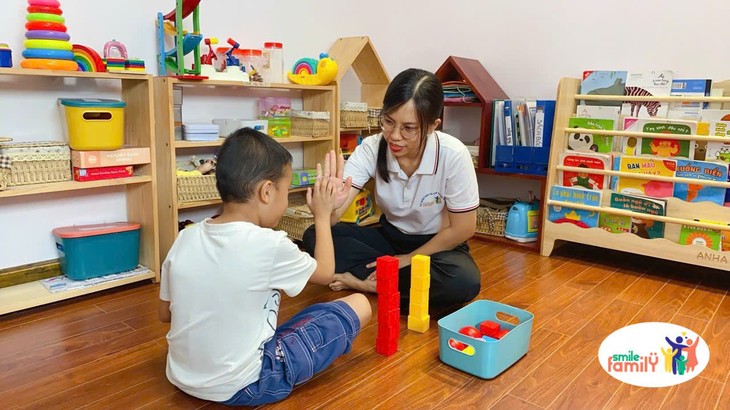
 A one-on-one intervention session between Pham Tran Phuong Uyen and little boy named Bi (Photo credit: Smile Family Center) A one-on-one intervention session between Pham Tran Phuong Uyen and little boy named Bi (Photo credit: Smile Family Center) |
A mother’s journey: recognizing early signs of autism
“When he was little, my husband and I thought he was developing normally, like other kids. But around 15 or 16 months, I noticed he rarely responded to his name. He wouldn’t turn his head or run to greet us when we came home.”
Thuy Tien, the mother of a child with autism, told VOV the first signs were subtle but unmistakable. It wasn’t until her son was 21 months old that he was officially diagnosed.
“The biggest difficulty for us was the psychological one. At first, we couldn’t accept it, and everyone around us reacted differently. Raising a child with special needs takes a lot of patience. Every bit of progress comes with a huge amount of effort,” Tien recalled.
Fortunately, early detection and professional support gave her hope. At the Smile Family Center in Ho Chi Minh City, Tien found guidance and understanding.
“I sent my child to one-on-one intervention sessions at a center while also letting him attend a regular preschool. At the center, I received detailed guidance and consultation that made me less confused than before,” said Tien.
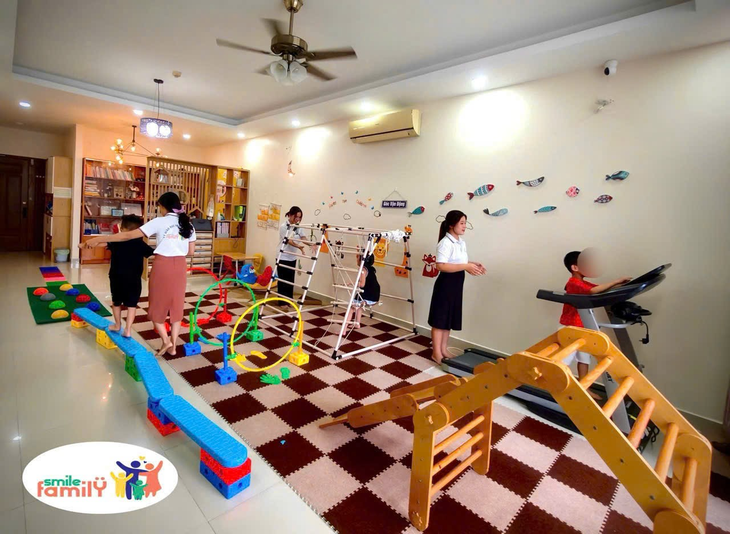 The learning materials are tailored to suit each child's intervention program. (Photo credit: Smile Family Center) The learning materials are tailored to suit each child's intervention program. (Photo credit: Smile Family Center) |
The critical importance of early intervention
According to psychologist Nguyen Thanh Hien, who works at the Smile Family Center, "In Vietnam, there are around 1 million people with autism, but many children remain undiagnosed. Late detection means losing the chance for effective intervention because the so-called golden period is in the first three years, when a child's brain is highly adaptable and neural connections are forming rapidly."
“The earlier the intervention, especially between 18 to 36 months—the better the outcomes,” Hien says, adding, timely support is crucial because the first three years of life are a “golden period” for brain development.
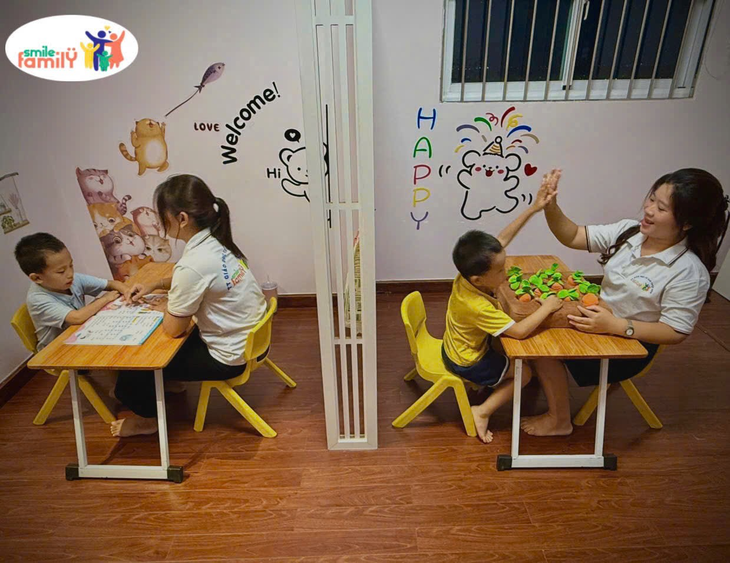 The classrooms offer a quiet environment free from distractions and structured lesson plans tailored to the strengths and interests of each autism child. (Photo credit: Smile Family Center) The classrooms offer a quiet environment free from distractions and structured lesson plans tailored to the strengths and interests of each autism child. (Photo credit: Smile Family Center) |
Personalized teaching and family collaboration
Teachers like Pham Tran Phuong Uyen are at the forefront of helping children make progress. She recalls her work with Bi, a student with autism: “When I first took him in, Bi couldn’t produce sounds clearly yet, didn’t know how to speak, only making some meaningless syllables. He often couldn’t control his emotions and would hurt himself...”
“But after three months of consistent intervention, he started vocalizing... he already knew how to imitate the teacher, manage his emotions, and even waited patiently when asked to complete his tasks,” Uyen said happily.
She added she believes that success comes from knowing each child deeply: “After learning and understanding Bi’s personality, we were able to outline a personalized plan for him. Then we applied it daily and with persistence.”
“Up to now, he keeps learning and I’m directly supporting him. Seeing his remarkable progress and his family’s regular exchanges of information and gratitude have motivated me to strive every day to fulfill my responsibilities,” said Uyen, adding, “It’s also a source of encouragement for teachers teaching other children. The child’s progress and the trust of the parents are a great joy to me. It’s impossible to fully express my emotions.”
Her methods involve clear speech, visual aids, and a quiet, structured environment. But above all, she highlights the importance of working with parents: “We regularly communicate and guide parents on how to support their child at home in line with the set learning plan.”
A paper flower making class (Credit: SEED)
|
SEED Career Center: empowering through vocational training
As children grow, integrating into society becomes the next major challenge. That’s where the SEED Career Education and Training Center plays a key role. Led by Dr. Dao Thu Thuy, SEED offers career guidance and hands-on training to help young people with autism become self-reliant.
20-year-old Dinh Ngoc Duong, who suffers from mild autism spectrum disorder, was able to make a beautiful silk chrysanthemum for his mother thanks to the support of the teachers of his silk flower making class.
Duong says proudly, “I learned to make flowers for my mom, dad, and siblings... I think it makes my parents very happy, very pleased. I feel happy here at the training center.”
18-year-old student, Hoang Tung who has flourished in a baking class at the SEED center, said, “I’ve been making cakes at the training center for a long time. I can make sponge cakes, caramel, yogurt, cream puffs, and boat cakes.”
A cake making class offered by the SEED Center (Credit: SEED)
|
SEED’s instructors take great care to match each student’s training to their interests and abilities. Students can learn to make tote bags, silk flowers, or even take computer classes.
Vo Minh Nghia dreams of becoming a graphic designer: “I’ve been learning to use Photoshop for several months. I’m also learning how to mix drinks. I hope to earn enough money to buy a washing machine for my parents. My mother has already retired, but my father is still working. I hope to land a job and earn money to help my parents.”
Not all students are high-functioning. SEED also supports those with more severe autism. In the pre-career class, they participate in physical activities and expressive arts.
Teacher Luong Thu Ha notes, “Without patience, you can’t do this work. It can take all day to teach the students to do a simple thing. It might take months or even a couple of years for some students. In the skills classes, we often see children fighting. It takes a lot of love to teach some of the bigger boys, who can weigh up to 100 kg.”
The efforts of SEED’s teachers have been rewarded, making them even more attached to the children.
When Dang Mai Lam, a girl with high-functioning autism, first arrived at SEED, she had severe behavioral issues. After two years of studying and practicing communication skills at SEED, her condition is improving. She even can assist teachers and earn a modest salary. Although Lam finds it difficult to talk about her feelings, she is happy to work to show her gratitude for her parents and teachers.
“I can make beautiful artificial flowers such as daisies and roses. I give my salary to my parents. My parents are very happy and that makes me want to work more,” said Lam.
Community support and a shared triumph
Parents, too, find renewed hope. Nguyen Thi En, whose son Phu is in a label-making class, said, “Phu has earned a salary for three months. In the first month he worked hard and received 90 USD. He was happy and I was even happier than him.”
The SEED Career Education and Training Center is a model that many autism education centers are particularly interested in collaborating with.
Nguyen Thuy Huong, Director of the Green Rainbow Center, said, “The two most important parts of career training for children with autism are the cooperation of the parents and the efforts of the children. It also requires the support of caregivers, philanthropists, and organizations who understand the children and have a broad perspective of the environment they need.”
SEED currently runs facilities in Hanoi, Hai Phong, and Thai Nguyen and, to date, has supported 120 students. Its work shows that career training is not just about jobs, but dignity, purpose, and connection. As Dr. Thuy put it, her team is “sowing the seeds of love with the belief that love and sharing will nurture our future”.
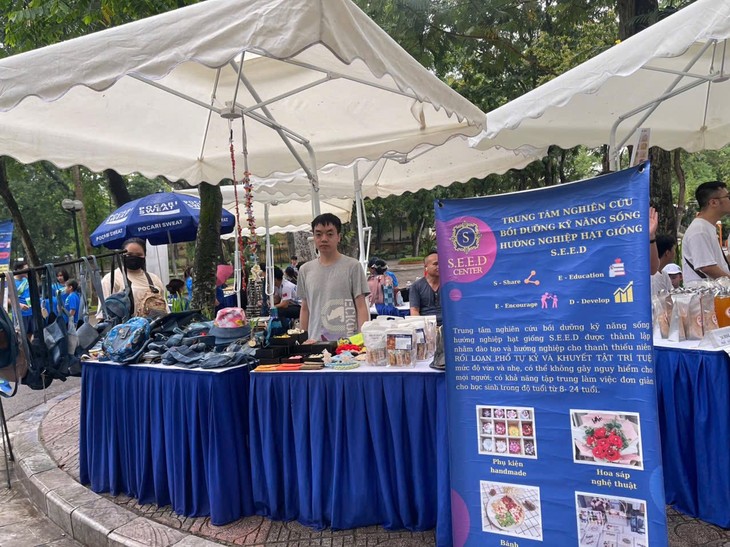 The products made by SEED’s students are on display at a recent festival in Hanoi (Credit: SEED) The products made by SEED’s students are on display at a recent festival in Hanoi (Credit: SEED) |
This belief echoes in early intervention as well. Tien, the mother who once felt overwhelmed, now urges others, “First, be brave and face the situation, then learn as much as you can about autism so that you can better understand your child. Gradually, we’ll find the most suitable ways to help your child. We must always be patient throughout the process of walking beside your child.”
In every classroom and training room, in every mother’s reflection and teacher’s commitment, one truth is clear: when a community comes together—with understanding, patience, and belief—children with autism can thrive. From learning to speak to baking cakes, from making silk flowers to earning a first paycheck, every small step forward is a triumph shared by many hands and many hearts.