Vietnam has one of the best infertility treatments in Southeast Asia. A report in 2024 by Research and Market said it expects 7.47% annual growth for IVF, from now till 2029. The cost for an IVF cycle is one-third that of other countries in ASEAN and about a quarter of the cost in the US.
But it wasn't that way a decade ago, when Nguyen Thi Chanh and her husband went to every hospital she could find and afford for infertility treatment.
Healthcare, and specifically infertility treatment in Vietnam, has improved explosively in just a few years, said Dr. Nguyen Binh Duong, an expert in IVF from Hong Ngoc-Phuc Truong Minh General Hospital.
"Now Vietnam is becoming more and more attractive for couples who try to do IVF because first we have a high success rate. Second, we offer a really good price compared to other regions. We have every technique available in the market, like IVF, ISCI, IMSI, IVM. We can do PESA, Micro-Tese, Piezo ISCI, etc. And we do it routinely so we have a high standard to achieve a good pregnancy rate," said Duong.
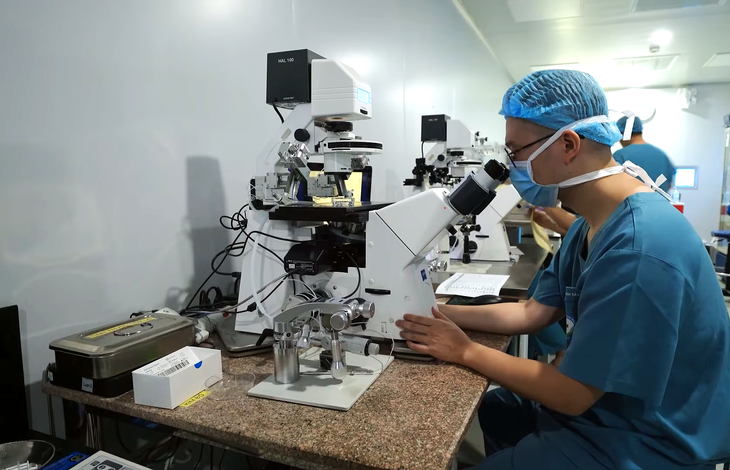 Top hospitals in Vietnam now have all available techniques for infertility treatments on the market. (Illustrative photo: Vietnam Post hospital) Top hospitals in Vietnam now have all available techniques for infertility treatments on the market. (Illustrative photo: Vietnam Post hospital) |
The success rate for infertility treatments in Vietnam is now around 60%, and can go up to 80% for certain procedures, which is markedly higher than global average, said Dr. Vuong Vu Viet Ha from the IVF Center at Vietnam Post hospital. But what do these numbers mean to patients?
"With MicroTESE, we have a 60% success rate at finding sperms in infertile men. That's a significant number. But we're trying to find hope for the other 40% as well," Dr. Ha said.
These are incredible numbers but many years ago, they didn't mean much. The success rate was obviously lower before, but there were also a lot of unknowns.
"The hospitals I went to concluded "unexplained infertility". And no explanation is really the most difficult of outcomes," said Nguyen Thi Chanh, a patient from Hanoi.
 (Illustrative photo: Wikimedia Commons) (Illustrative photo: Wikimedia Commons) |
"The doctor told me that I had azoospermia, meaning no sperms were found. They didn't tell me what to do about it or to do more tests. I cried a lot on my way back," said Chu Van Ngoc, another patient from Hanoi.
On the other end of the spectrum, sometimes the challenge for infertility treatments isn't technical, but convincing patients to seek treatments in the first place.
"A lot of people didn't really look into reproductive health. Some of my patients came to me when they were around 40 and never once tried for a baby. They were brilliant, highly-educated people. A woman came in, and I asked, ‘How long have you been married?’ She replied, ‘For a long time.’ Well, why did it take you so long to get a check-up? She said, ‘We planned it out. It didn't work so I decided to come.’ That's when I realized a lot of people don't know much about reproductive health," said Dr. Nguyen Thi Nha, Director at the IVF Center at Vietnam Post hospital.
In a separate interview not too long ago, Dr. Nha said one of her patients, a man, refused tests, saying he was perfectly healthy. Infertility treatments require that a doctor looks into both the husband and the wife, so she worked really hard to convince him to do some tests. Results came in and said he had azoospermia, a common condition similar to the one Chu Van Ngoc had. It occurs in 1% of the male population.
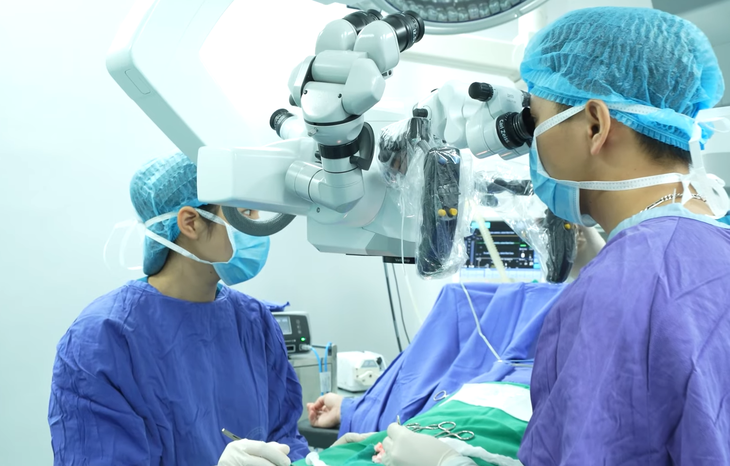 A microsurgery at the IVF Center at Vietnam Post hospital (Photo: Vietnam Post hospital) A microsurgery at the IVF Center at Vietnam Post hospital (Photo: Vietnam Post hospital) |
In the 36 years that she had been in the field, Dr. Nha has treated quite a few such cases. "It feels bad sometimes. There were definitely challenging cases and some patients who... didn't really get what I was trying to tell them."
Nha was one of the first doctors at Vietnam Post hospital to sign up for training on infertility treatments in Ho Chi Minh City. That was in 2005 and IVF was very much a new field in Vietnam. Nha said she herself wasn't particularly interested in IVF.
Still, she moved south, spent nearly a decade studying infertility, away from her family. And in 2013, she returned to Vietnam Post Hospital to lead an IVF center here.
Not much changed in the 8 years gap though. "The IVF Center was founded in 2013. When I was told to manage it, we had, on some days, 6 people. We had very few equipment and resources to work with. What we did have a lot of was faith," Dr. Nha said.
"Dr. Nha told me that I had about 10-15% chance of success since I'd passed that best age for a baby. I didn't want to try anymore. But the doctors there told me that if I go through with it, I at least have a chance. If I don't, the chance is zero. In three years, I did two embryo transfers, and then I had a baby girl and a baby boy", said Nguyen Thi Chanh, who in 2020, gave another try at parenthood.
To have a chance at success, you have to go through with it. That, according to Dr. Nha, was the only way to beat the odds. But now, she said, "Nowadays, we have options for almost any causes of infertility. If an approach doesn't work, we'll look for another."
A 10-15% chance of success means different things to patients and doctors. For doctors, a low probability is something to optimize for.
"The key is to provide personalized treatments, help them in every steps of the process. We need the best possible eggs, best possible embryos, and the most optimized procedures. Every person's body has different needs so we have to account for that too. If we can optimize every little things like that, it's possible to increase the chance of success. This is especially true for people who have tried times and times again, at different hospitals. They need every optimizations they can get", said Dr. Nha.
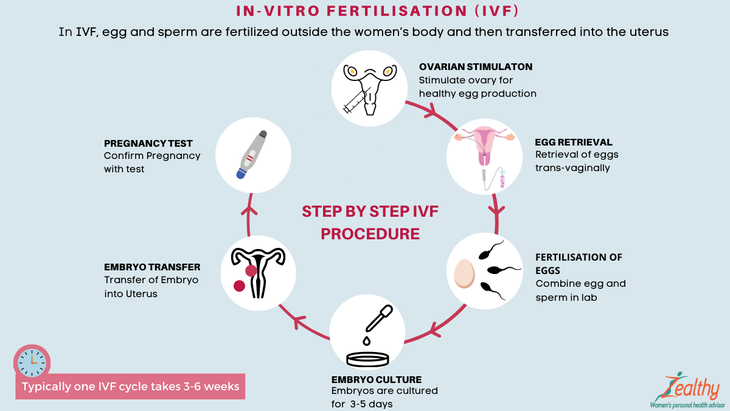 A graph showing the typical steps involved in IVF treatment (Photo: Wikimedia Commons) A graph showing the typical steps involved in IVF treatment (Photo: Wikimedia Commons) |
Her colleague, Dr. Bach Thi Thu Cuc, head of the research team at IVF Center, Vietnam Post hospital, added, “For cases with 1% chance, or even less than that, we still have to do everything we can. We see 1%, but the patients and their families see hope. They see 100% chance at happiness.”
We mentioned Chu Van Ngoc, another patient who was diagnosed with "azoospermia". The doctors at the IVF Center offered him an option - a very difficult, microsurgery procedure called Micro-TESE.
"We were in despair, but not anymore. I'm really glad that we came across this Micro-TESE method and gave it a go. The doctors helped us every steps of the way. They made my happy family possible," said Mr. Ngoc's wife.
Safe to say, the procedure worked. Dr. Nha said, there are two moments when a fertility specialist like herself gets to witness in their line of work that makes all the hard-work worthwhile. One of them is, of course, the moment a child is born. But even before that, the moment she loved the most was when her patients saw hope.
"A lot of the times, the husband would send me pictures of his wife the second she gave birth. He would tell his wife did it, how much the baby weighs. That's my favourite moment. And also when test results say they have positive beta", she said.
Dr. Nha left Hanoi to go study infertility treatment in 2005. Her daughter was still very small at the time, she said. It was a decision that would seem to most people, a gamble.
"I was in my 4th year at medical school. My older sister had been trying for a baby with no success. Vietnam at the time, in general, had next to no options for infertility treatments. So even before graduation, I felt like I had to find out more about it. I just want to have a better understanding of it, so that the people I love wouldn't have to go through the misfortunes that they did", she said.
Dr. Nha said she frequently asked herself whether she could have done something for her sister.
To her, leaving everything behind for an answer to her question wasn't a gamble, because to have a chance at success, you have to exhaust all options, and go through with it.