"If Trinh were alive today, I think he would say: ‘Keep going.’ He was never afraid of change, so I really believe that if someone sings his songs honestly, in their own voice, he would love it," said “Jazz Lady” Quynh Pham.
But believing that Trinh Cong Son would approve of reinterpreting his music doesn’t make it easier. It actually makes it harder, because when you truly love someone’s music, you don’t want to get it wrong. For Quynh Pham, who has spent more than two decades on Hanoi’s jazz stages, the question wasn’t whether jazz could cover Trinh, but whether it should cover his songs.
“I’ve been a jazz singer all my life, but when I wanted to make my own album, I realized I didn’t want to sing foreign music, I wanted to sing Vietnamese songs. I kept coming back to Trinh for his lyrics, his poetry, and the way his songs speak so gently about being human. And because jazz is who I am, my songs naturally were jazz.”
That’s how the project ‘Let’s Love Jazz’ began. The name was inspired by one of Trinh’s most beloved songs, ‘Let’s Love Each Other’.
Trinh Cong Son, whose musical career began in 1958, when he was 19 years old, with the song “Tearing Lashes,” is one of the greatest Vietnamese songwriters. His music is everywhere in Vietnam – not as something people talk about, but as something they live with. His songs are often heard at quiet moments, when people are alone, when they are remembering something, when life slows down.
For many, his music has been there through love, loss, war, and peace. His songs are close to life and its fragility.
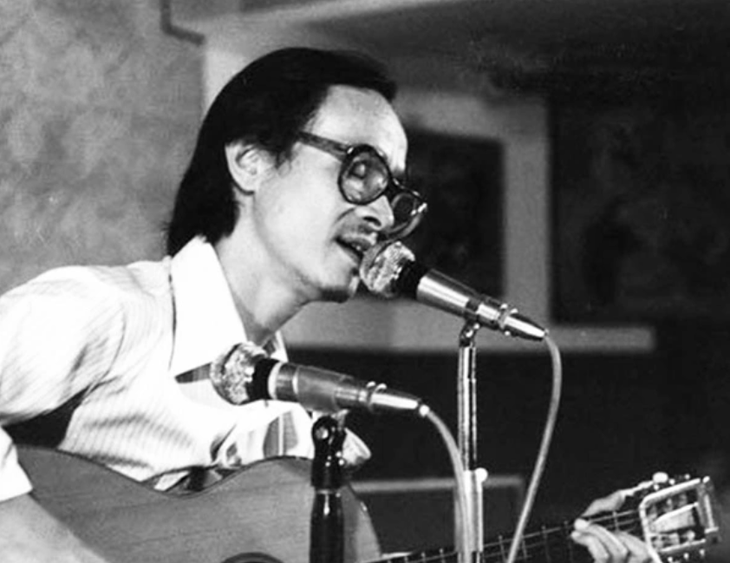 Trinh Cong Son owns a remarkable catalog of more than 600 songs. Trinh Cong Son owns a remarkable catalog of more than 600 songs. |
Trinh Cong Son once said, "I started thinking about life and death very early, when I was 10. It became an obsession. To me, losing a person and losing a love feel quite similar. Love can go on. But a human life doesn’t. Each of us only lives once. And that awareness never left me. That’s why sadness is part of my music."
When Trinh Cong Son talked about sadness, he was talking about how he understood life, its limits, and its endings. For Quynh Pham, that sadness in his songs was something she felt long before she tried to interpret his songs.
"Sometimes I don’t fully get what he wrote, but I can feel it, a kind of sadness that’s gentle, not heavy, not painful. And I’m always a little surprised by it. How something so sad can also feel so beautiful, so poetic?" Quynh said.
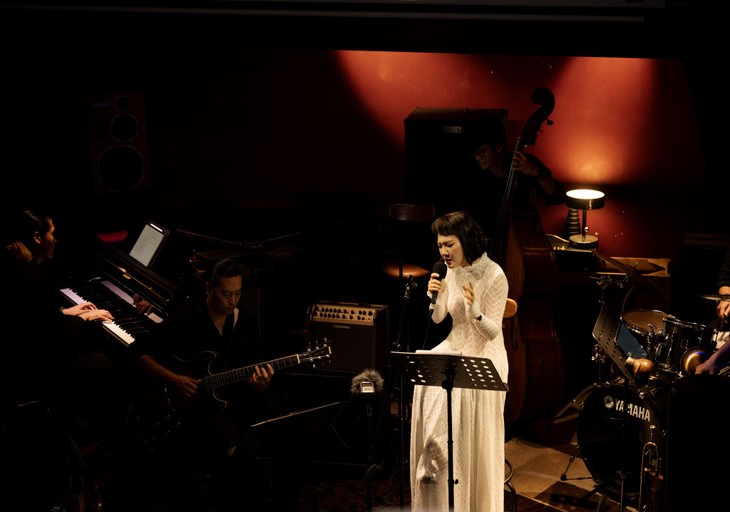 "Jazz Lady" Quynh Pham, the founder of the project ‘Let’s Love Jazz’ "Jazz Lady" Quynh Pham, the founder of the project ‘Let’s Love Jazz’ |
When Quynh Pham began working on reimagining Trinh’s music, she explored that feeling more, and it shaped the music into something that felt truly like her.
Jazz was born in the West, a genre characterized by improvisation and freedom. In jazz, musicians don’t play what’s written. They listen, respond, and create in the moment. You might hear a melody you already know, but in jazz it can be stretched, bent, or played in a completely different way.
For Quan Pham, a jazz singer involved in the project ‘Let’s Love Jazz’, its flexibility is what allows Trinh’s music to endure in different forms. Trinh songs always carry something melancholic, Quan said, adding that they’re often sad, sometimes moody, usually in a darker tone. Jazz gives those songs a new life, like a new coat.
"Sometimes a sad song can feel light or even joyful. Sometimes a happy song can feel sad. Jazz allows that kind of shift," said Quan.
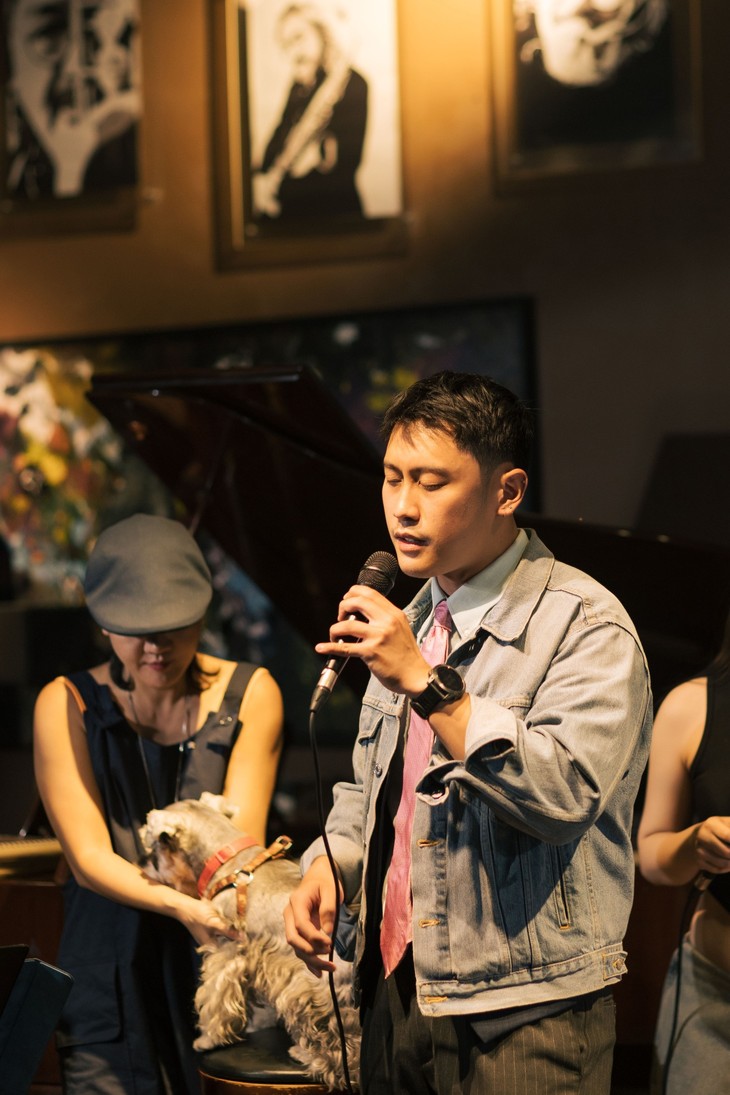 Jazz singer Quan Pham believes jazz is a genre anyone can enjoy as long as they keep an open mind. Jazz singer Quan Pham believes jazz is a genre anyone can enjoy as long as they keep an open mind. |
Jazz is still unfamiliar to many listeners in Vietnam. For them it seems too free, too improvised, not something you’d go looking for. That’s okay, because jazz isn’t meant to be forced. Quan Pham doesn’t believe jazz needs to be explained or recommended.
"I wouldn’t tell beginners, ‘Oh my God, you have to love jazz.’ No. Just let it happen naturally. Maybe you start with one song you like. If it speaks to you, it speaks to you. If it doesn’t, that’s fine, too. Don’t try to love jazz. Just feel it."
Beyond the musicians and the ideas, what matters is how Trinh’s music - reimagined in a jazz style - is received.
Nguyen Phuong Lan of Hanoi listened to the songs, not as a jazz expert, not as a purist, but as someone who has lived with Trinh’s music for years. “As long as the new doesn’t erase the old - as long as the soul of Trinh is still there - I’m happy to welcome it.”
Lan said that she has always loved how deep Trinh’s music is, the lyrics, the melodies, the way it makes her think about life. "I don’t usually listen to jazz. I just follow whatever touches me. So hearing his songs in jazz today, it felt fresh. Free. Very alive. Some people say his music is already perfect, that it doesn’t need to be changed. I get that. But I don’t mind new takes, as long as they respect the old, and keep the heart of the music. And if it helps others feel what I feel, I’m happy to listen and enjoy it, too."
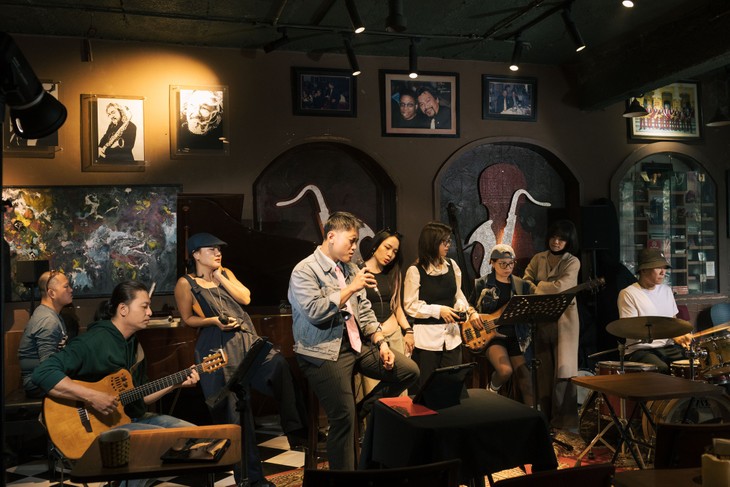 Quynh Pham and fellow jazz vocalists perform at a club in downtown Hanoi. Quynh Pham and fellow jazz vocalists perform at a club in downtown Hanoi. |
Just when you think you know these songs, they surprise you. This is Trinh’s music, in a jazz style…and in English!
“The lyrics and the melodies of Trinh’s songs are so beautiful that I felt they deserve to be heard by more people. Why not share them further? You just have to start. And honestly, I’m just following what Trinh said: ‘We just keep playing through life’… and here, that playing happens in the music,” Quynh Pham elaborated
Trinh Cong Son wrote ‘When autumn took its leaves’ in 1963, when he was a young, sensitive student discovering life, love, and all its sadness.
Today, this song has found a new life through a collaboration between Quynh Pham and Dattie Do, a young jazz singer who only started performing Trinh’s music two years ago at the opening of a pedestrian street named after the renowned songwriter in Hanoi. But even in her early steps with his songs, Dattie already felt their magic. As she says, his music is truly the best of both worlds.
Dattie said Trinh's music is pretty catchy, and it goes straight to the heart of the audience. And in terms of lyrics, she thinks the philosophical meanings are very deep. "I like it because some of the songs, the meaning of the songs, really aligns with my philosophy. The philosophy is very simple - live in the moment."
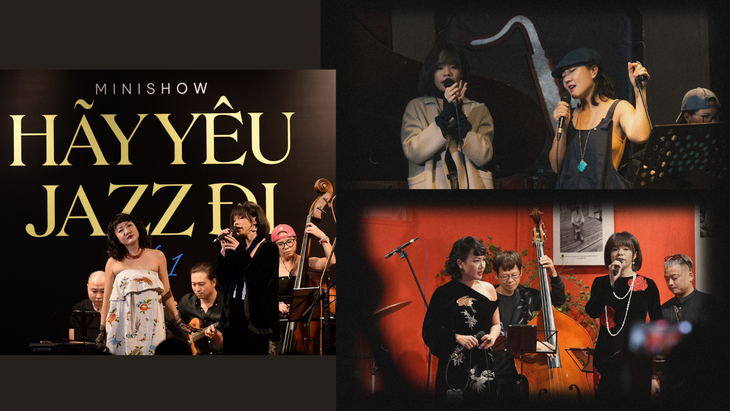 Quynh Pham and Dattie Do collaborate on many Trinh's songs. Quynh Pham and Dattie Do collaborate on many Trinh's songs. |
Dattie sees jazz as all about being in the moment which, she says, is Trinh’s philosophy. Jazz is built on improvisation, and to improvise, you have to really be present. That’s why she feels jazz fits his songs so naturally. It’s what makes jazz different, and it’s what gives these songs a new life in this album.
Dattie is just one of several young artists featured on the album. Quynh Pham has always wanted to create space for younger musicians to share her journey, and to give them a chance to explore and honor Vietnamese jazz. She believes that when more artists are involved, when the community grows together, the music and Trinh’s songs will become even richer and more alive.
Quynh said she likes to think of it as a garden: not a single flower, but a whole array of beautiful blooms. Everyone can come, look, and enjoy. It’s about letting many voices grow together, not just mine alone, she added.
So who handled the challenging job of translating the lyrics? That was Dr. Tran Nhat Tuan, who once lived in Europe and is a big fan of jazz. 10 years ago he heard Quynh sing and he was hooked. With that kind of inspiration? Yep, he signed on.
When it comes to Trinh’s songs, one of the first things Tuan told himself was that any author or songwriter has their own definition of their work. “If we try to stick to the very message itself, it would be quite complicated for people to get it, especially for the foreigners…As a translator, I can’t capture that 100%, but I should be capable of conceptualizing what the song is about."
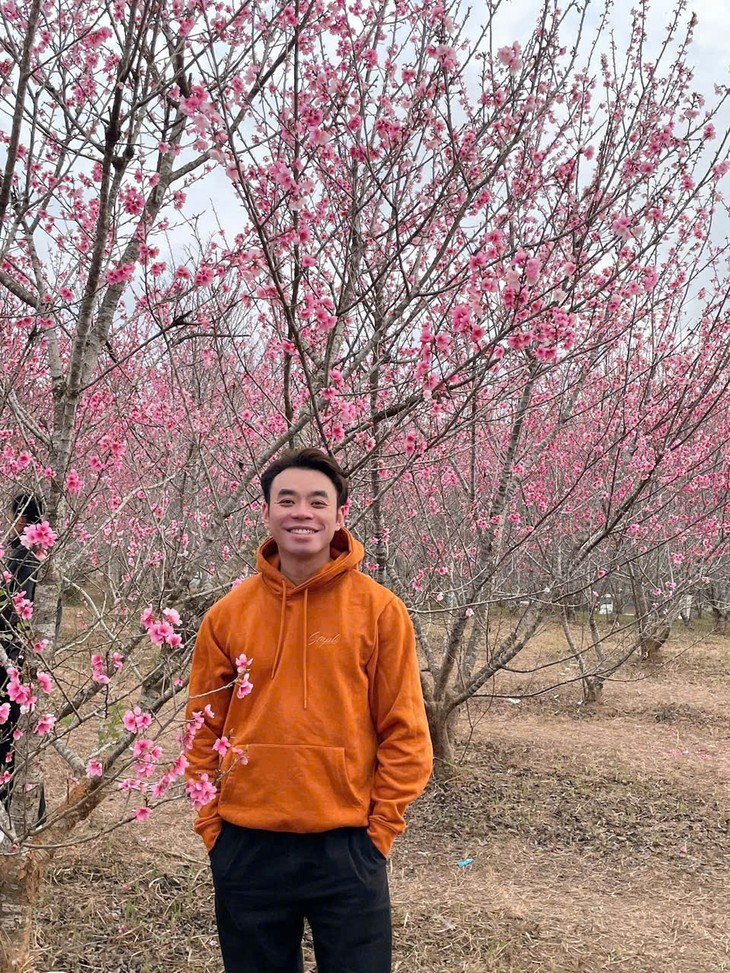 For Tran Nhat Tuan, a translator should be able to grasp the essence of a song and turn it into a mini story. For Tran Nhat Tuan, a translator should be able to grasp the essence of a song and turn it into a mini story. |
After spending some time having fun with the translation, some lines popping out instantly, others taking days to settle on the right words, perhaps the most rewarding moment for Tuan was hearing the recording.
"Oh, that feeling was incredible! It was a rainy night in Hanoi when I received the recording of ‘The seasons call us home’. Hearing the arrangement, the music, and the lyrics in English…it felt so alive, so natural. At that moment, I thought, wow, maybe I did a good job, it doesn’t sound like a translation, it just flows."
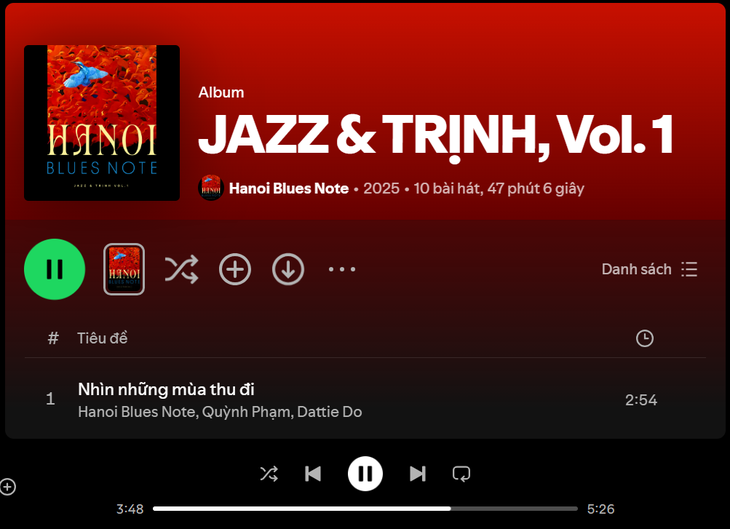 Jazz & Trinh, an album from the project that features Trinh Cong Son’s songs in a jazz style, is now available on Spotify. Jazz & Trinh, an album from the project that features Trinh Cong Son’s songs in a jazz style, is now available on Spotify. |
And of course, music is nothing without listeners. Since Volume 1 of the album was released on Spotify and Apple Music, it has drawn reactions from a wide range of listeners. Some recognized the classics, others discovered songs they hadn’t heard before. And here are some thoughts from listeners:
"Some classic songs I recognized and some I didn't. It’s a good mix of English songs and Vietnamese. And, absolutely, I thought they were really amazing."
"For me, autumn is the most beautiful season, and I really loved Dattie Do’s voice. When the singers started, I just got completely lost in the music - fully immersed."
"It was great. I think they did a fantastic job."
Music seems to have a secret life of its own. Every time Quynh Pham records a song, films a video, or brings Trinh’s music to life…it rains – as if by magic. It almost seems as if the songwriter himself is listening, smiling softly somewhere beyond.
Trinh Cong Son’s words still linger: "One day we won’t be here, this life won’t be here. So as long as we are, I’ll speak of love, celebrate love, and leave a little grace in this world."
The ‘Let’s Love Jazz’ project connecting generations through music will run until 2028. The first phase, until 2026, is focused on new young voices, mini-shows, online concerts, and albums that mix jazz with Trinh Cong Son’s songs. The project is also setting up ‘Jazz Stations’, spaces for young artists to perform and experiment, in Hanoi, Hue, Da Nang, and Ho Chi Minh City.
In 2027, the project will work with international artists, release music digitally abroad, and hold bigger live concerts in Vietnam. By 2028, it plans new music, international jazz exchanges, and guest performances by popular international singers.
The music will start with an EP of five bilingual tracks, then a deluxe edition of eight songs, released digitally on CD and vinyl on February 28, 2026 - Trinh Cong Son’s 87th birthday.