(VOVWORLD) -Arezoo Eskandari, a clinical psychologist, professional athlete, and tourism ambassador for Iran’s historic city of Isfahan, is cycling 18,000 kilometers across Asia. After a demanding month riding south from Beijing, she has arrived in Vietnam—one of the destinations she was eager to experience. Known among Iranian travelers for its warm hospitality and striking landscapes, Vietnam quickly lived up to its reputation. From her first encounter with a local family at the border to her early days cycling through Hanoi, Arezoo has found strong cultural connections and a shared philosophy of “slow life.” She spoke with VOV about her journey, her values, and the bridges she is building along the way.
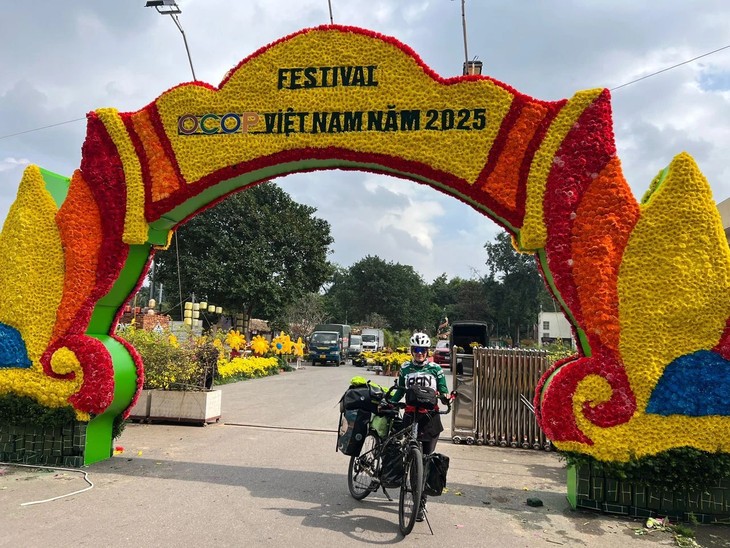 Eskandari arrives in Vietnam on December 22, 2025 and plans to travel across the country for one month. (Photo credit: Arezoo Eskandari) Eskandari arrives in Vietnam on December 22, 2025 and plans to travel across the country for one month. (Photo credit: Arezoo Eskandari) |
Bao Tram: Welcome to Vietnam! Thank you for joining us. Could you briefly introduce yourself to our listeners?
Arezoo Eskandari: Greetings to the hospitable and warm-hearted people of Vietnam. I’m Arezoo Eskandari, a clinical psychologist with a master’s degree and many years of experience in therapeutic work. To speak about my athletic background, it has been about 12 years since I started professional sports. I’m a mountaineering and cycling coach. I began my travels by bicycle about 8 years ago, and I’ve had many trips both inside and outside of Iran up to this point.
Bao Tram: You’re cycling across Asia. Tell us about this journey and why Vietnam is a part of it?
Arezoo Eskandari: This is part of a major one-year journey where I plan to cycle 18,000 kilometers across the Asian continent. I started in Beijing, China, a month ago and cycled south before entering Vietnam.
Vietnam has an incredible reputation in Iran. Many tourists dream of coming here because of the famous hospitality and striking nature. Before I arrived, my friends who had visited expressed a strong desire to return because the experience was so positive. As soon as I crossed the border and arrived in Vietnam, I met a very kind Vietnamese family. They helped me exchange money, get a SIM card, and invited me to eat with them. We had duck soup, and it was very delicious. Everything I had heard about the kindness and hospitality of Vietnamese people was truly confirmed for me.
Bao Tram: You come from Isfahan and serve as a tourism ambassador. How does that shape your travels?
Arezoo Eskandari: I’m from Isfahan—a city of civilization and history. We call Isfahan ‘half of the world.’ I’m proud to say that Isfahan was chosen as the Tourism Capital of Asian Countries in 2025.
I’m an ambassador for Isfahan tourism, and my goal has been to introduce the culture of my people and the tourism spaces of my city to people across Asia, and to invite them to visit my city and my country. One thing I’d like to introduce about my people to Vietnam is their hospitality. My people are extremely hospitable, and they believe that people from other countries are friends they are meeting—friends they welcome to their own table. This is something I have also seen among Vietnamese people, and it really impressed me.
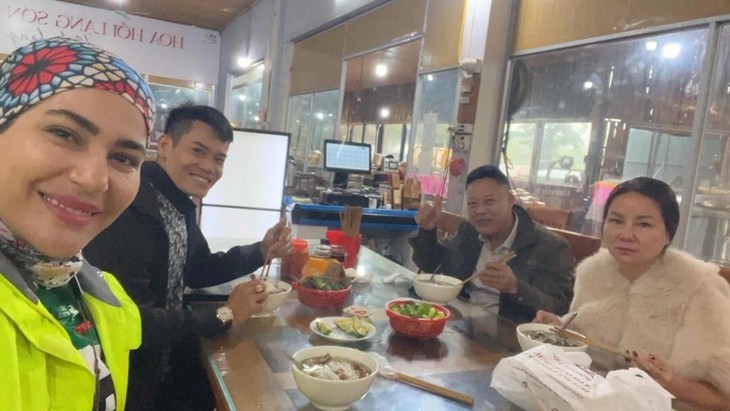 Eskandari is welcomed by local residents and has a meal with them. (Photo credit: Arezoo Eskandari) Eskandari is welcomed by local residents and has a meal with them. (Photo credit: Arezoo Eskandari) |
Bao Tram: How do you stay mentally strong during such a long solo journey?
Arezoo Eskandari: I have a philosophy behind cycling travel, which is called slow life or co-living—the art of living in the moment, the art of being aware of what surrounds you. On my journeys, I move very slowly. A distance of 100 kilometers that might take an hour by car takes me from morning until night, because I can only cycle about 15 kilometers per hour. So for me, the destination and arrival are not important. Enjoying the journey is what truly matters. What was very interesting for me is that I saw this very clearly among Vietnamese people as well. People sitting together, having a drink, talking, laughing, feeling happy, without much stress or worry. This really attracted me, because this is exactly my travel style and my travel philosophy. After leaving Hanoi, I’ll head toward central and southern Vietnam, traveling from city to city and village to village, connecting with people. I’ll become a guest in the homes of villagers and residents of different places, talk with them, and experience their food and culture.
Born in 1990, Arezoo Eskandari, a psychologist and cycling coach with over eight years of experience in long-distance cycling and adventure travel.
During these years, Eskandari has completed several major cycling trips, including three journeys across Turkey and a solo ride around Iran — covering 8,400 kilometers over 5 months.
She is now preparing for her most ambitious journey yet: a one-year solo cycling trip around Asia. The journey began in China and passes through Vietnam, Laos, Cambodia, Thailand, Nepal, India, Kazakhstan, Tajikistan, Turkmenistan, Azerbaijan, Armenia, Georgia, and Turkey. This is the first time Eskandari has come to Vietnam, the second leg in the trip.
Bao Tram: You’ve cycled extensively in Iran and China. How does Vietnam compare?
Arezoo Eskandari: Iran is a four-season country, so I’m used to diverse terrains, from mountains to coasts. In Vietnam, I was immediately amazed by the mountainous landscapes, lush forests, and tropical fruits.
But traveling alone brings challenges, such as language barriers and unfamiliar foods. Comparing Vietnam to China, I found China much more challenging. Communication was harder there, and the food was very different from Iranian cuisine. In Vietnam, I feel a much closer cultural connection. Even just riding my bike and having people wave and say "hello" gives me immense encouragement.
 Hanoi is one of Eskandari’s destinations in her Vietnam trip. (Photo credit: Arezoo Eskandari) Hanoi is one of Eskandari’s destinations in her Vietnam trip. (Photo credit: Arezoo Eskandari) |
Bao Tram: What habits of Vietnamese people have stood out to you the most?
Arezoo Eskandari: There are a few things in Vietnam that really stood out to me. One thing is that I see people are greatly interested in sports. When I go out for a morning walk, I see people everywhere exercising early in the morning—walking, working out, and cycling. Another thing is how early people get up. For example, when I’m at the hotel and go out at six in the morning, it feels like everyone is already awake—having breakfast early, starting their day early. This early-rising habit is really great. Then there’s their eating style. They eat very healthily and use a lot of fruits and vegetables. They don’t overcook their food so that its nutritional value isn’t lost. And finally, there’s the spirit—the high morale. The calmness on Vietnamese people’s faces, and the joy and happiness I see, are signs of strong mental well-being.
Bao Tram: Finally, what message would you like to share with other travelers?
Arezoo Eskandari: Sustainable tourism has three pillars: respecting local people, bringing economic benefits to the destination, and preserving the environment. As travelers, we should not add anything to nature or take anything away, except for photos and memories.
I’m heartened by the growing movement against plastic, which is toxic to our environment. By traveling by bicycle, I use no fossil fuels and cause the least possible harm. I hope my style of travel inspires others to think about their impact on the planet. Every day of travel is a lesson in maturity, and the kindness I’ve found proves that the language of human love knows no borders.
Bao Tram: Thank you very much, Arezoo Eskandari, for an interesting talk. We wish you a safe and meaningful journey as you continue through Vietnam and across Asia.