(VOVWORLD) - Introduced to Hanoi over a century ago, European architecture, particularly French architecture, has been uniquely transformed by the craftsmanship of local artisans, giving its classic lines a subtle Vietnamese character. This fusion creates an urban landscape of quiet elegance and timeless charm and is a bridge from the city’s past to its dynamic future.
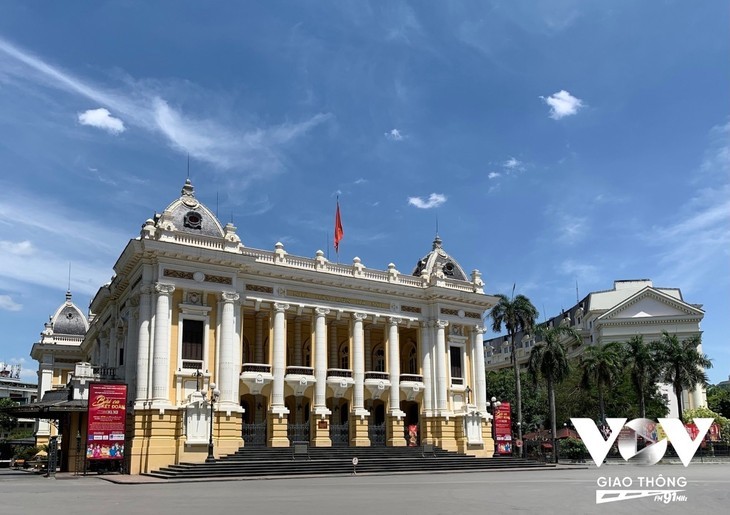 The Hanoi Opera House, one of the capital city’s symbols, is modeled after Paris’s Opera Garnier. (Photo: Quang Hung/vovgiaothong.vn) The Hanoi Opera House, one of the capital city’s symbols, is modeled after Paris’s Opera Garnier. (Photo: Quang Hung/vovgiaothong.vn) |
“To me, Hanoi is most beautiful in the early morning. I love watching the city at that time. The old houses with their distinctive architecture—tiled roofs, weathered paint, moss-covered walls—come alive as residents step out onto balconies to exercise or survey the tranquil streets. This makes Hanoi unique.” Pham Hoang Chien, a Hanoi resident, said the varying shades of yellow on French-style buildings give Hanoi’s streets a solemn, nostalgic beauty.
Hanoi’s Old Quarter and the “Old Streets” referred to as the French Quarter, preserve many architectural gems treasured by the capital. More than a century ago, Western, especially French, architecture arrived in Hanoi, was localized, and evolved into what is now known as Indochine architecture.
While the buildings’ structural proportions adhered to French standards, decorative elements like iron railings, metal doors, porcelain doorknobs, and various other components were strongly influenced by local culture and the Nguyen Dynasty’s architectural motifs.
Many houses have traditional wooden panel doors, chrysanthemum motifs, scroll designs, bats symbolizing longevity, and peach emblems, all of which are hallmarks of Eastern aesthetics. Inscriptions in Vietnamese or in Han-Nom script, a blend of Chinese and Vietnamese characters, adorn many homes and have been preserved by generations of owners.
Architect Tran Huy Anh said that Hanoi has undergone 100 years of urban development influenced by Western styles, with various phases producing diverse architectural styles. “The buildings in the French or Old Quarter are like puzzle pieces forming a refined and elegant picture. They allow us to envision a future Hanoi that is both developed and comfortable, yet retains a beauty many Asian cities have lost in their rush to urbanize,” Anh noted.
These French-style houses have been a source of inspiration for artists like painter Bui Quang Khiem, who was born and raised in Hanoi’s Old Quarter. Khiem has created numerous paintings that capture the blending of classic architecture with modern life. His woodcut artwork, which won an award at the capital’s fine arts exhibition in 2018, captures the charm of an old house juxtaposed to a motorcycle parts shop.
He said he keeps exploring and documenting modern life in and around these fading structures. “If Hanoi didn’t have its rows of old streets, artists wouldn’t have so much inspiration. If painter Bui Xuan Phai hadn’t recognized that beauty and awakened these values, people might have forgotten it. In musician Trinh Cong Son’s famous song ‘Remembering Hanoi’s Autumn,’ the old houses with simple brown roofs leaning gently, like in Phu Quang’s ‘Darling! The Streets in Hanoi!,’ evoke deep emotion. These images are unlike those of any other city,” said Khiem.
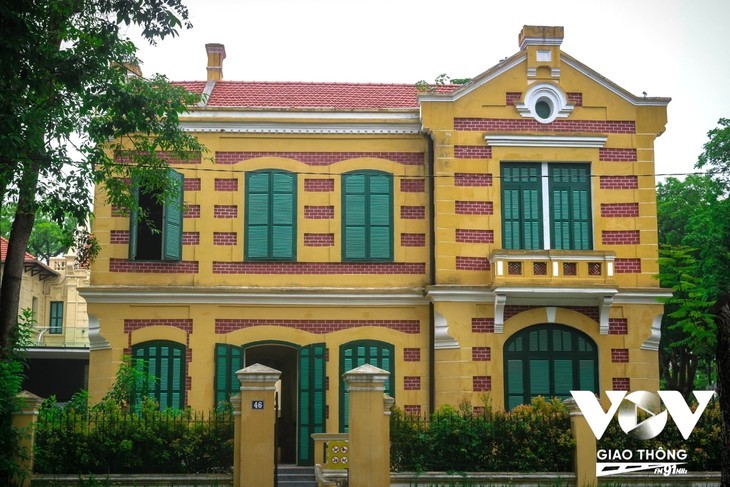 The French villa at 49 Tran Hung Dao Street (Photo: Quang Hung/vovgiaothong.vn) The French villa at 49 Tran Hung Dao Street (Photo: Quang Hung/vovgiaothong.vn) |
Some French-style buildings have stood for over a century and now serve a new purpose – offering public access and glimpses into Hanoi’s rich history. The Hanoi Opera House, constructed between 1901 and 1911 and modeled after Paris’s Opera Garnier, remains one of Vietnam’s grandest theaters, still hosting major events and classical performances.
Several villas in the French Quarter have been restored as cultural spaces. For example, the French villa at 49 Tran Hung Dao Street, originally a garden home for a French doctor built by Vietnamese craftsmen, now functions as a cultural exchange hub. It is dedicated to preserving Hanoi’s architectural heritage and fostering cultural dialogue, especially between Vietnam and France.
“The villas in Hanoi resemble private homes in the French countryside. They were not built according to urban planning grids, but as garden or vacation houses,” said French architect Emma Reix. “In France, villas vary by region in materials and style, but Hanoi’s villas share consistent construction methods and materials and are mostly built from stone.”
The old homes, villas, and other French-style buildings invite a look back at a bygone Hanoi.