(VOVWORLD) - Ta So Hamlet 1 in Moc Chau ward, Son La province, home to the Mong ethnic group, is located at “Heaven’s Gate,” about 20 kilometers from the center of Moc Chau. The locals, who once relied solely on corn and rice cultivation, now earn income from community-based tourism. The beautiful landscapes are already attractive to tourists, and villagers are now working to preserve their unique culture.
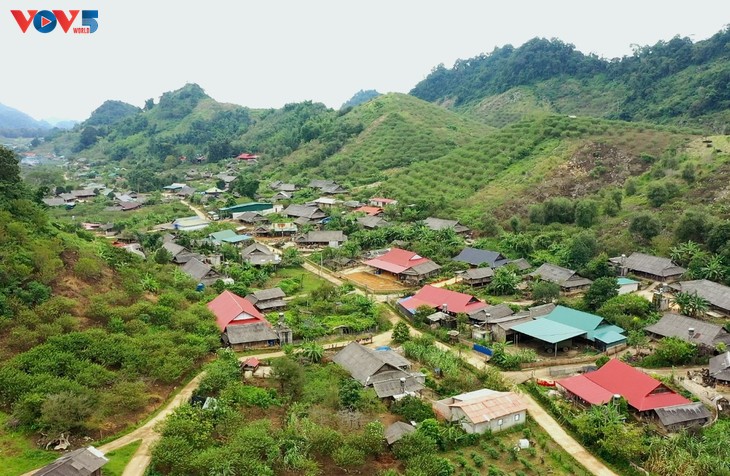 The traditional cultural values of the ethnic Mong in Ta So hamlet 1 are well preserved. (Photo: Huyen Trang) The traditional cultural values of the ethnic Mong in Ta So hamlet 1 are well preserved. (Photo: Huyen Trang) |
A boy, dressed in the traditional purple costume of the Mong, sits beneath a peach tree playing a flute. The melody, the pink peach blossoms, and the white blooms of nearby plum trees, complement the tranquility of the mountain hamlet. Whenever spring arrives and the flowers are in full bloom, local households engaged in community tourism get busy welcoming visitors. This is their peak tourist season.
On quieter days, Mua A Nha refurbishes his homestay and tends to his one-hectare plum garden. Before 2019, he knew only how to grow corn and rice. When a community tourism development project was introduced to the hamlet, Nha became one of the village’s first tourism pioneers. His family built some small guest houses for visitors.
Nha personally crafted lampshades, water stands, and clothing racks from wood collected in the forest, designing each item himself. During the early days of his business, Nha attended training courses and visited famous community tourism models in Van Ho commune in Lao Cai and Sin Suoi Ho hamlet in Lai Chau.
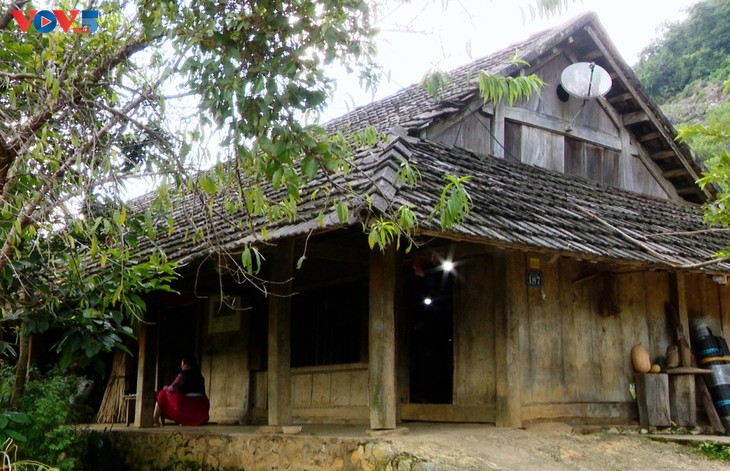 An ancient five-compartment wooden house of Mong ethnic families (Photo: Huyen Trang) An ancient five-compartment wooden house of Mong ethnic families (Photo: Huyen Trang) |
Drawing on lessons learned from other places, combined with his own creativity, Mua A Nha has become one of the most successful community tourism providers in Ta So Hamlet 1.
“Tourism allows us to preserve the Mong culture. I decorate my homestay with Mong patterns and brocade. When I built it, I wrapped the structure in wood so that when guests arrive, they feel they’re entering a natural space imbued with Mong culture. Since we started doing tourism, our financial situation has become more stable than when we just grew corn and rice,” said Nha.
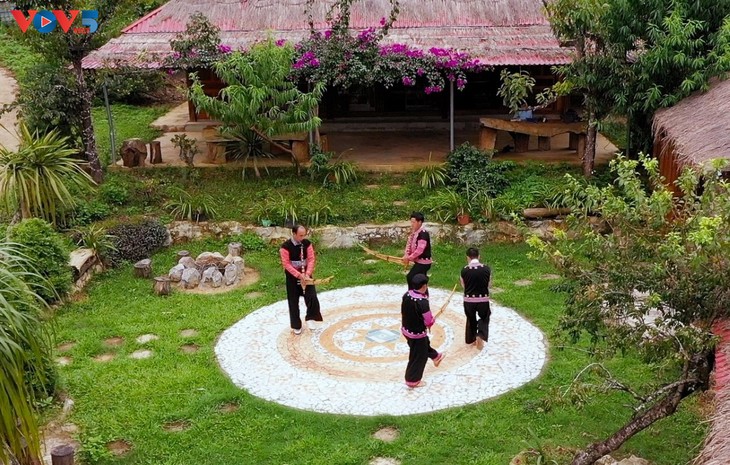 The Mong people work together to preserve their ethnic cultural identity for community-based tourism. (Photo: Huyen Trang) The Mong people work together to preserve their ethnic cultural identity for community-based tourism. (Photo: Huyen Trang) |
Not far away, in a house built in 1964, Mua A Pha is performing Mong spiritual rituals. Through these rites, the Mong pray for good health and prosperity, seek blessings before long journeys, or offer prayers for everyday matters such as hatching eggs or livestock health. On such occasions, Pha’s family prepares offerings to the spirits and the God of the Land to ask for protection and blessings.
Inside the house are seven places for burning incense: the main altar, the main supporting pillar, the spiritual hearth, the main door, two side doors, and the two spiritual stoves. There is one spiritual stove in the living room, which provides warmth for guests on cold days, and another next to the host’s bedroom, on top of which is always a full container of water. Since community tourism came to the hamlet, this house has been preserved as a place for visitors to learn about Mong life.
“There are a few old houses in the hamlet, but most have updated their interiors. Mine has been almost entirely kept as it was in the past. When guests come, I explain every detail,” said A Pha, adding, “First is the area for drinking water and the spiritual stove. The middle section is the main space, with three altars, the main supporting pillar, and the main door, used for weddings and funerals. Next is the host’s bedroom, opposite the second spiritual stove, followed by the eldest son’s room.”
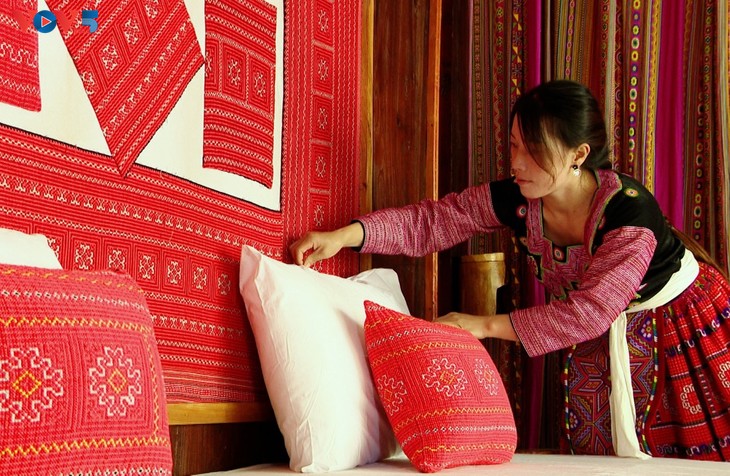 A homestay is decorated with brocade patterns and motifs of the Mong ethnic group. (Photo: Huyen Trang) A homestay is decorated with brocade patterns and motifs of the Mong ethnic group. (Photo: Huyen Trang) |
Under the eaves, Ms. Hang Thi Chu prepares a small fire, a plate, and some beeswax for beeswax drawing, a sophisticated art of costume decoration practiced by Mong women. She carefully dips a small wooden pen into the beeswax and draws fine lines on white cloth. Gradually, intricate patterns and motifs emerge.
“It takes a day just to draw the straight lines. Completing a full pattern takes about three days. Once the colorful motifs are finished and worn, they look stunning. Beeswax drawing is faster than embroidery, but the fabric needs to be dyed afterward, so the overall process takes longer. When guests come here, they most enjoy experiencing beeswax drawing because it’s something new and fascinating,” Ms Chu said.
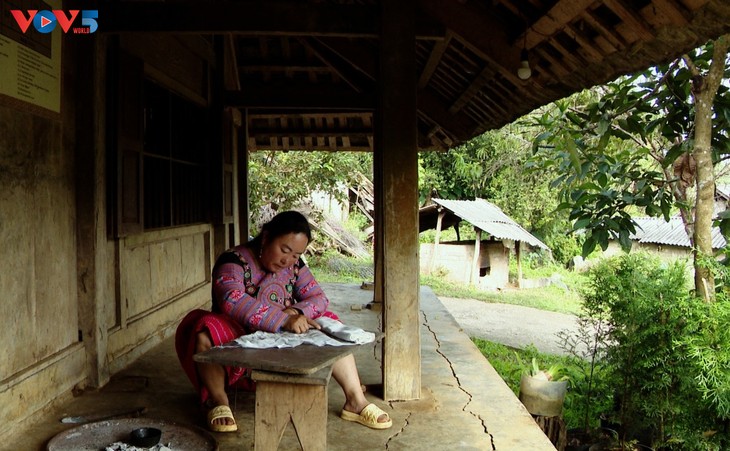 Ms. Hang Thi Chu drawing with beeswax to decorate traditional costumes. (Photo: Huyen Trang) Ms. Hang Thi Chu drawing with beeswax to decorate traditional costumes. (Photo: Huyen Trang) |
In the past, the mountain hamlet of Ta So 1 was very isolated from the outside world. Local people lived quietly and had little interaction with strangers. Since the development of community tourism, in addition to stabilizing their livelihoods, the Mong have gained opportunities to learn new skills.
Mua A Di, the head of Ta So 1 hamlet, said, “When tourists come here, they can take part in many activities and traditional games, such as tu lu spinning tops, chicken fighting, and making sticky rice cakes. Ta So still preserves traditions like pan-pipe making and old-fashioned houses.”
“In the past, villagers just grew corn. Since the tourism began, they’ve renovated the village roads and alleys and their homes. Living conditions have improved a lot, and people now have time to grow fruit trees, welcome tourists, and interact with other ethnic groups,” A Di recalled.
The local Mong people understand that tourism development goes hand in hand with preserving their ethnic identity, which is the key to attracting new visitors.