(VOVWORLD) - “A millennium of castanet rhythms,” directed by People’s Artist Le Viet Huong, is a documentary film about Ca Tru (ceremonial singing), recounting the history of the folk art that has shaped Vietnam’s cultural identity. It also highlights the importance of preserving and developing that heritage.
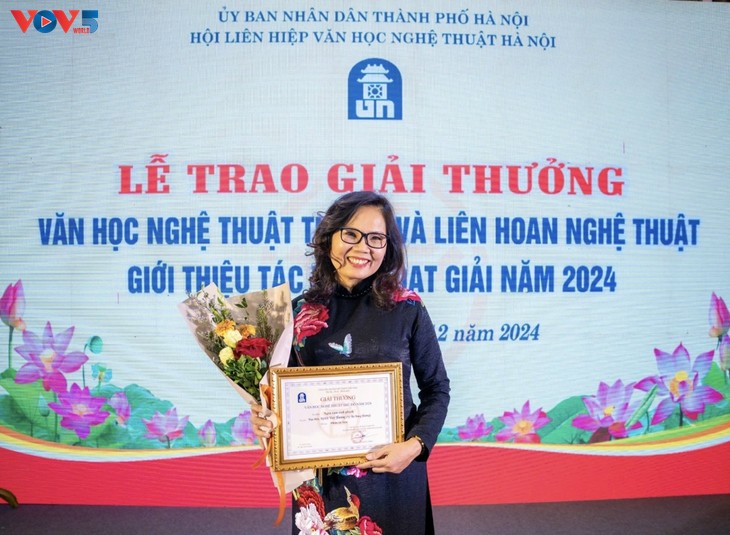 People’s Artist Le Viet Huong (Photo: Kim Lieu/ VOV5) People’s Artist Le Viet Huong (Photo: Kim Lieu/ VOV5) |
“After renowned Vietnamese-French Professor Tran Van Khe returned to Vietnam, he met with veteran Ca Tru singer Quach Thi Ho, recorded her performances, and presented them to the International Music Council. It was only after Ca Tru was officially recognized as an intangible cultural heritage that efforts to revive it truly began. However, by then master artists had already grown very old. A veteran musician once said that 60 years had passed, and now he could play the musical instrument again, which really moved me. I truly hope people will join hands to preserve and develop Ca Tru, a precious art form that our ancestors have passed down to us,” that’s the message People’s Artist Viet Huong wants to convey to audiences through her documentary “A millennium of castanet rhythms,” a 70-minute exploration of one of Vietnam’s most distinctive traditional musical forms.
It takes viewers through the ups and downs of Ca Tru, from its golden age to periods of decline to modern efforts at revival, while analyzing the key elements of Ca tru artistry.
“This is a documentary film, but it includes reconstructed elements, such as the story of the origin of Ca Tru. I was able to recreate the story of how the ‘dan day’, a long-necked lute with three silk strings and 10 frets, came into being, which is part of the film’s artistic reconstruction. As for the elements that reflect historical reality, I relied on the cultural heritage left by our ancestors, including ancient manuscripts and carvings found in temples and communal houses. For example, at Dong Ngac communal house and Van Dinh communal house in Hanoi, there are still carvings dating back 300 years that depict people playing the dan day,” said Huong.
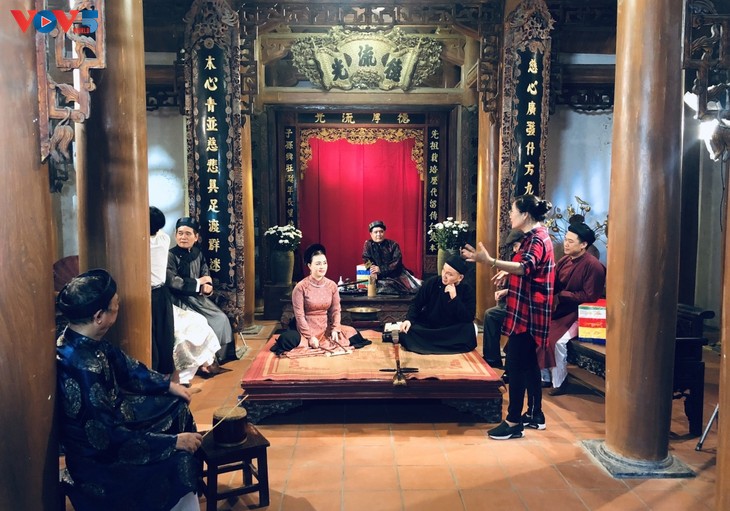 The filming of a reenacted traditional Ca Tru performance. (Photo: Kim Lieu/ VOV5) The filming of a reenacted traditional Ca Tru performance. (Photo: Kim Lieu/ VOV5) |
In the film, Ca Tru singing sessions are recreated in traditional performance spaces such as communal houses and shrines.
“To help younger generations appreciate Ca Tru, we needed to present it in an engaging and appealing way. We recreated a traditional singing session from the early twentieth century, in which female singers performed Ca Tru live. The only staged element was the audience, officials and scholars from the past, whose nods and expressions of appreciation became the highlight of the performance,” Huong said.
Through the stories of Ca Tru masters such as Quach Thi Ho, Le Thi Lieu, Meritorious Artist Bach Van, and dan day player Nguyen Phu De featured in the film, audiences gain a deeper understanding of the lives and dedication of those who have devoted their lives to this art form.
Artist Mai Tuyet Hoa, Director of the Center for the Preservation and Development of Traditional Arts, said, “In the documentary ‘A millennium of castanet rhythms’, Ca Tru is viewed across different dimensions of space and time. By placing Ca Tru in a multicultural context, and especially through the stories of the people involved, the director tells the story of the art form in an engaging way. As someone who works to preserve this heritage, I realize that no single person can fully encompass it all. But through this film, I feel as if we are truly living the experiences that our ancestors once lived.”
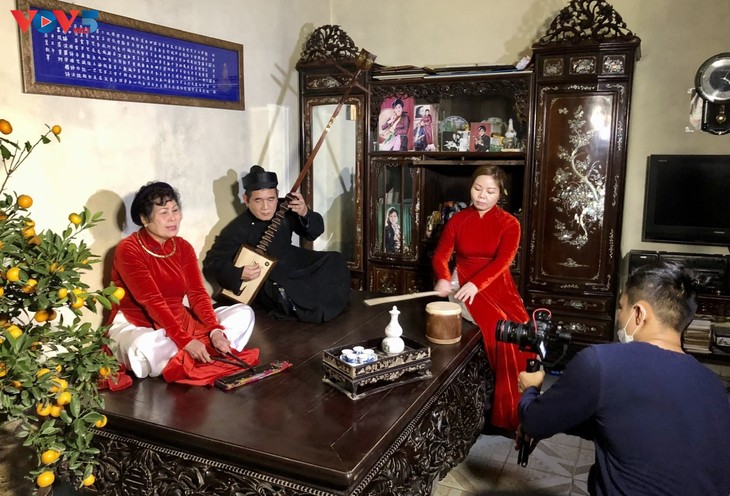 (Photo: Kim Lieu/ VOV5) (Photo: Kim Lieu/ VOV5) |
“This is a film with profound cultural depth. It combines music with historical materials, interviews, and critical perspectives from many scholars. This is a genre rarely seen in cinema and television. Beyond the beauty of Ca Tru and its music, the film also has meticulous staging and a wealth of valuable archival materials about the respected figures in the art of Ca Tru. It is a very good film and one that deserves strong encouragement,” said Director Nguyen Khac Hai Ha.