(VOVWORLD) - In folk and applied arts, the horse is portrayed in a simple yet vivid style, symbolizing a loyal animal closely tied to everyday human life. In modern visual art, it has emerged as a strong source of inspiration, carrying a wide range of expressive and symbolic meanings.
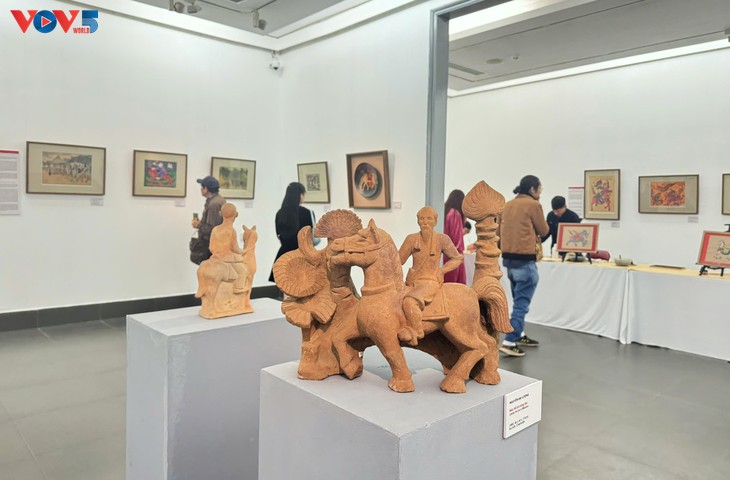 Artworks on display at the themed exhibition “The Horses in Visual Arts” in Hanoi. (Photo: Thuy Tien/VOV) Artworks on display at the themed exhibition “The Horses in Visual Arts” in Hanoi. (Photo: Thuy Tien/VOV) |
Sixty artworks on display at the ongoing themed exhibition “The Horse in Visual Arts” at the Vietnam National Fine Arts Museum in Hanoi present diverse perspectives on the image of the horse in Vietnamese art. Notable highlights include depictions of legendary Saint Giong in works by Nguyen Tu Nghiem, Ngo Manh Lan, and Tran Khanh Chuong, which reflect a harmonious fusion of traditional values and modern visual language.
In the daily lives of highland ethnic communities, horses appear as close companions, captured in works by To Ngoc Van, Nguyen Van Ty, and Bui Xuan Phai.
During the resistance wars, the image of the horse accompanying soldiers, particularly alongside President Ho Chi Minh, emerged as a powerful symbol of humanistic values, as seen in works by Duong Bich Lien, Nguyen Trong Kiem, and Nguyen Thu. For many art enthusiasts, the exhibition offers a rare opportunity to admire representative works by some of Vietnam’s most celebrated master artists.
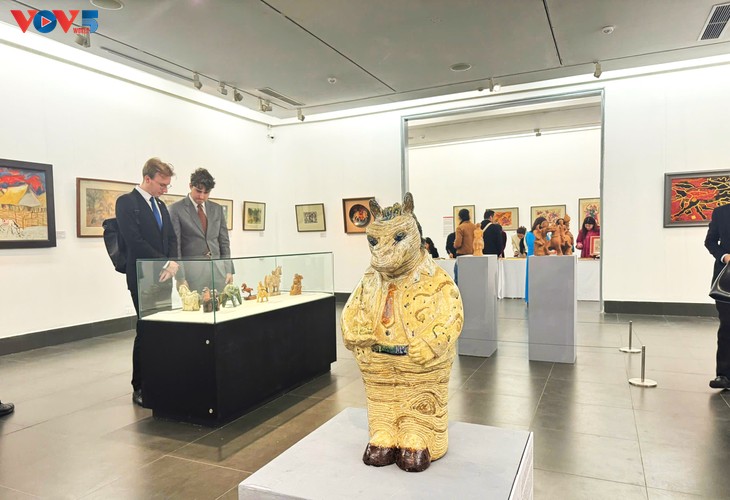 The exhibition draws both domestic and international visitors. (Photo: Thuy Tien/VOV) The exhibition draws both domestic and international visitors. (Photo: Thuy Tien/VOV) |
“The horse is one of the twelve zodiac animals and has long been part of folk culture and everyday life. However, it is often more closely associated with village life and the resistance wars. Through this exhibition, I’ve had the chance to see several rare works from the museum’s collection as well as from private collections,” said a visitor.
Another added, “Many artists have explored the theme of the horse in highly creative ways, using diverse forms of expression and materials. The exhibition features not only paintings, but also lacquer works, sculptures, and ceramic pieces. I was particularly impressed by a work by Bui Xuan Phai, which shows a little girl riding a toy horse, capturing a sense of innocence and purity.”
The exhibited works demonstrate diversity in both form and material, including lacquer, oil on canvas, silk, paper paintings, wood, terracotta, and ceramics. They were created by many generations of Vietnamese folk artisans and visual artists, from the Indochina Fine Arts School era and wartime resistance period to the present.
Telling a visual story of how the image of the horse is renewed in contemporary sculpture, the artwork “Mr. Ngo” by Nguyen Thang Long leaves a strong impression on viewers with its distinctive form.
“There are two elements that distinguish the piece. First is the form. I combine contemporary art with the zodiac animals, which are symbols of Eastern culture. The suit jacket, on the other hand, is a symbol of the Western culture, this is the initial concept for shaping the work. The second element is the use of material. I construct the surface using clay coils, an ancient technique,” said Long.
“Traditionally, artisans would smooth the surface after applying the coils, but I chose to preserve the traces of the process. These marks become patterns, fingerprint-like impressions that record the entire act of creation and give the work its own distinctive beauty,” he added.
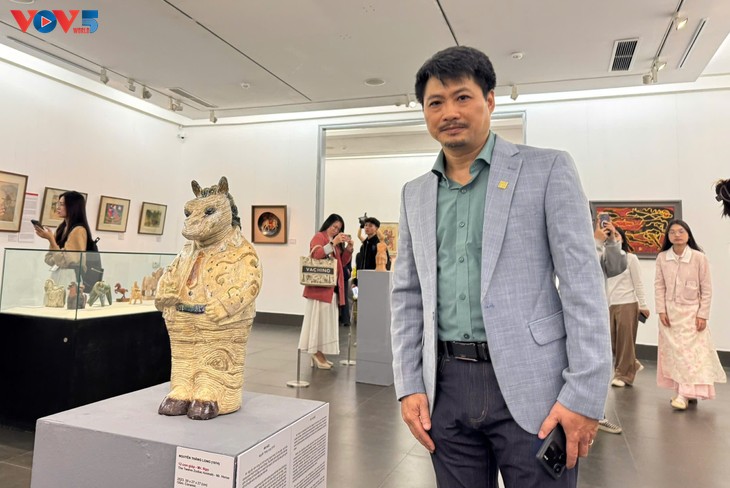 Painter Nguyen Thang Long and his “Mr. Ngo” (Photo: Thuy Tien/VOV) Painter Nguyen Thang Long and his “Mr. Ngo” (Photo: Thuy Tien/VOV) |
As part of the exhibition “The Horse in Visual Arts”, visitors can take part in hands-on activities such as drawing on do (poonah) paper.
Hanoi resident Nguyen Lan said, “The exhibition is very engaging. It doesn’t just present the horse as a zodiac animal, but also explores its image across different artistic periods, from folk and traditional art to modern expressions. I especially enjoyed taking part in the folk horse-printing activity.”
The exhibition opens until March 1.