(VOVWORLD) - Last weekend, Vietnam Electricity (EVN) began construction on Phase 2 of the Bac Ai Pumped Storage Hydropower Plant in Ninh Thuận province. This will be Vietnam’s first pumped storage hydropower plant and one of EVN’s key national energy projects this year. The plant is expected to boost national energy security and support Vietnam’s transition to a greener, more sustainable economy.
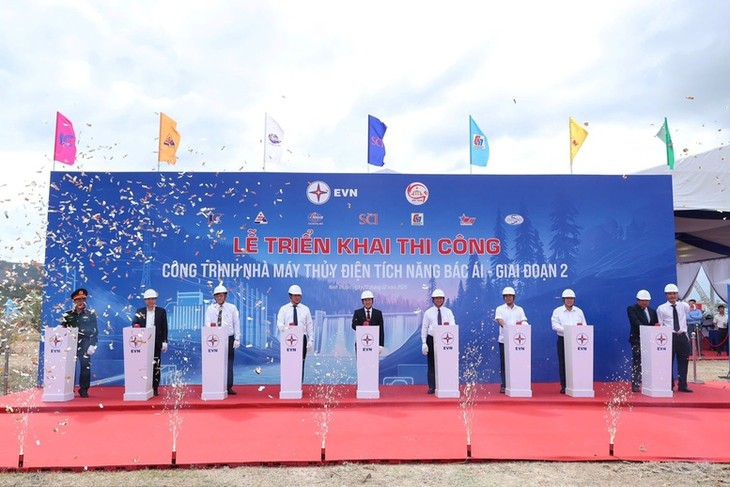 Vietnam breaks ground on its 1st pumped storage hydropower plant in Ninh Thuan province Vietnam breaks ground on its 1st pumped storage hydropower plant in Ninh Thuan province |
Pumped storage hydropower operates like a giant battery, storing excess electricity during off-peak hours and releasing it when demand is high. The Bac Ai project will be developed in stages, with the first generating unit scheduled for completion by December 2029, unit 4 by December 2030, and full project completion by May 2031. The plant is expected to begin operation in 2029 or 2030.
Vice Chairman of the Ninh Thuan provincial People’s Committee, Trinh Minh Hoang, says the plant will have a capacity of 1,200 MW.
"This is one of the projects that drive the province’s economic growth and contribute to its 13.5% growth target for this year. It has a close connection with the planned Ninh Thuan nuclear power plant. Both projects will help regulate the power system and optimize electricity use," said Hoang.
The Bac Ai Pumped Storage Hydropower Plant will have two reservoirs at different elevations with a hydroelectric facility in between. During periods of low electricity demand, excess power will be used to pump water from the lower to the upper reservoir. During peak demand, water flowing back down will generate electricity.
Nguyen Anh Tuan, General Director of EVN, said: "We will work closely with contractors and consultants to ensure the project’s quality, safety, and environmental responsibility. EVN urges contractors to mobilize adequate materials, manpower, and financing to meet the project’s schedule and quality standards."
The Bac Ai project was approved by the Prime Minister as part of Vietnam’s National Power Development Plan for 2021-2030, with a vision to 2050 (Power Plan VIII). It has an estimated investment of 880 million USD.