(VOVWORLD) - Last December Australia became the first country to legally ban children under 16 from accessing major social media platforms, including Facebook, Instagram, TikTok, Snapchat, X, Reddit, and YouTube — with the sole exception of YouTube Kids. In Vietnam, the question “to ban or not to ban” has sparked a heated debate on public forums. Would we be shielding children from harm or merely preventing them from fully integrating into the digital age?
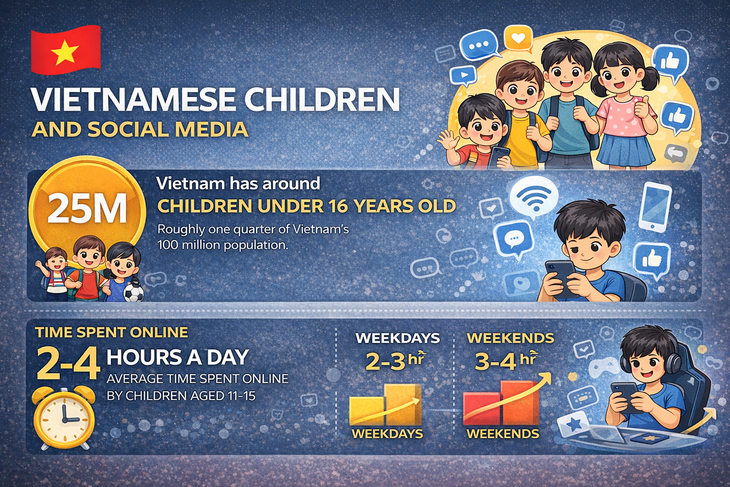 (AI-created photo) (AI-created photo) |
It’s undeniable that social media acts like a giant magnet, powerfully attracting young users. But behind the swipes and taps lie risks to a child’s still-developing brain, along with potential traps if left unchecked.
Tuan Ha, founder and chairman of Vinalink Media, a digital marketing consultancy and Founder of Vinalink Academy, a pioneering institution in Digital Marketing training in Vietnam, with more than 25 years of experience. The organization is highly regarded for its hands-on, practice-oriented courses in SEO, TikTok, and Facebook Marketing, delivered by a team of reputable and experienced instructors.
"There are 4 types of addictive hormones. Dopamine is released when we surf social media. It creates a sense of excitement or euphoria that can easily lead to addiction,” Ha explained.
He added, “For children under 16, the frontal lobe — the area responsible for consciousness and self-control — is not yet fully developed. Because the brain is still immature, its ability to regulate behavior is limited. Instead, the midbrain dominates and produces dopamine. Fast-paced images and short clips easily trigger this response, causing children to lose control over their time and behavior."
He also warns of so-called “brain rot” syndrome, in which excessive consumption of short-form content leads to reduced critical thinking, weakened family connections, and emotional distress when facing real-life challenges.
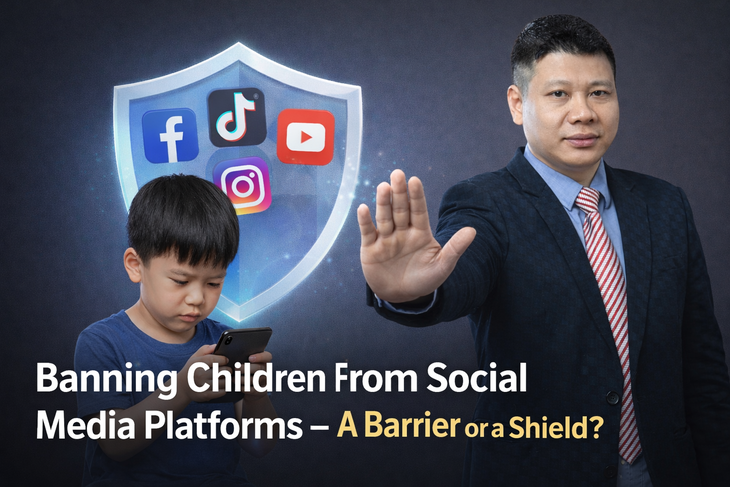 Tuan Ha, an expert with 25 years of experience in digital strategy and social media ecosystems (AI photo) Tuan Ha, an expert with 25 years of experience in digital strategy and social media ecosystems (AI photo) |
Le Huyen Trang, a Hanoi mother of two daughters under 16, talked about her experience, "Although I don’t see too many problems because I set strict rules on screen time, I’ve noticed that my children are becoming reluctant to read long essays or watch films with intellectual depth. A kind of ‘disconnection’ has also appeared. They’re often absorbed in their phones during meals and need repeated reminders to put them down.”
Trang said she has also warned them about ‘brain rot’ and meaningless content, but she doesn’t impose a total ban, because the more you forbid something, the more children will try to access it in secret.
Applying a total ban similar to Australia’s model in Vietnam would not be easy. According to Ha, big obstacles include identity verification and inconsistent parental supervision.
“With international platforms like Facebook, the State does not encourage mandatory ID verification. This makes it difficult to confirm users’ identities. Parental responsibility is another issue. If parents allow their children to stay up late freely surfing the web, the risks increase significantly," said Ha.
The lack of effective monitoring tools also poses a challenge for Vietnamese parents. In today’s digital era, young people have both the right and the need to access information online. Many parents acknowledge the risks but question whether a blanket ban is the solution.
Dang Thi Hoa of Hanoi, who has two children under 16, said, “I don’t think children under 16 should be completely banned from social media. It’s not just entertainment, it’s also a learning tool that helps them access study materials, apply for scholarships, and develop communication skills.”
“Because their brains aren’t fully mature, they can easily become addicted to ‘likes’ and ‘views’ or be affected by harmful content. Instead of banning use, we should manage it strategically — limit screen time, restrict certain platforms and, most importantly, teach children digital skills so they know how to protect themselves online,” Hoa said.
According to Pham Quang Vinh, an expert in social, governance, and legal issues, many countries, including Vietnam, are attempting to strike a balance between access and protection.
Vinh said, “Countries like China take a different approach. They regulate both social media and youth internet use in general. Device manufacturers are required to limit daily usage hours, and content or messaging platforms must verify the real identities of young users.”
Rather than imposing a blanket ban, Tuan Ha — himself a father of teenagers — advocates a more nuanced approach: a strict ban for children under 14, combined with strong guidance for those aged 14 to 16.
"I guide my children toward long-form content and platforms that encourage deeper analysis, such as YouTube. I still allow Facebook, TikTok, and Zalo, but monitor how frequently they use them. If we ban everything, they will find ways to bypass restrictions. Instead, I orient them toward more meaningful content,” said Ha.
He noted that he even purchases Pro accounts for apps like ChatGPT, Gemini, and Canva so they can learn to create presentations and develop practical skills. “But I always guide them on how to use these tools effectively," said Ha.
Ha proposes integrating age verification through VNeID, using FaceID to prevent identity fraud, and developing algorithms to filter sensitive content. He said schools should teach “Digital Skills” as a subject to help children build their own internal filters.
Vinh echoed that view, emphasizing that digital literacy can’t be taught in isolation from real-world practice. The challenge lies in balancing skill development with effective regulation.
“To some extent, Vietnam’s approach is reasonable because it balances protection with the right to access and learn. But effective implementation is the key, including ensuring that social media companies comply with regulations,” Vinh concluded.
Social media is a double-edged sword. Enabling Vietnamese children to thrive in the digital era requires close coordination among families, schools, and the State — combining discipline, guidance, and appropriate regulatory measures.