(VOVWORLD) - Tra Su cajuput forest, a large and beautiful flooded cajuput forest in Vietnam, is in An Cu commune, An Giang province, about 10 kilometers west of the Vietnam-Cambodia border. It has a diverse ecosystem and stands out as a distinctive ecotourism destination in the Mekong Delta.
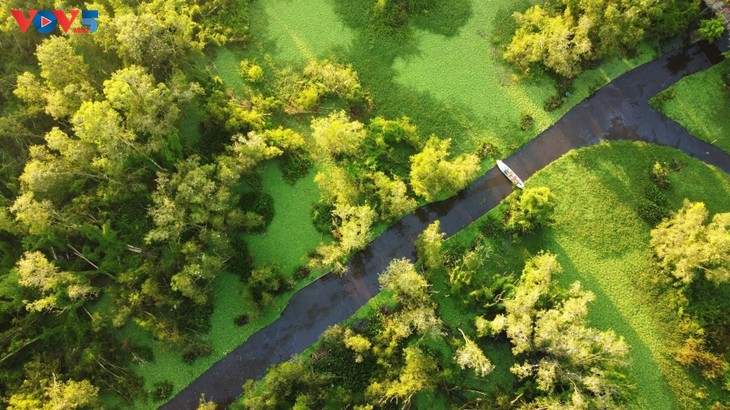 A overview scene of the Tra Su cajuput forest (Photo: Van Anh/ VOV in the Mekong Delta) A overview scene of the Tra Su cajuput forest (Photo: Van Anh/ VOV in the Mekong Delta) |
Tra Su cajuput forest was recognized as a protected landscape area in 2005. It plays an important role as a “green lung” of the Mekong Delta and its conservation is now tied to ecotourism development. With a core zone of 845 hectares and a buffer zone of more than 1,100 hectares, the forest is home to hundreds of plant and animal species, including two listed in the Vietnam Red Book – the Painted Stork (also known as Giang Sen, scientific name Mycteria leucocephala) and the Oriental Darter (also known as Dieng Dieng, scientific name Anhinga melanogaster).
The flood season is the most beautiful time to explore the forest. From September to November, the whole landscape dons a new graceful “coat”. The rising water nourishes lush greenery. Duckweed grows massively on the water surface, and purple water lilies and yellow Dieng Dieng flowers add bright splashes of colors. Schools of fish and shrimp swim in the water, and above them flying flocks of birds add to the tranquil natural landscape.
 The bamboo bridge stretches more than 10 km through the forest. (Photo: Van Anh/ VOV in the Mekong Delta) The bamboo bridge stretches more than 10 km through the forest. (Photo: Van Anh/ VOV in the Mekong Delta) |
In January 2020, Tra Su set two Vietnam records: “The most beautiful and famous cajuput forest in Vietnam for flood-season tourism” and “The longest bamboo bridge in a cajuput forest in Vietnam” (over 10 km).
Truc Ly, a tour guide at the Tra Su cajuput forest tourist site, said: “Tra Su cajuput forest holds two Vietnam records: largest cajuput forest and the ‘ten-thousand-step’ bamboo bridge. The forest is home to 70 bird species, including cranes, storks, and grey herons. There are two boating services: motorboats and hand-rowed boats. In hand-rowed boats, visitors travel about 2 km, weaving through the forest to watch many types of birds. The best time is from 7 a.m. to 9 a.m., when the birds go out to feed, and from 4 p.m. to 5 p.m., when they return to their nests. Motorboat tours cover about 4 km, taking visitors deeper into the forest.”
Passing through the entrance gate of the forest, visitors come to the Tra Su bridge, surrounded by carefully tended gardens of flowers and ornamental plants. The bamboo bridge stretches more than 10 km through the forest. Along the bridge are rest huts for visitors. The bridge leads to the motorboat pier, where tourists begin their aquatic tour of the forest.
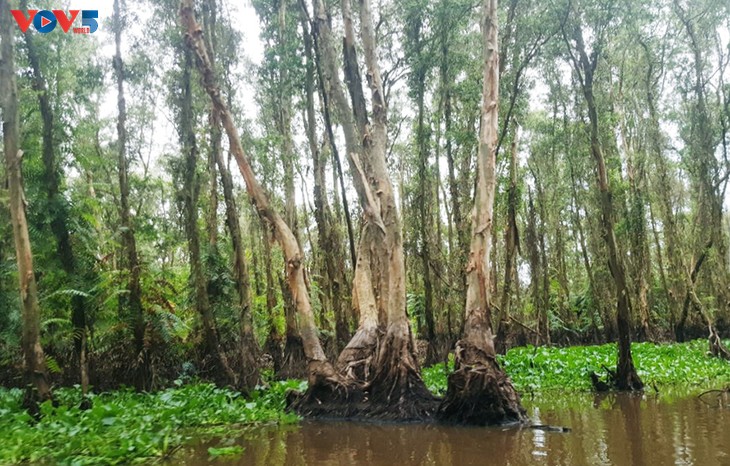 Old mangrove trees (Photo: Ngoc Anh/ VOV5) Old mangrove trees (Photo: Ngoc Anh/ VOV5) |
Gliding along narrow canals, the boats take visitors deeper into the cajuput forest. Le Thi Nang, a boat rower, said: “The boat goes in a circular route. A hand-rowed boat can carry four tourists. On busy days, I make six or seven trips. Foreign visitors come from France, the US, the UK, and other countries, while domestic tourists come from places like Ho Chi Minh City and Hanoi. If visitors take a motorboat to go farther, they may pass a beekeeping farm.”
Near the boat pier visitors will see pigeon houses, a popular check-in and photo spot. Many couples choose this location for wedding photos. Visitors can climb an observation tower to look through a telescope at the forest and the nearby Khmer village.
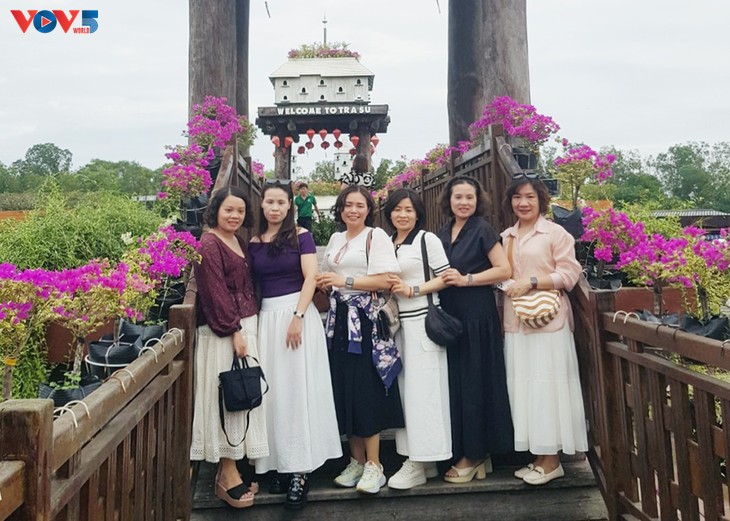 Tourists take photo at Kieu bridge in Tra Su forest. (Photo: Ngoc Anh/VOV5) Tourists take photo at Kieu bridge in Tra Su forest. (Photo: Ngoc Anh/VOV5) |
On his first visit to Tra Su cajuput forest, Italian tourist Enrico Eldighieri said: “It’s incredible and amazing place. I think it’s better than Pu Luong and Ha Long Bay. It’s an amazing experience. We want to come back with our friends and family.”
Beyond its natural resources and rich flora and fauna, Tra Su also embodies cultural elements of the local communities and their traditional crafts, such as brocade weaving, palm sugar making, cajuput oil distillation, and beekeeping.
After touring the forest, visitors can enjoy typical dishes of the Mekong Delta region, such as grilled linh fish, snakehead fish steamed with gourd, salt-and-chili grilled chicken, roasted snakehead fish wrapped in lotus leaves, and field crab dipped in tamarind fish sauce. Tra Su cajuput forest is also a popular site for scientific research.