(VOVWORLD) -Trade promotion has enabled Vietnamese exporters to expand markets, increase brand value, and strengthen the nation’s prestige and soft power. The year 2026 is seen as a pivotal milestone for Vietnam’s trade sector, as new strategic directions are rolled out, with a strong emphasis on technology and connectivity to generate breakthroughs.
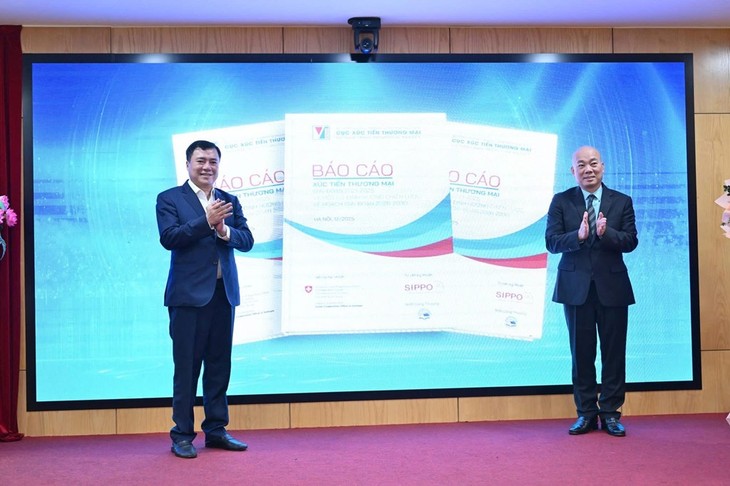 Deputy Minister Nguyen Sinh Nhat Tan presents the trade promotion report for 2021-2025 period and strategic directions and an action plan until 2030. (Photo: Ministry of Industry and Trade) Deputy Minister Nguyen Sinh Nhat Tan presents the trade promotion report for 2021-2025 period and strategic directions and an action plan until 2030. (Photo: Ministry of Industry and Trade) |
Economists say that from 2026 onward, global trade will enter a phase of profound restructuring. Major markets are tightening technical barriers and raising requirements for quality standards, safety, traceability, and social responsibility. These changes will directly affect production and export activities.
Nguyen Tien Dung, Deputy Director of the Department of Industry and Trade of Quang Ninh province, called on the Vietnam Trade Promotion Agency to create favorable conditions for localities to host national and international trade fairs and to participate in overseas exhibitions, linking local brand development with these events. “Priority should also be given to resources for specialized trade promotion programs. There must be a strong push in providing market information and promoting digital trade,” said Dung.
Truong Van Cam, Deputy Chairman and Secretary-General of the Vietnam Textile and Apparel Association, said he hopes to continue receiving support from the trade agency this year to secure more resources for trade promotion. “Early planning is essential to avoid being passive in exports. It is also necessary to continue organizing training sessions on trade promotion skills and to maintain regular briefings with overseas trade offices. These are highly effective activities that businesses are very interested in,” Cam noted.
Under the trade promotion action plan through 2030, the Ministry of Industry and Trade aims to improve sustainable export efficiency and shift the export structure toward growth in both scale and quality. This includes increasing the share of processed and manufactured industrial goods in total export turnover. The plan also emphasizes strong development of national and industry-specific brands, helping build a national image of “reliable, sustainable, and smart” products.
Specific targets for the next five years include maintaining average export growth of 5 to 6% per year, with processed and manufactured goods accounting for 90% of total exports. The National Digital Trade Promotion Platform will be operational, ensuring seamless data connectivity at all levels. The platform will integrate AI, Big Data, blockchain technology, and cross-border B2B trading floors.
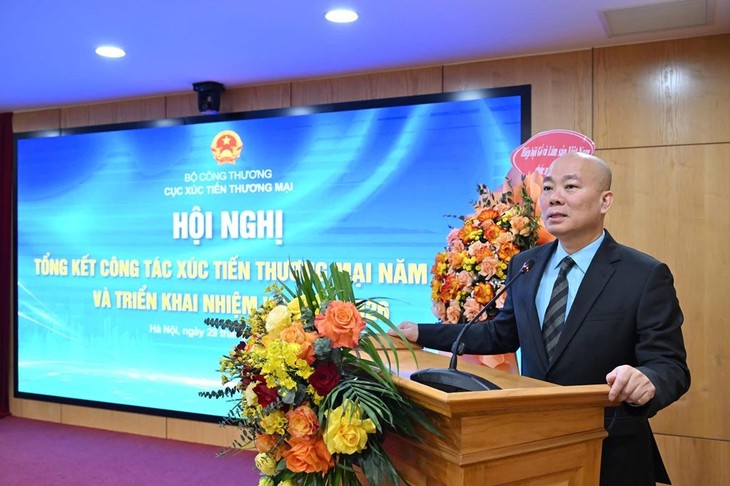 Vu Ba Phu, Director of the Trade Promotion Agency at the Ministry of Industry and Trade. (Photo: Ministry of Industry and Trade) Vu Ba Phu, Director of the Trade Promotion Agency at the Ministry of Industry and Trade. (Photo: Ministry of Industry and Trade) |
Vu Ba Phu, Director of the Vietnam Trade Promotion Agency, underscored the need to continue to apply trade promotion methods creatively, with the National Trade Promotion Program as the core, while coordinating with localities to launch new, targeted initiatives. “To become an industrialized nation by 2030 and a developed industrial nation by 2045, demand for importing machinery, equipment, and advanced technology transfer will be immense. This is a critically important task in our trade promotion efforts,” according to Phu.
Resolution 57 on breakthroughs in science, technology, innovation, and digital transformation; Resolution 68 on private economic development; and the “Go Global” program through 2035 all set new requirements for trade promotion.
A key priority is market diversification and maximizing the benefits of free trade agreements, with a focus on consolidating and upgrading access to mid- and high-end market segments. This requires meeting green standards and traceability requirements in traditional markets such as the US, EU, China, Japan, the Republic of Korea, and ASEAN.
For potential markets, trade promotion will be intensified through industry clusters, supported by in-depth market research. At the same time, the national trade promotion system is being developed into a “connected–modern–professional” network, improving the capacity of Business Support Organizations and local Trade Promotion Organizations.
Nguyen Viet San, Deputy Director of the Foreign Market Development Department, said, “Business support activities will continue in a more specific and close-up approach tailored to each market and industry. This includes organizing trade delegations to new and niche markets and promoting new trade promotion models that combine face-to-face engagement with digital formats and cross-border e-commerce.” “We will also strengthen cooperation with Vietnam’s overseas trade office network to better identify partners and buyers,” San concluded.
The period from now until 2030 is critical for elevating Vietnam’s position in the global value chain. The trade promotion ecosystem currently taking shape is expected to help Vietnamese enterprises achieve broader market access and sustainable development.